
Cover crops in Texas don’t follow one calendar. Along the Gulf Coast, winters stay mild enough that legumes and cereals can grow almost year-round with only a short cold snap to manage. In the Panhandle, that same crop calendar shifts by months and the ground freezes hard enough to matter. The honest answer to “when do I plant” is: it depends which Texas you’re standing in, and the numbers below are anchored to Houston, the mild end of that range.
When the soil is warm enough in Texas
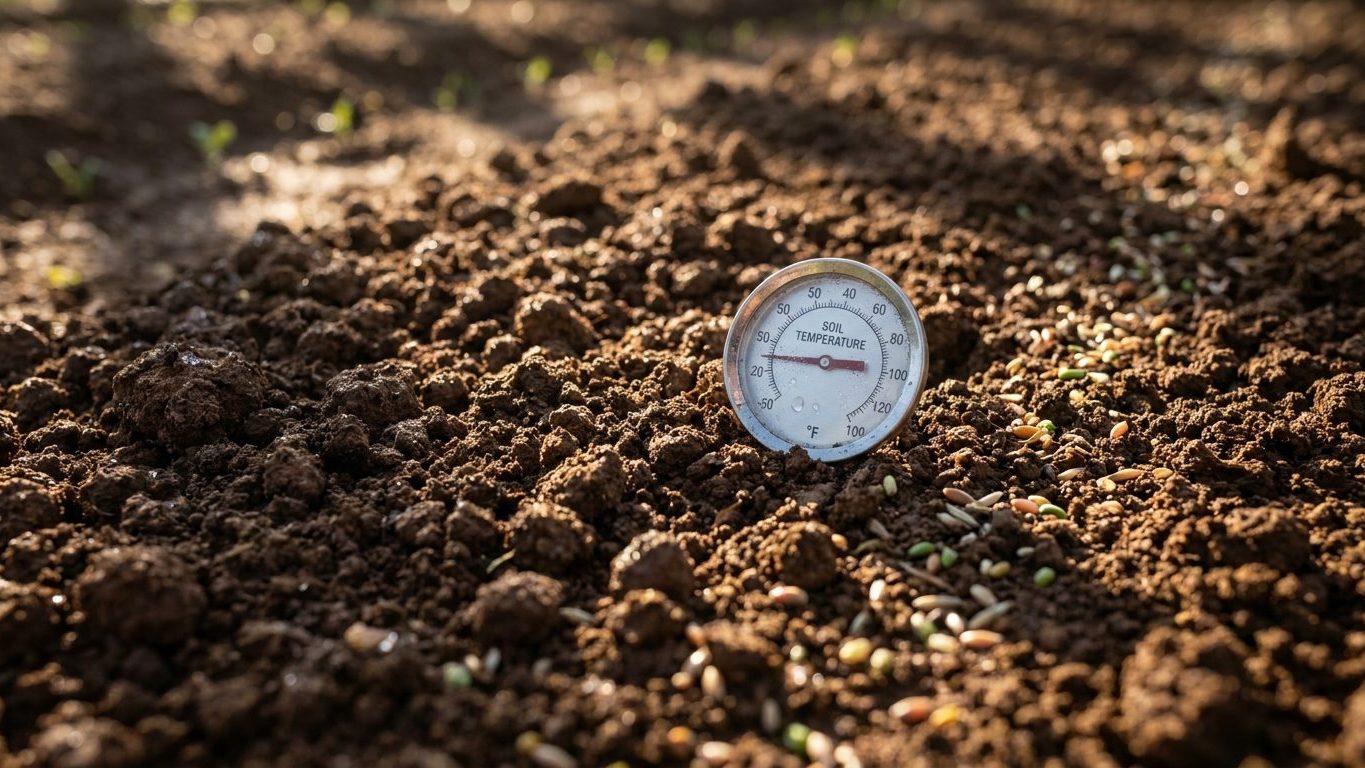
At Houston’s Bush Intercontinental Airport station (USW00012960), NOAA’s 1991-2020 Climate Normals put the last spring frost somewhere between February 4 and March 1, based on the 30-70% freeze-probability band. That date is useful, but it’s a proxy, not the real signal. Cover crop seed doesn’t care about air temperature at 2 a.m.; it cares about soil temperature at seed depth, and soil warms on its own schedule, days or sometimes weeks after the frost risk has passed. A gardener who drills seed the morning after the “last frost date” is often planting into ground that’s still too cold to germinate anything but the toughest cereal grains.
Treat that February-to-March window as a probability, not a promise. Some years the last freeze lands well before February 4; other years it sneaks in after March 1. Checking soil temperature directly, with a simple probe a few inches down, tells you more than the calendar does.
Why this Houston window isn’t a Texas window
Texas covers USDA hardiness zones 6a through 10a, and the Houston figures above sit at the mild Gulf end of that spread. The Panhandle freezes months earlier in fall and thaws months later in spring. Hill Country and North Texas land somewhere in between, with their own frost patterns entirely. Even within the Houston metro, Hobby Airport runs about two weeks milder than the IAH station these numbers come from, which shows how much local microclimate can shift a planting date even inside one city.
What decides how much seed goes down, and in what pattern, is species, planting method, and soil type, not a number pulled from a national chart. Your county office of the Texas A&M AgriLife Extension Service has trial data specific to your region and can walk through rate and method for whatever species you’re considering. Termination, when the time comes, is mechanical here: mowing, crimping, cutting, or letting a hard freeze do the work, not a chemical burn-down.
How long the season lasts here
Subtract Houston’s last spring frost window (February 4 to March 1) from its first fall frost window (December 1 to December 19), and the frost-free stretch runs somewhere around nine to ten months. That’s an unusually long runway compared to most of the country, and it changes the whole planning conversation for gardeners in this part of the state.
A window that long allows for more than one cover crop cycle in the same year. A gardener could run a warm-season legume or grass through summer, terminate it, and still have time to establish a cool-season stand before the brief winter arrives, then clear that one out again before spring planting. That’s a very different rhythm than a garden with a four-month frost-free season, where the first sowing is often the only sowing and every week counts.
The flip side of a long warm season is a short cold one. Houston’s actual frost period, the gap between first fall frost and last spring frost, is only a matter of weeks, not months. That narrow winter changes how much benefit there is to babying transplants versus just direct-seeding and letting the long season absorb any slow start. With this much frost-free time on the calendar, the root disturbance that comes with transplanting matters less than it would somewhere with a tighter window. For the mechanics of stacking a second sowing into a season like this, the site’s succession sowing guide walks through timing a second stand once the first one is terminated.
Heat and water in Texas
For cover crops, the deciding factor isn’t the peak of summer heat, it’s what happens in the coldest month. Houston’s coldest month has a mean daily minimum of 43.7°F, according to NOAA’s 1991-2020 Climate Normals. That’s mild. It stays above freezing on an average night even in the depths of winter, which means most cool-season cover crop species here don’t get killed back by cold the way they would farther north.
That single number, 43.7°F, reshapes the whole termination conversation. In a colder territory, a hard freeze does the work of ending a cover crop stand for you, turning it into a dead mulch by spring with no extra effort. In a Houston-mild winter, that same species can keep growing right through the season, which sounds like a bonus until it’s March and last year’s cover crop hasn’t died back on its own and is now competing with whatever you meant to plant next. A mild winter turns an easy, frost-killed cover crop into one that has to be mowed, crimped, or cut down by hand at the right moment.
Summer here runs long and humid rather than short and dry, and that has its own effect on cover crop choices, though the precise day-count and rainfall totals for this specific comparison sit outside the verified figures for this page. What’s well established is the pattern: long, warm, humid stretches favor species that tolerate heat stress and hold up under disease pressure, rather than the fast-germinating, cool-loving types that would suit a shorter, drier growing window elsewhere. Humidity, more than heat alone, is often the bigger management headache for anything left standing too long in a Gulf Coast garden.
Which cover crops suit Texas
Reasoning from what’s verified here, three things shape the choice: a frost-free season long enough to allow a second sowing, a winter mild enough that many species won’t die back on their own, and a summer humid enough that disease resistance matters as much as heat tolerance. Those three facts point toward general species categories, not specific named varieties.
| Cover crop type | How it behaves in a mild Gulf winter | Main summer concern here |
|---|---|---|
| Legumes (clovers, vetches, peas) | Often keep growing through winter rather than dying back; may need mechanical termination in spring | Fungal disease pressure under humidity |
| Cereal grains (oats, rye, wheat) | Oats especially can persist into a weedy stand if winter stays this mild; rye and wheat handle heat better later | Rust and mildew in damp, still air |
| Warm-season legumes and grasses (cowpea, sorghum-sudangrass types) | Not relevant in winter; suited to the long frost-free summer window | Need airflow and root-zone shade to handle sustained heat |
This page won’t name a cultivar, and that’s a deliberate choice rather than an oversight. Variety trials run by Texas A&M AgriLife Extension test specific seed lines against local disease pressure, local soil, and local rainfall patterns in ways a general site never can. A variety that performs well in a Hill County trial plot may behave completely differently in Houston’s humidity, or in the Panhandle’s shorter season. The species-level reasoning above tells you what category of plant fits your local frost and heat pattern; the extension office tells you which specific seed lot has actually proven itself in a plot near you. Seeding rate follows the same logic: it shifts with species, planting method, and soil condition, so that’s a conversation for the same extension office rather than a number printed here.