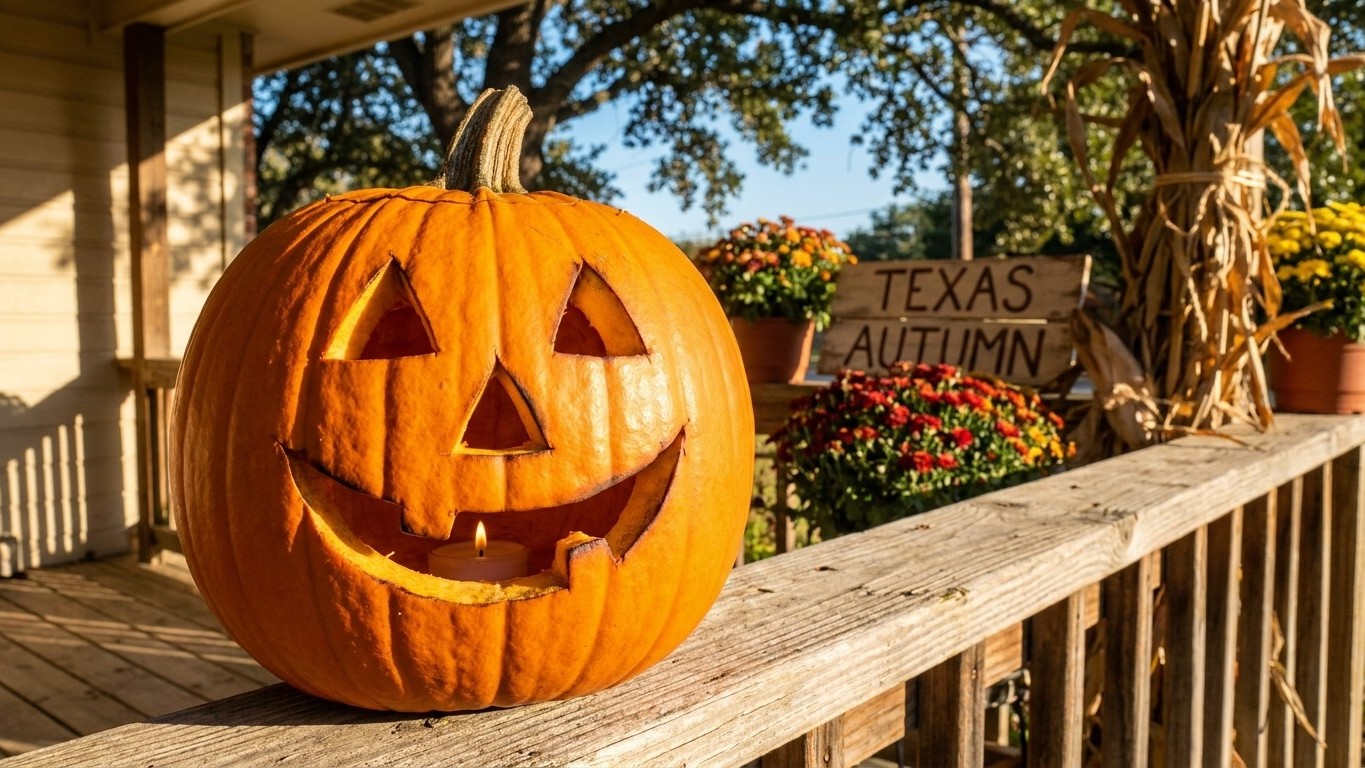

Around Houston, the mean first fall frost doesn’t show up until December 1 to December 19, according to NOAA climate normals for the region. That’s weeks, sometimes over a month, past Halloween. For a Texas pumpkin sitting on a porch through October 31, frost isn’t the risk at all. Heat is. Here’s the window that actually matters, and how to protect what you carve until the day it counts.
The short answer

Start with the number: a mean first fall frost of December 1 to December 19 for the Houston area, based on NOAA’s 1991-2020 Climate Normals from station USW00012960 at Bush Intercontinental Airport. A mean date is an average of three decades of data, not a promise for this particular year, and it’s worth saying twice because so many gardening calendars treat it like a hard line. Around here, that line falls a full five to seven weeks after Halloween.
What that means in practice is simple. A pumpkin on your porch this Halloween isn’t going to freeze. It’s going to sit through some of the warmest October afternoons in the country, and that changes the calculation entirely. Instead of asking “how many days before frost can I carve,” the Houston question is “how many days can this pumpkin hold up in warmth before it softens.” That’s a much tighter window, and it points toward carving close to Halloween itself, not days ahead of it.
A reasonable target: carve no more than one to two days before Halloween if the pumpkin will sit outside in daytime warmth, longer only if you can keep it in a cool, shaded, indoor spot. That’s the opposite advice you’d give someone in Minnesota or Vermont, where frost timing drives the calendar. Here, the calendar is driven by how long cut flesh can tolerate heat and humidity before it wilts, and no extension service publishes a fixed number of days for that, because it depends on how warm the week runs and how the pumpkin was handled at the patch.
One more caution worth repeating: Texas spans four separate USDA hardiness zones, and this frost window belongs to the mild Gulf Coast end of that range. The Panhandle sees its first frost months earlier, Hill Country and North Texas land somewhere in between, and even within the Houston metro, Hobby Airport tends to run about two weeks milder than the Bush Intercontinental station used for these normals. None of this should be read as a statewide planting or carving calendar. It’s a Houston-area figure, and if you’re carving in Amarillo or Lubbock, the frost math looks completely different.
Frost or heat: which one gets it here
The cold end
A whole pumpkin keeps best between 45 and 50 degrees Fahrenheit, per University of Illinois Extension guidance, in a cool, dark spot. It’s worth checking that band against what Houston’s coldest month actually looks like. NOAA’s 1991-2020 normals put the mean daily minimum of the coldest month at 43.7°F for Houston, meaning even the chilliest stretch of the year, typically January, barely dips below the bottom of that storage range on an average night. October, two to three months earlier in the calendar, runs well above it. Freezing is simply not a factor in how long a pumpkin can sit outside here in late October. The hardiness-zone map that shows Houston in a warmer zone doesn’t set that frost date either; it describes what perennial plants survive over winter, a different question entirely from when the first freeze actually arrives.
The warm end
Heat is the actual adversary. A pumpkin held anywhere near or above that 50-degree ceiling starts breaking down faster: the flesh softens, cut edges dry out or turn slimy, and mold gets a head start in Gulf Coast humidity. Houston’s late-October days regularly run warm enough that an uncarved pumpkin on a sunny porch is already working against the storage window, and a carved one loses its shape even faster once the rind is opened and the inside is exposed to air and warmth at the same time. That’s why the warm end of the scale, not the cold end, is what should govern carving decisions in this part of Texas. Anyone moving here from a colder climate and applying old frost-based timing will end up with a collapsed jack-o’-lantern well before the 31st.
Where to keep it until you carve
Getting close to that 45-50 degree band indoors, in Houston, in October, takes some deliberate choices. A few options, ranked roughly by how well they hold the temperature and the dark:
- An interior closet or pantry away from exterior walls. These stay cooler and darker than almost anywhere else in a Texas home, and they’re shielded from afternoon sun that heats up garages and porches.
- A shaded, air-conditioned interior room, if a closet isn’t available. Even a corner of a laundry room or mudroom works, as long as it’s out of direct light and away from a heat-generating appliance.
- An attached garage, but only if it stays shaded and isn’t baking in direct sun through a window or door. A garage that faces west and catches full afternoon sun in October can run hotter than the porch it was meant to replace.
- Never a sunlit porch, windowsill, or car trunk. All three trap heat well above the storage range and accelerate softening within days.
- Away from any ripening fruit, including apples, bananas, potatoes, and tomatoes. Ripening produce gives off ethylene gas, and that gas ages a pumpkin faster than most people realize. The fruit bowl on the counter is not a neutral neighbor.
At the patch or the store, look for a pumpkin with one to two inches of stem still attached, per University of Illinois Extension. That stem isn’t a handle, and it should never be used to carry or lift the pumpkin. It’s a seal. Once it snaps off, that spot on the pumpkin is exposed and spoils faster than the rest. Skip anything with soft spots or blemishes, and don’t worry about shape, since weight is a better indicator of a solid, well-formed pumpkin than how symmetrical it looks.
Checking this against your own county
These figures come from a single NOAA station near Houston, and Texas is too large and climatically varied for one station to speak for the whole state. Someone gardening near the Red River, in the Hill Country, or out toward El Paso is working with a different frost timeline and a different heat profile in late October.
For local numbers, the reliable source is Texas A&M AgriLife Extension, which maintains county offices across the state and can point to frost data and seasonal guidance specific to your area. It’s a better check than applying a Houston-area figure statewide, especially if you’re carving anywhere outside the immediate Gulf Coast.
Common questions
Will my pumpkin freeze if I leave it out until Halloween in Houston?
No. The mean first fall frost here doesn’t arrive until December 1 to December 19, well over a month after Halloween. Warmth, not cold, is what threatens a Houston pumpkin in October.
How long can I store a whole pumpkin before carving it?
University of Illinois Extension puts whole pumpkin storage at three to six months in a cool, dark spot between 45 and 50 degrees. Hitting that range consistently in a Houston October usually means an interior closet or air-conditioned room rather than a porch or garage.
How long will a carved pumpkin last once I cut it?
No university extension publishes a fixed number of days for a carved pumpkin, and there’s no verified preservation protocol, so treat any specific figure you see elsewhere with skepticism. What’s actually known: choose a pumpkin with an intact one-to-two-inch stem and no soft spots, keep it whole for as long as possible, and carve it as close to the day you’ll display it as you can.
Is it safe to carry a pumpkin by its stem?
No. The stem functions as a seal over the pumpkin’s interior, not a handle. Carrying or lifting by the stem risks snapping it off, which exposes that spot and speeds up spoiling.