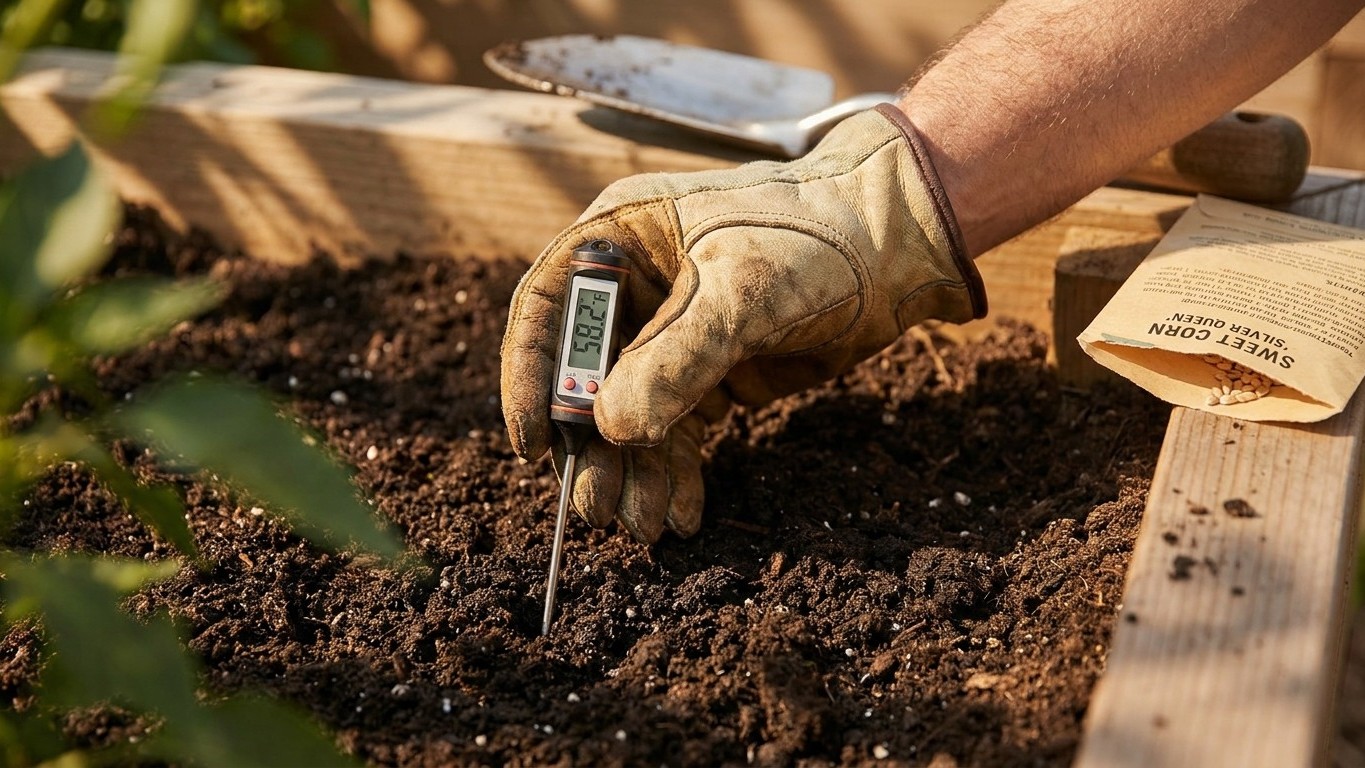

In the Houston area, sweet corn goes into the ground once soil holds steady above 60°F, not on the day of the last frost. Based on IAH climate data, that last spring frost falls somewhere between February 4 and March 1, but soil takes weeks longer to catch up. A 60- to 90-day variety fits well before the first fall frost, dated December 1 to December 19 at the same station. That gap is unusually wide, but this window belongs to the Houston area alone.
The short answer
Air and soil don’t warm on the same schedule. The last frost date tells you when hard freezes stop being likely, but bare Gulf Coast clay and loam sit cold for weeks after that, holding moisture and shading root zones from the sun. Sweet corn seed planted into soil still under 60°F just sits there, more likely to rot than sprout. So the real starting gun for Houston gardeners rings later than the frost calendar suggests, somewhere in the stretch after that February 4 to March 1 window closes.
Once soil clears that 60°F mark, the 60-to-90-day clock starts. And here the Houston numbers work in the gardener’s favor: with a first fall frost not expected until December 1 to December 19, there’s an enormous stretch of frost-free days sitting between spring planting and the season’s end. On paper, even a slow 90-day variety has room to spare.
But frost isn’t the only clock running. Houston averages 102.4 days a year at 90°F or hotter, and that heat load lands squarely in the middle of the growing season. Sweet corn pollinates through silk and tassel timing, and extreme heat during that stretch causes poor kernel fill no matter how much frost-free time remains on the calendar. So the practical answer isn’t just “plant after the last frost and count 60 to 90 days.” It’s “plant early enough that tasseling happens before the worst of that 102-day heat stretch sets in, or late enough in late summer that it happens after the worst of it passes.”
That gives two realistic entry points for Houston gardeners: a spring planting timed to soil crossing 60°F, aiming to finish pollination before peak heat builds, and a second window later in the year, counted backward 60 to 90 days from that December first-frost date, landing planting in late summer once the hottest stretch starts easing. Both routes work. Neither one is simply “the frost dates minus 60 days,” because heat, not cold, is what actually squeezes the Gulf Coast growing season.
None of this transfers north or west. Texas spans four USDA zones, and the Panhandle freezes months earlier and thaws months later than the Gulf Coast. Hill Country and North Texas sit somewhere between the two extremes. Even inside the Houston metro, Hobby Airport reads about two weeks milder than IAH, the station behind these figures. A planting date that works in a Houston backyard can miss the frost window entirely three hundred miles north.
Does a late variety fit here?
Whether a given variety fits the Houston window comes down to more than counting days between frosts. It comes down to where those days land relative to the 102.4-day stretch of 90°F-plus heat that sits in the middle of the calendar.
A 60-day variety
A quick 60-day type is the flexible choice here. Planted as soon as soil clears 60°F in spring, it can often finish tasseling and fill kernels before the heaviest heat of summer arrives, cutting down the risk of poor pollination. It also works as a late-summer planting, counted backward from the December 1 to December 19 first-frost window, giving gardeners a real shot at a fall crop once the worst of the 90°F-plus days start thinning out. Because it moves through its cycle fast, a 60-day variety gives the most room to dodge Houston’s heat stretch on either end of the growing season.
A 90-day variety
A 90-day type fits the frost-free calendar without trouble; the gap between last spring frost and first fall frost here is wide enough to swallow it twice over. The tighter question is whether its slower pace pushes tasseling into the middle of that 102.4-day heat stretch. Planted right after soil crosses 60°F in spring, a 90-day variety’s pollination window often lands squarely inside the hottest part of summer, which is the exact condition that damages kernel fill. Planted late enough in the year to dodge that heat, it risks running past the December first-frost date before harvest. So the honest answer is that a 90-day variety technically fits the frost-free window here, but its timing margin against the heat is much tighter than the calendar alone suggests, and in many years it does not clear that heat stretch cleanly.
| Criteria | 60-day variety | 90-day variety |
|---|---|---|
| Fits frost-free window | Yes, with room to spare | Yes, on paper |
| Avoids peak heat (102.4 days above 90°F) | Usually, on either planting date | Difficult; pollination often lands mid-heat |
| Fall planting option | Comfortable margin before Dec. first frost | Tight margin, risk of running past frost |
What goes wrong here
- Soil sown too cold. Planting right after the last frost date, before soil has actually crossed 60°F, leaves seed sitting in cold, damp ground where it’s prone to rot rather than sprout. The remedy is patience: wait for soil to hold above 60°F rather than counting days from the frost date alone.
- A variety too late for the season. A 90-day type planted for either the spring or fall window can end up tasseling right in the middle of Houston’s 102.4-day stretch of 90°F-plus heat, or running past the December first-frost date before it finishes. The remedy is choosing a faster variety, or planting the slower one early enough that pollination clears the heat stretch before it peaks.
- Sweetness lost to a neighboring variety. This one has nothing to do with Houston’s climate. Su, se, and sh2 sweet corn types cross-pollinate freely, and if two different types tassel at the same time nearby, the sweetness of both crops suffers. The remedy is timing plantings so the types don’t tassel together, and keeping each type in its own block of three or more rows so pollen mostly lands within its own planting rather than drifting into a different type.
Common questions
Can I plant sweet corn right after the last frost in Houston?
Not reliably. The last frost date only marks when hard freezes stop being likely; the soil itself typically needs more time to climb above 60°F, and cold soil is where rot beats germination.
Is a fall planting realistic with a December first frost?
Yes, and the wide gap between spring frost and the December 1 to December 19 fall frost date here makes a second planting possible. The trick is timing it late enough in summer to avoid the worst of the 102.4-day heat stretch, while still leaving 60 to 90 days before frost.
Why does my sweet corn taste starchy instead of sweet?
The most common cause has nothing to do with soil or timing against frost. It happens when a su, se, or sh2 type tassels at the same time as a different type planted nearby, and cross-pollination dulls the sweetness of both.
Does this planting window apply to the rest of Texas?
No. These dates come from the IAH station and reflect the mild Gulf Coast end of the state. The Panhandle, Hill Country, and North Texas run on entirely different frost schedules, and even nearby Hobby Airport reads about two weeks milder than IAH.