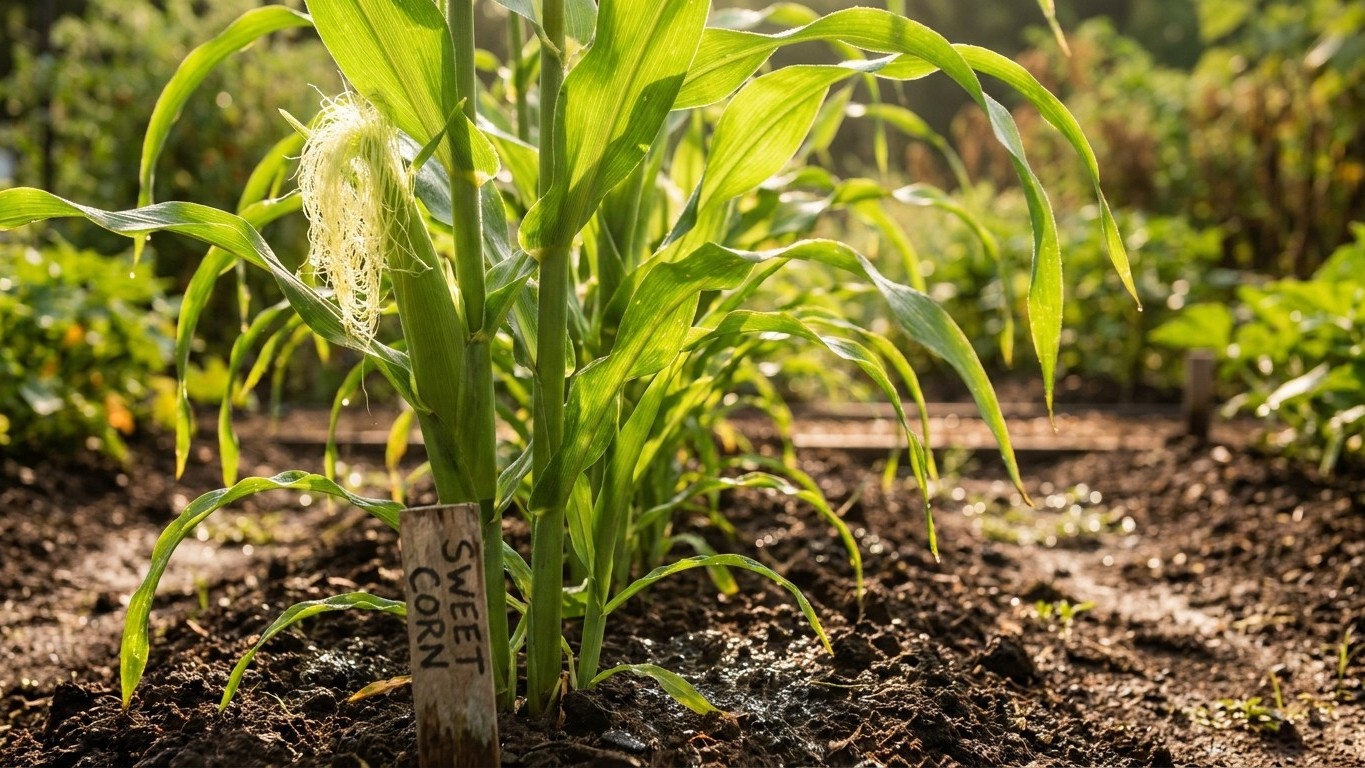

Yes, in most of Texas sweet corn has enough time to ripen before the first fall frost arrives. But the calendar that makes this true depends heavily on where in the state you’re standing: the mild Gulf Coast around Houston offers a stretch of roughly nine months between frosts, while the Panhandle and Hill Country work on a far tighter schedule. What actually starts the clock isn’t the frost date at all. It’s soil temperature, and that distinction changes everything about how you plan a planting date.
The short answer
Sweet corn germinates and grows reliably only once the soil holds steady above 60°F. That’s a different milestone than the last frost, and it comes later. Using the Houston reference station (USW00012960, NOAA NCEI 1991-2020 Climate Normals), the last spring frost typically falls somewhere between February 4 and March 1. Frost risk is measured at 32°F in the air, a few feet above ground. Soil warms on a slower curve than air does, so a garden bed can sit well below 60°F for weeks after the frost risk has technically passed. Growers who count 60 or 90 days from the calendar date of last frost, rather than from an actual soil reading, are working from the wrong starting line.
That caution matters even more because Texas is not one climate. It spans four USDA hardiness zones, and the Houston figures above sit at the mild Gulf end of that range. The Panhandle freezes months earlier in fall and thaws months later in spring. Hill Country and North Texas run their own separate calendars. Even inside the Houston metro, Hobby Airport reads about two weeks milder than the IAH station used here. None of these numbers should be read as a statewide planting calendar; they describe one reference point on the mild end of a very large state.
With that caveat in place, here’s what the Houston-area numbers show. The first fall frost at the same station falls between December 1 and December 19. That leaves a frost-free stretch of roughly nine to ten months once soil finally clears 60°F in spring. Sweet corn’s 60 to 90 day window from planting to harvest fits inside that stretch with plenty of room to spare, at least at this reference point. The real constraint on the Gulf Coast isn’t season length. It’s heat. The same station averages 102.4 days a year at 90°F or higher, a heat load that drives water demand hard and can disrupt pollination if tasseling lands during the hottest weeks of summer. So the short answer is yes, sweet corn ripens here, provided the soil is checked with an actual thermometer rather than assumed from the frost date, and provided the planting window is timed to keep tasseling out of the worst heat.
Does a late variety fit here?
A 60-day variety
A variety at the fast end of the 60 to 90 day window is the easier fit almost anywhere in Texas, and especially at the mild Gulf Coast reference point used above. Even accounting for soil that lags several weeks behind the last frost date before it clears 60°F, a 60-day crop planted once that threshold is confirmed still leaves months of buffer before the December 1 to December 19 frost window closes. That buffer is generous enough to allow a second planting later in the season, which is exactly how many Gulf Coast gardeners stretch their sweet corn harvest across spring and fall rather than picking it all at once.
A 90-day one
A variety at the slow end of that window still fits at this reference station, but the margin is tighter than it looks at first glance. Ninety days from a soil-confirmed planting date, even one delayed into later spring while the ground finishes warming, still lands well ahead of the early-December frost risk at IAH. So for the Gulf Coast reference point specifically, the answer is plainly yes: a 90-day variety fits. That answer does not travel with you to the rest of the state. Where the last frost lingers into spring and the first fall frost arrives earlier, as it does across the Panhandle and much of North Texas, the same 90-day variety can run out of room before frost returns. Nothing in the data used here describes those regions, and a gardener there should not borrow this math.
What goes wrong here
- Soil sown too cold. Planting on the calendar date of last frost, rather than after confirming the ground is actually above 60°F, is the most common failure. Seed sits in cold soil, germination is slow and uneven, and young plants stall before they ever get moving. The fix is simple: check soil temperature directly and hold off until it’s stable above that mark, even if that means waiting weeks past the last frost date.
- A variety too late for the season. At the Gulf Coast reference point used here, a full 90-day variety does fit, but only because the frost-free stretch runs so long. Anywhere the season is shorter, choosing a variety near the slow end of that 60 to 90 day range without checking the local frost window risks a crop that’s still filling out ears when frost finally returns. The remedy is matching variety length to your actual local window, not to what worked at a different reference point.
- Sweetness lost to nearby tasseling. Su, se and sh2 sweet corn types cross-pollinate if they tassel at the same time, and the result is starchy, disappointing ears regardless of how well the season and soil went. No isolation distance is published for this; the fix is timing, not feet of separation. Stagger planting dates so different types don’t tassel together, or grow only one type per season, and always plant in blocks of three or more rows rather than a single thin row, since that shape is what allows reliable pollination within the same planting.
Common questions
Does the last frost date tell me when to plant sweet corn?
No. Sweet corn needs soil above 60°F, and that threshold arrives after the last frost date, sometimes weeks after. The frost date only marks when air temperature risk drops off; it says nothing about how warm the soil actually is.
How do I know when to pick, once the corn is planted?
Watch for three signs together: dry, browned silks, husks that are still moist and green, and milky juice from a punctured kernel. All three should show up at once; any one alone isn’t a reliable signal.
Can I grow both a fast and a slow variety in the same garden?
You can, but keep their tasseling times apart. If su, se or sh2 types tassel at the same time, cross-pollination can strip the sweetness out of both crops, regardless of how well each was planted or timed.
Does the 60 to 90 day figure tell me the exact week to harvest?
No, that figure only tells you whether the crop fits your season, counted from planting. The week to pick is a separate clock, roughly 17 to 24 days after silks first emerge, and it’s confirmed by checking for the three ripeness signs together rather than by counting days alone.