
Utah’s cover-crop calendar answers to two things: how late the last spring frost lingers and how cold the coldest month runs. Between those two numbers sits a window that’s long enough for a second planting in the valleys but tight enough near the mountains that timing, not variety, decides whether a cover crop earns its keep.
When the soil is warm enough in Utah
The date gardeners actually want isn’t the frost date, it’s the soil date, but frost is the number we can measure and Utah’s is unusually spread out. At Salt Lake City station USW00024127, NOAA’s 1991-2020 Climate Normals put the last spring freeze (32°F) somewhere between April 12 and April 29, based on the 30 to 70 percent probability band. That’s a 17-day swing in a single valley station, and it’s worth saying once, plainly: a frost date is a probability, not a promise. Some years the risk clears earlier, some years it drags into May.
Salt Lake sits low and mild for Utah. Most of the state runs higher and colder, so a garden in Cedar City or up near Logan should expect that window to slide later, while low desert country around St. George typically clears frost weeks ahead of the valley average. None of that is guesswork, it’s just elevation doing what elevation does.
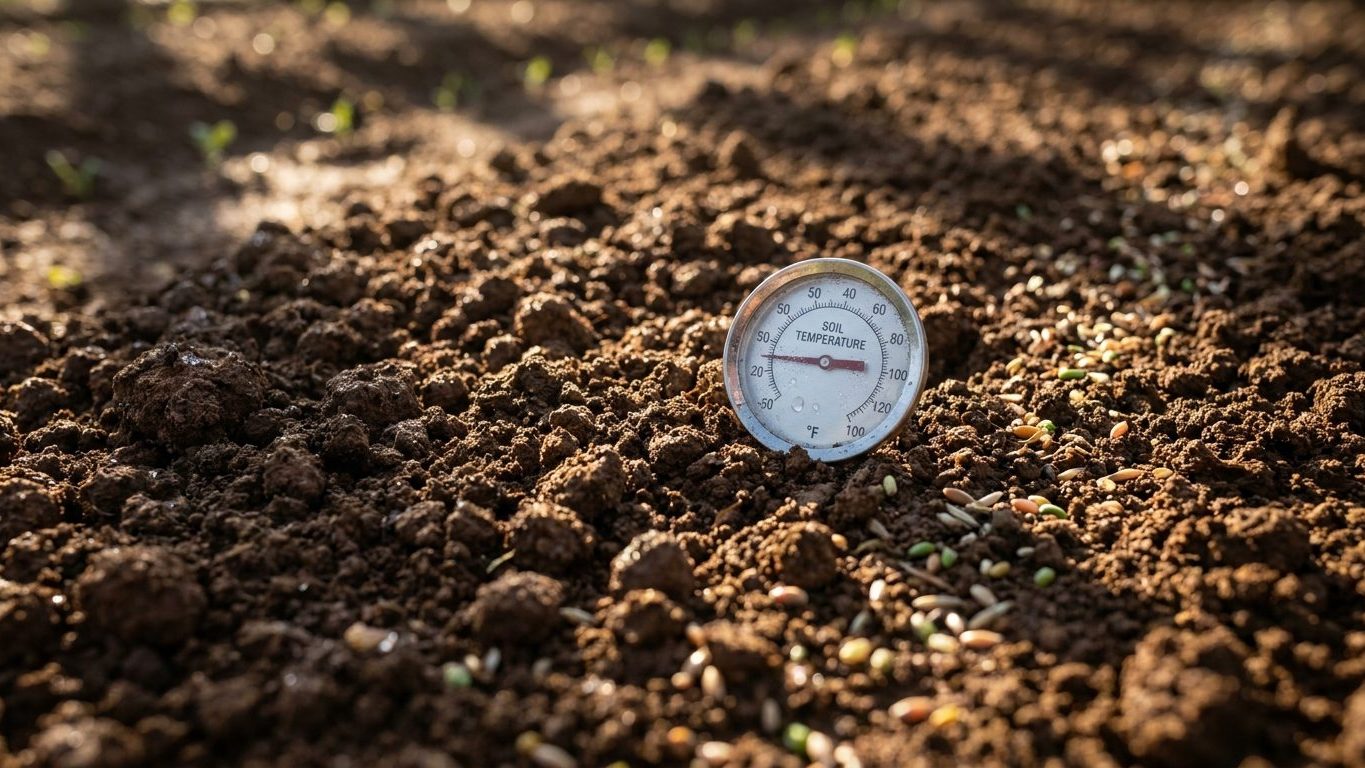
Soil temperature lags behind air temperature by design. Ground that’s been sitting under snow or frozen crust doesn’t spring to life the day the thermometer stops dropping below freezing. Legumes like field peas and vetch, along with cool-season grasses such as oats or cereal rye, will germinate in soil that’s still on the cool side, but broadleaf covers like buckwheat or forage radish want it warmer and more settled. That’s a species question, not a calendar trick, and it’s exactly why this page won’t hand you a seeding rate in pounds. How much seed you put down depends on the species, whether you’re broadcasting or drilling, and the seed source’s own germination numbers. Utah State University Extension publishes rate tables built for this state’s soils and elevations, and that’s the number worth using, not a generic figure lifted from a bag grown for a different climate.
Termination matters just as much as the sowing date. This is mechanical country: mowing a stand before it sets seed, crimping it flat, cutting it back, or simply letting a hard frost do the work for you. No herbicide step belongs in a cover-crop rotation built around building soil, and Utah’s own frost calendar hands you a free termination tool every fall.
How long the season lasts here
Run the two ends of the calendar against each other and Utah’s frost-free window comes out somewhere between roughly 172 and 200 days, depending on which edge of the normal range you land on in a given year. The last spring frost falls between April 12 and April 29; the first fall frost, at that same Salt Lake reference station, arrives between October 18 and October 29. Pair the earliest spring date with the latest fall date and you get close to 200 days. Pair the latest spring date with the earliest fall date and the window shrinks to about 172 days. Either way, that’s roughly five and a half to six and a half months of open ground.
That’s a long enough season to matter. A window stretching past six months leaves room for a spring-sown cover crop, a summer cash crop, and a second cover crop seeded in early fall before that October frost line closes things out. Gardeners working the shorter end of that range, closer to 170 days, get one real shot: whatever goes in after the spring frost date is likely the only cover crop that season, which shifts the decision toward direct-seeding hardy types rather than fussing with transplants and root checks that eat into an already tight calendar.
Elevation changes this math more than most gardeners expect. A backyard at 4,300 feet in the Salt Lake Valley and a plot at 6,000 feet outside Park City aren’t playing the same season at all, even though they’re an hour apart by car. The higher garden loses weeks off both ends of the window, which is the difference between fitting in a second sowing and not. Anyone working out whether their own plot can carry a second cover crop after the first comes down should look at the site’s succession sowing guide, which walks through how to stack plantings once you know your local frost bracket.
Heat and water in Utah
For most row crops, Utah’s story is heat and drought stress through July and August. For cover crops, that’s mostly beside the point. A cover crop’s toughest test in this state isn’t the hot afternoon, it’s the cold night five months later, and that’s where the real decision gets made.
The number that matters is the mean daily minimum of the coldest month at the Salt Lake City reference station: 24.2°F. That’s not a record low and not a monthly average, it’s the typical overnight floor during the coldest stretch of winter, and it’s the figure that separates a cover crop that survives to spring from one that dies back into mulch by December. Oats are the clean example: in a climate where winter minimums stay reliably below the mid-20s, oats winterkill on schedule and leave a flat, weed-suppressing mat that needs no mechanical termination at all. Push that same oat crop into a milder pocket of the state, one of the warmer low-desert valleys where winter minimums don’t drop that far, and the oats can limp through and reseed themselves the following year, turning a tidy winter-kill crop into a volunteer weed problem the next spring.
That’s the practical lesson behind USDA’s hardiness zone range for Utah, 4a to 9a. That range is built on one variable, average annual extreme minimum temperature, and it spans an enormous amount of ground between a high mountain valley and the low desert near the Arizona line. A gardener in a warmer zone near the top of that range should expect species that die back reliably in Salt Lake’s climate to instead persist and need mechanical mowing or crimping the following spring. A gardener at the cold end gets the opposite problem, more winterkill risk for tender legumes like some clovers, and less certainty that a fall-sown crop makes it to spring at all.
Utah’s dry summers do shape the front end of the cycle: germination after a late-summer sowing depends on irrigation, not rainfall, since the state doesn’t reliably deliver the kind of soaking summer storms that carry a cover crop’s first two weeks in wetter regions. That’s a management detail, not a species filter, but it’s worth planning irrigation into a fall-sown cover crop the same way you’d plan it into a fall lawn seeding.
Which cover crops suit Utah
Sort Utah’s cover crop choices by what the calendar and the winter cold actually demand, not by brand names on a seed bag. Three broad types cover most of what this state’s gardens need:
- Early cool-season grasses and legumes (oats, field peas, some vetches) for gardeners on the shorter end of the frost-free window, since they establish fast in cool soil and don’t need a long runway before termination.
- Winter-hardy grains and legumes (cereal rye, hairy vetch, certain clovers) for a fall sowing meant to carry through to spring, chosen specifically for how they handle that 24.2°F winter minimum without dying back too early.
- Deep-rooted broadleaf types (buckwheat, forage radish) for breaking up compacted soil during the warm middle of the season, when soil temperature is no longer the limiting factor.
Within each of those types, which specific variety performs best in Cache Valley versus the Uinta Basin versus the Dixie corridor around St. George is a question this page can’t answer honestly, because those trials are local and this page isn’t. Utah State University Extension runs and publishes exactly that kind of variety testing for the state’s growing regions, and it’s the only source that can tell you which winter pea or which rye selection actually held up through last year’s cold snap in your county. Refusing to hand out a cultivar name here isn’t a gap in the page, it’s the honest answer: a variety that thrives at 4,300 feet in a mild valley pocket has no business being recommended sight-unseen to a garden at 6,500 feet with a harder frost line.
The same goes for seeding rates and any legume’s nitrogen contribution. How much seed goes down and how much nitrogen a vetch or clover stand banks for the next crop depends on species, stand density, and how much biomass you let build before you mow, crimp, or let frost take it down, mechanically, without a chemical step in between. Extension’s local rate tables account for all three variables in a way a flat number never could.