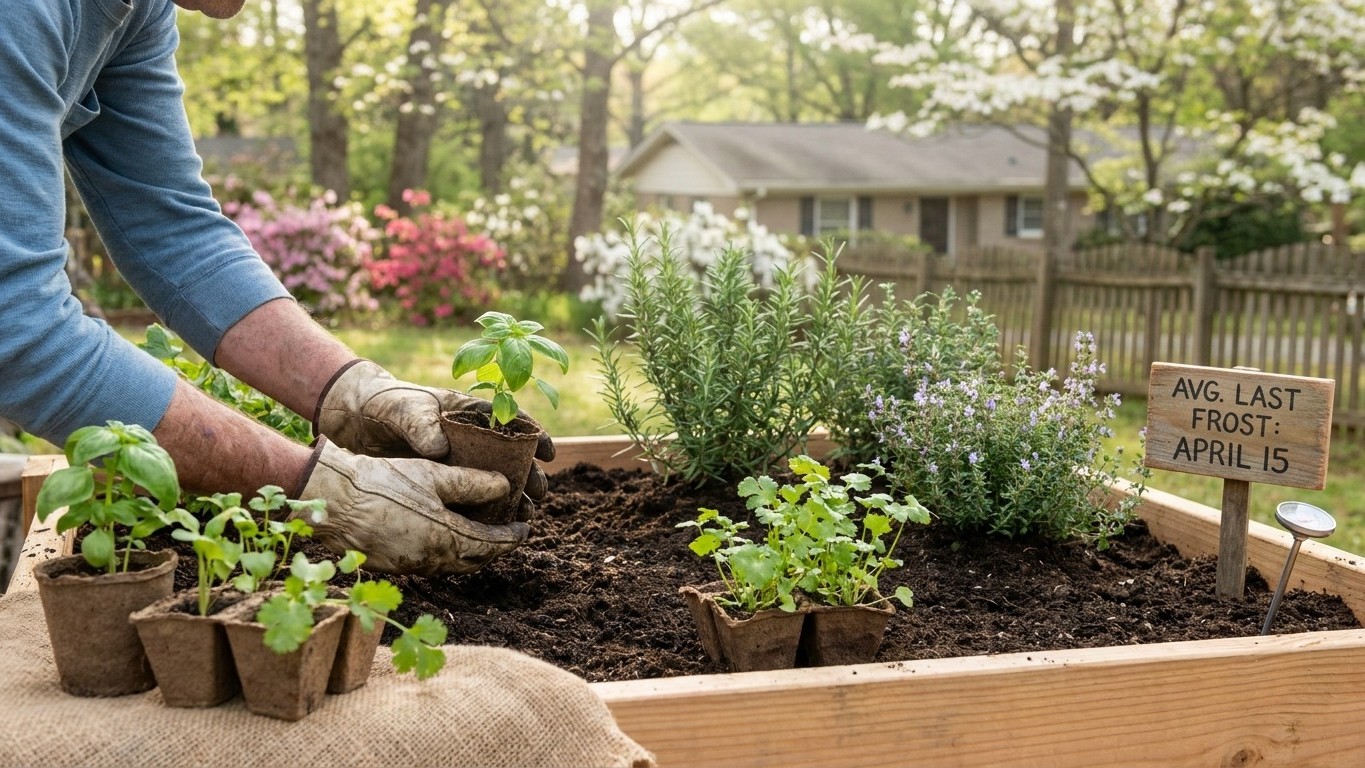

Most herbs in the Salt Lake Valley go into the ground between mid-April and late May, but that single window hides a lot of variation. Hardy herbs tolerate the early edge; tender ones need warmer soil than the frost date alone tells you. Elevation and latitude push the real dates in either direction across the state.
The short answer for Utah
Cold-hardy herbs like parsley, chives, and cilantro can go into Utah soil as early as mid-April along the Wasatch Front. Basil and other heat-loving herbs wait until frost risk has mostly cleared, which lands in late April to early May in the Salt Lake Valley.
NOAA’s 1991-2020 Climate Normals for the Salt Lake City station (USW00024127) put the last spring freeze at 32°F somewhere between April 12 and April 29, and the first fall freeze between October 18 and October 29. Those aren’t fixed calendar days. They mark a probability band, the stretch where a 32°F freeze has between a 30 and 70 percent chance of showing up on any given day. Plant before April 12 and the odds of losing seedlings run high. Wait past April 29 and most, though not all, of the freeze risk has passed.
That gives the Salt Lake Valley something close to a 170 to 200-day frost-free stretch, depending on where the year actually falls inside that band. Hardy herbs handle the early end fine, even a light frost. Tender annuals need soil that has actually warmed, not just air that’s stopped freezing, which is why many gardeners hold basil transplants a week or two past the last-frost date shown here.
| Herb type | Examples | When relative to the frost band |
|---|---|---|
| Frost-hardy, direct sow | Chives, cilantro, parsley | Early edge of the window, mid-to-late April |
| Cool-tolerant, bolts in heat | Dill, cilantro (again, for fall) | Early spring sowing, then a second late-summer sowing |
| Tender, needs warm soil | Basil, tender annual herbs | One to two weeks after the last-frost date |
| Perennial, established plants | Thyme, oregano, sage | Transplant any time after soil is workable |
None of this is a statewide date. It’s what the numbers show at one reference station in one valley. Cilantro and dill split the difference between hardy and tender: they germinate in cool soil but bolt the moment summer heat sets in, so the practical move is an early sowing at the start of the window and a second one in late summer aimed at maturing before the October frost band closes things down.
What will not work here
Rosemary planted straight into the ground and left outdoors over winter is a common disappointment. The coldest month at the Salt Lake City reference station averages a daily minimum of 24.2°F, not an occasional dip but the typical low for that month. Rosemary and other herbs rated for USDA zones 8 and warmer routinely fail to survive that as an outdoor perennial here, no matter how well they performed all summer. Treat them as annuals, or bring pots indoors, rather than betting on a mild winter.
A long, slow-maturing herb sown too late is the second common failure. With roughly six months between the two frost dates in the Salt Lake Valley, and considerably less at higher elevation, herbs that need a very long season to bulk up before flowering or harvest can run out of daylight before the October freeze band arrives. Fall sowings of anything that needs 90-plus days to reach a usable size are a gamble once the calendar passes mid-August.
Weekly watering is the third failure point, and it’s an aridity problem more than a heat problem. Utah’s summer days combine strong sun with low humidity, so container herbs and shallow-rooted seedlings dry out faster here than the same watering schedule would suggest in a wetter climate. Basil and cilantro in particular wilt within a day or two of missed watering during the hottest stretch of summer, and a once-a-week schedule that works in a humid state simply won’t keep pace.
Tight spacing causes fewer problems here than it would somewhere humid, since low humidity limits fungal disease pressure. But it still isn’t free: herbs packed close together compete hard for the limited soil moisture available during a dry Utah summer, and that competition shows up as stunted, woody growth rather than disease.
What changes across Utah
Utah is not one climate, and the USDA Plant Hardiness Zone Map (2023 edition, built on 1991-2020 normals) puts the state across a spread from zone 4a to zone 9a. That’s a difference of roughly 45 degrees Fahrenheit in average annual extreme minimum temperature between the coldest mountain valleys and the warmest low-elevation pockets in the southwest. A herb calendar built for one end of that range will be wrong for the other.
The frost dates and coldest-month figure above come from the Salt Lake City station specifically, sitting in a comparatively mild valley. Higher elevation towns in northern and central Utah run colder and see later last-frost dates and earlier first-frost dates, which shortens the growing season further. Southern Utah, particularly the lower-elevation areas near St. George, sits at the warm end of that 4a-9a spread, with a longer frost-free stretch and a milder winter minimum that changes which perennial herbs can actually survive outdoors.
This page can’t tell an individual reader which zone applies to their own yard. That number depends on elevation, slope, and local cold-air drainage in ways a state-level page has no way to see. The USDA’s interactive hardiness zone map is the right tool for pinning that down street by street, and it’s worth checking before betting a rosemary plant or a fig on a general statewide answer.
The practical takeaway is a shift, not a fixed rule: gardeners at higher elevation or further north should expect to push both the spring planting date later and the fall harvest date earlier than the Salt Lake Valley figures above. Gardeners in the warmer southern pockets can generally start earlier and stretch the season further into fall.
Where to check this for your own county
Utah State University Extension is the land-grant extension service for the state, and it publishes county-level detail. Start at extension.usu.edu and look specifically for two things: a local planting calendar tied to your county’s actual frost dates, and a list of herb and vegetable varieties that have been trialled and recommended for that county’s conditions.
A county sitting at 6,000 feet in a mountain valley has a genuinely different frost calendar than one at 2,800 feet near the Utah-Arizona line, and a state-level average can’t capture that gap.
County extension offices also tend to track which herb varieties actually perform well locally, something a statewide page has no way to verify. A basil variety that thrives in the drier heat of southern Utah might struggle with a shorter, cooler season further north, and the reverse is just as true. That kind of variety-level guidance comes from local trial plots and local agents, not from climate normals.
A county recommendation, built on local trial data, beats a state-level estimate every time they disagree.
If you follow the almanac, here is when to plant herbs by the moon. It is a tradition, not a proven method.
Checking this against your own garden
Every date is a probability, not a promise, and your own garden will tell you more than any calendar once you know what to look for. Three signs are worth tracking without any equipment beyond your hands and eyes.
Soil warmth by feel is the first. Cold, damp soil that clumps and feels almost wet through a light glove is still too cold for tender herb seeds to germinate reliably, even if the calendar says the frost date has passed. Soil that crumbles and feels merely cool, not cold, is closer to ready for basil and other warm-season herbs.
Volunteer weeds are the second, and they’re an underrated local indicator. Dandelions and other early bloomers opening up in your own yard signal that the soil around them has crossed a warmth threshold specific to your microclimate, whatever the regional average says.
The first true leaves on any seedling already growing, whether a self-seeded herb from last year or an early transplant, are the third. True leaves (not the initial seed leaves) show the plant has moved past its most frost-vulnerable stage and is responding to actual local conditions rather than a forecast. If they’re slow to appear compared to what a neighbor a few miles away is seeing, that’s your yard’s own microclimate talking, and it’s worth trusting over a state average.