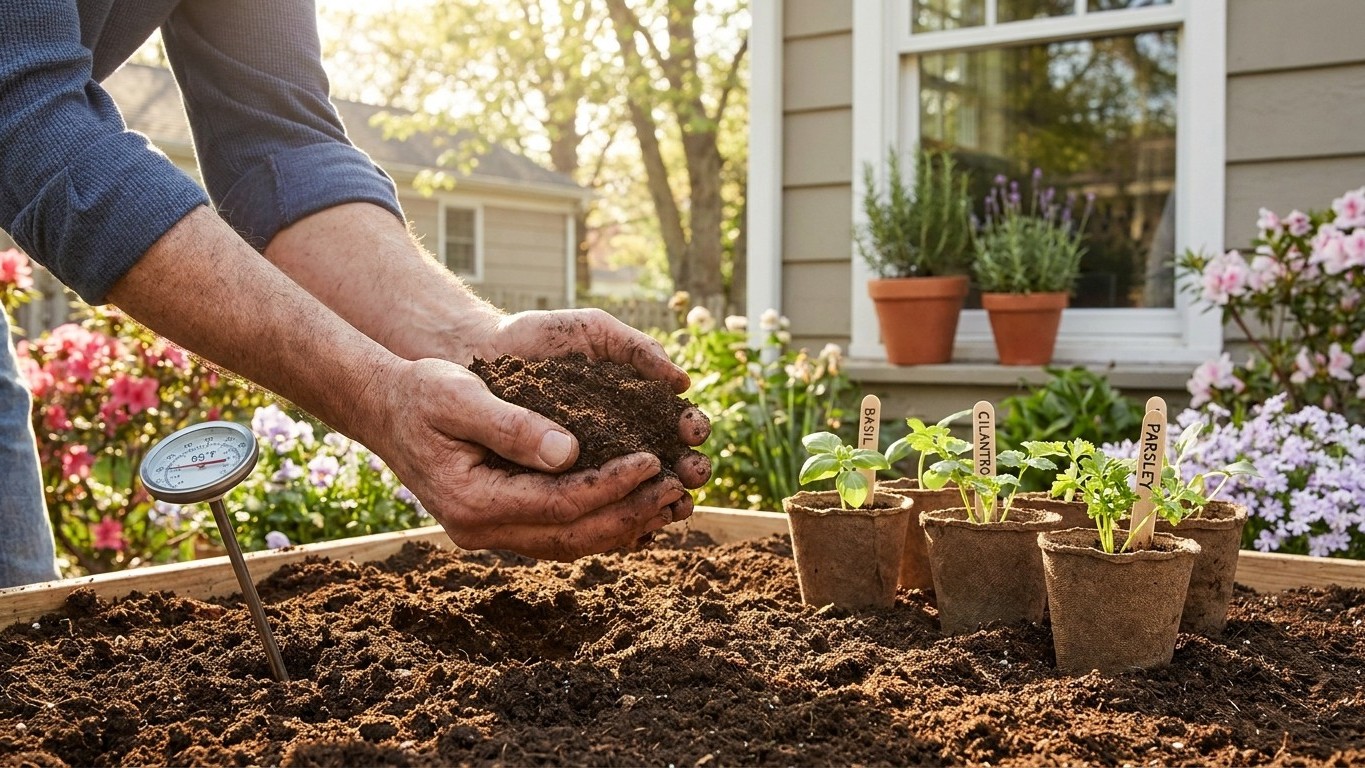

Herbs in Utah go into the ground once the soil itself has warmed, not simply once the calendar clears the frost risk. That single distinction matters more here than almost anywhere else in the country, because Utah’s elevation swings from valley floor to mountain bench within a few miles, and the frost date recorded at one station tells you almost nothing about a garden a thousand feet higher.
When the soil is warm enough in Utah
The last spring frost at the reference station (USW00024127, near Salt Lake City) falls between April 12 and April 29, based on NOAA’s 1991-2020 Climate Normals for the 30-70% freeze probability band. That’s a probability window, not a promise: some years the risk clears earlier, some years it lingers past the 29th. Treat it as a planning range, not a fixed date to circle on the wall calendar.
Here’s the part that trips up a lot of gardeners moving to Utah from milder states: frost date and soil temperature are not the same clock. Air can clear freezing risk while the soil six inches down is still cold and slow. Herbs care about the second number far more than the first. Tender, warm-season types (basil is the obvious example) stall or sulk if set out the moment frost risk fades, because their roots sit in soil that hasn’t caught up yet. Hardier, woody Mediterranean types (rosemary, thyme, oregano, sage) tolerate cooler soil and can go in earlier, closer to the start of that frost window rather than the end.
Cool-season herbs that you direct-sow, like dill and cilantro, actually prefer to go into the ground while the soil is still on the cool side. They bolt to seed fast once soil and air both heat up, so an early sowing inside that April window often outperforms a later one.
Why the valley number isn’t your number
Salt Lake City sits in a comparatively mild valley. Most of Utah sits higher and colder than that, which pushes the safe soil-warming date later by anywhere from a week to a month depending on elevation. Southern Utah runs the other direction, warming earlier than the valley average. If you garden in Cedar City, Moab, or up in the Uintah Basin, the Salt Lake window is a reference point to adjust from, not a date to copy.
The practical move is to check soil temperature directly rather than relying on the frost date alone. A basic soil thermometer, pushed a few inches into the bed, tells you more about when herbs will actually take off than any date on a chart. Wait until the soil sits reliably in the range that warm-season herbs need before setting out tender transplants, even if the frost date on paper has already passed.
How long the season lasts here
The other end of the calendar matters just as much. At the same reference station, the first fall frost arrives between October 18 and October 29, per the same NOAA Climate Normals dataset. Put the two windows together and the frost-free season in the Salt Lake City area runs somewhere between 172 and 200 days, depending on which edge of each probability band actually plays out in a given year.
| Milestone | Date range | Source |
|---|---|---|
| Last spring frost | April 12 to April 29 | NOAA NCEI 1991-2020 Normals, station USW00024127 |
| First fall frost | October 18 to October 29 | NOAA NCEI 1991-2020 Normals, station USW00024127 |
| Frost-free season length | Roughly 172 to 200 days | Calculated from the two windows above |
Nearly six months of frost-free ground is a genuinely workable window for herbs, not a tight squeeze. That length is enough room to justify a real strategy rather than a single planting day.
What that window allows
Short-cycle herbs like cilantro and dill don’t hold up well through a full Utah summer; they bolt once the heat sets in. A season this long means you can sow them early in that spring window, let them run their course, then sow a second round in late summer for a fall harvest before the October frost band arrives. That’s a real second sowing, not a stretch. If you want a fuller breakdown of how to stagger plantings across a season like this one, the succession sowing guide on this site walks through the timing logic in more detail.
Longer-lived herbs change the calculation. Because the window here isn’t marginal, transplanting perennial starts (rather than direct-sowing seed) is usually worth the extra step, since you’re not racing a short season to get a woody herb established before frost. A quick root check before transplant, confirming the plant isn’t rootbound, is worth the minute it takes given how much growing time these plants actually have ahead of them.
Heat and water in Utah
This page doesn’t have a verified count of days above 90°F or a summer rainfall figure specific to Utah, so it won’t invent one. What the record does confirm, and what actually decides more for herb growers here, is winter.
The mean daily minimum temperature in Utah’s coldest month sits at 24.2°F at the Salt Lake City reference station, per NOAA Climate Normals. That’s not the record low and not a monthly average; it’s the typical overnight floor during the coldest stretch, and it’s the number that determines whether a herb survives outdoors year to year or needs to come inside.
Utah’s USDA Plant Hardiness Zone range spans 4a to 9a across the state, under the USDA’s system built on average annual extreme minimum temperature. That’s a huge spread for one state, and it means a hardiness zone answer for Boise-adjacent valleys is meaningless for a garden in St. George or one at 7,000 feet in the mountains. When you look up your zone, use your specific location rather than the statewide range, and treat the Salt Lake City figures here as one reference point among many across a genuinely varied territory.
Why winter reorganizes the herb bed
A 24.2°F average minimum in the coldest month puts woody Mediterranean herbs like rosemary and bay in a tough spot across most of Utah. In the milder pockets (roughly zone 7 and up), some gardeners keep rosemary outdoors year-round with a protected spot against a south-facing wall. Across the colder majority of the state, those same herbs function better as container plants that spend winter indoors near a bright window, then move back outside once the spring soil has warmed.
Perennial herbs rated to zone 4 or 5, such as chives, oregano, thyme, and most mints, generally handle Utah’s winter minimums without protection once established, though mint’s aggressive spreading habit is worth managing regardless of climate. The dry air that defines much of Utah’s climate also tends to work in favor of herb foliage: fewer of the mildew and fungal problems that plague herb gardens in consistently humid regions. That’s a genuine advantage of gardening in a drier territory, even without a specific rainfall figure to cite.
Which herbs suit Utah
The honest answer here is organized by type, not by variety name, and that’s deliberate. This page doesn’t have local trial data on which specific cultivars perform best in Utah’s soils and microclimates, and naming one without that evidence would be a guess dressed up as advice. The Utah State University Extension runs the trials that actually matter for this territory, tests candidate varieties against local heat, soil, and pest pressure, and publishes recommendations that reflect this specific place rather than a national average.
What the climate facts do support is a reasonable shortlist by category:
- Short-cycle, cool-season types (cilantro, dill): well suited to the wide frost-free window here, worth sowing twice given the season length available.
- Woody Mediterranean perennials (rosemary, thyme, oregano, sage): tolerant of cooler soil at planting, but their winter survival outdoors depends heavily on your specific hardiness zone within Utah’s 4a-9a range.
- Cold-hardy perennials (chives, most mints): generally reliable outdoors through Utah’s coldest-month minimums without extra winter protection.
- Warm-season tender herbs (basil): needs the soil, not just the air, to have warmed before transplanting, and benefits from airflow around the plant during Utah’s dry, often windy summer stretches.
A humid-climate herb garden lives or dies by disease resistance. Utah’s drier air shifts that priority: airflow at the root zone and winter protection strategy matter more here than fungal resistance does. That reordering, driven directly by this territory’s numbers rather than general gardening advice, is the real takeaway for anyone planning a herb bed in Utah rather than copying a plan built for somewhere wetter or milder.