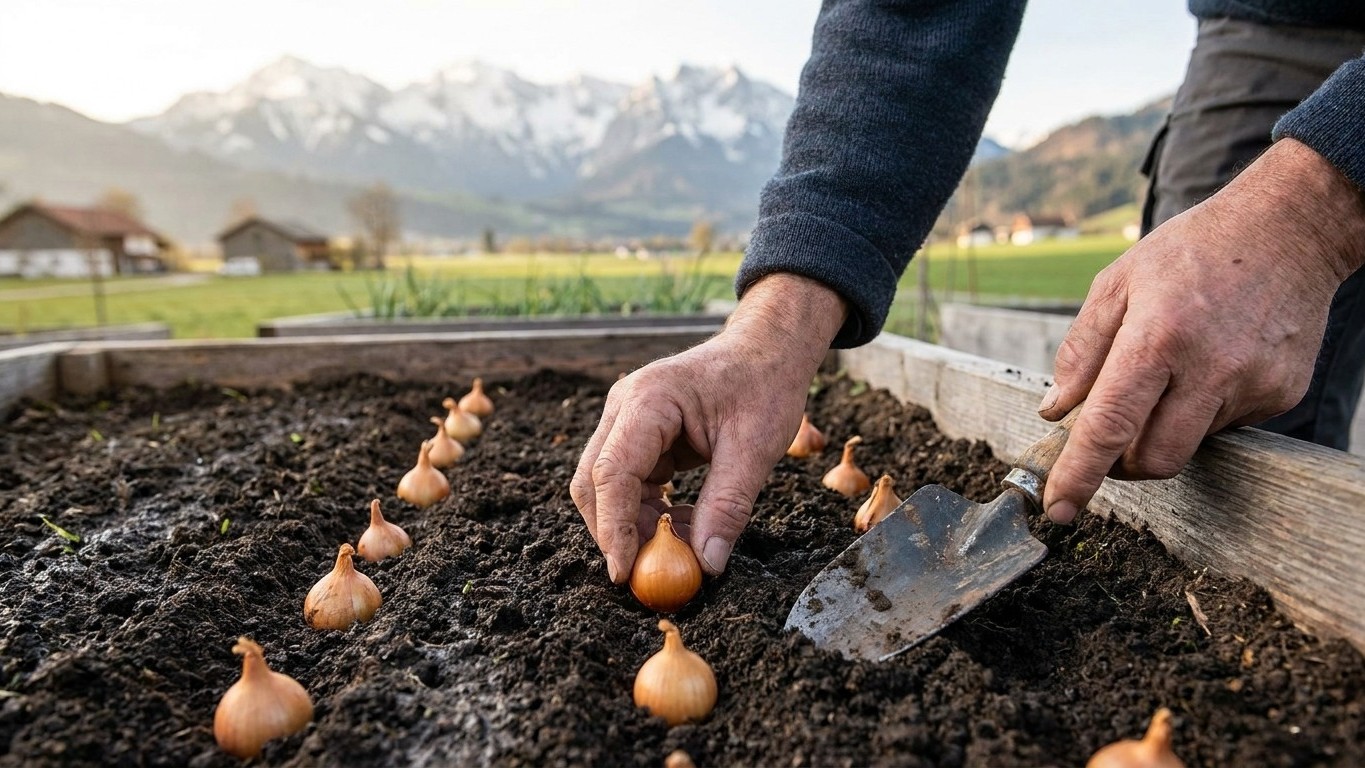

Utah onions go in the ground in late winter to early spring, not fall, because winters here are too cold for overwintering sets. The right varieties are intermediate-day and long-day types matched to Salt Lake City’s 40.78 degrees north latitude and its 14 hours 56 minutes of daylight on the longest day of the year. Get the day-length group wrong and the planting date won’t save you.
The short answer for Utah

Start with the two numbers that actually run this decision: Salt Lake City sits at 40.78 degrees north, and on the summer solstice the sun gives it 14 hours and 56 minutes of daylight. That figure is not trivia. Onions decide when to stop growing leaves and start forming a bulb based on how long the day has gotten, not how warm the soil is. At just under 15 hours, Salt Lake City lands squarely between the two groups that dominate mid-latitude gardens: intermediate-day onions, which bulb around 13 to 15 hours of daylight, and long-day onions, which need 14 to 16 hours before they’ll bulb at all.
That means most of Utah can grow both groups successfully. From the documented varieties whose published latitude range covers 40.78N, intermediate-day options include Cabernet, Calibra, Elsye, Expression, Monastrell, Red Long of Florence, Red Long of Tropea, Scout, and Sierra Blanca. Long-day options that fit include Ailsa Craig, Barolo, Blush, Bridger, Frontier, New York Early, Patterson, Red Carpet, Rossa di Milano, and Walla Walla Sweet.
Because Utah’s winters run cold rather than mild, this state belongs to the “plant later” group rather than the fall-planting group used in warmer climates further south. Gardeners here start onions from seed indoors in late winter, or set out sets and transplants in early spring once the soil can be worked. The goal is to give the plant as many weeks of leaf growth as possible before the lengthening days flip the switch to bulbing, sometime in early to mid summer depending on the variety’s day-length trigger.
What will not work here
Planting an onion late in Utah doesn’t push the harvest back a few weeks the way it might with tomatoes or peppers. It shrinks the bulb permanently. Once daylight hits the threshold a variety needs to bulb, the plant stops building leaf mass and starts diverting everything into the bulb, whatever size it happens to be at that moment. A transplant that went in three weeks late simply makes a smaller onion. There is no catching up once the trigger fires.
Variety choice creates a separate, harder failure. Short-day onions, the type sold heavily in southern nurseries, are built for latitudes far south of Utah. Planted here, they hit their roughly 12-hour bulbing trigger while the plant is still small, giving tiny onions at best. On the other end, a handful of long-day varieties need more daylight than Salt Lake City ever provides, and those plants don’t bulb small, they don’t bulb at all. They keep making leaves through the season and then rot in the ground.
- Gabriella (short-day, published 20-35N): bulbs far too early here, giving undersized onions instead of a full crop.
- Madalyn (short-day, 20-35N): same problem, bulbing triggered while leaves are still small.
- Red Rock (short-day, 30-36N): too far south of Utah’s day length to size up properly.
- Red Sensation (short-day, 25-35N): bulbs prematurely at this latitude.
- Texas Grano 1015Y (short-day, 25-35N): built for shorter days than Utah ever has in summer.
- Vidora (short-day, 25-35N): same early-bulbing failure as the other short-day types.
- White Castle (short-day, 30-38N): still south of the range that fits 40.78N.
- Powell (long-day, 43-47N): needs more daylight than Utah’s longest day supplies, so it never bulbs, it just makes leaves and rots.
- Redwing (long-day, 43-65N): same failure mode as Powell, built for latitudes north of Utah.
Three more varieties sit close to a published boundary rather than clearly inside or outside it: Candy, Safrane, and Talon. These may bulb in Utah gardens, particularly at the northern edge of the state, but they’re working near the edge of their documented range rather than comfortably inside it.
What changes across Utah
All the figures above belong to one station, Salt Lake City at 40.78 degrees north. Utah runs roughly five degrees of latitude from its southern border near St. George up to the Idaho and Wyoming line near Logan, and that stretch is wide enough to matter for onions specifically, since bulbing runs on daylight hours rather than temperature.
| Location | Approximate latitude | Longest-day daylight, relative to Salt Lake City | What it changes |
|---|---|---|---|
| Salt Lake City (reference station) | 40.78N | 14h56 (measured) | Baseline for every figure on this page; matches intermediate-day types and most long-day types cleanly |
| St. George, southern Utah | about 37N | slightly less than 14h56 | Closer to the lower edge of many intermediate-day ranges; long-day varieties near the 40N floor, like Frontier and Red Carpet, sit nearer the edge of their published range |
| Logan, far northern Utah | about 41.7N | slightly more than 14h56 | Comfortably inside long-day territory; a better fit for the borderline northern types, Safrane and Talon, though still near the blurred edge of their range |
A gardener in St. George is planting under meaningfully shorter summer days than one in Logan, even though both live in the same state. Neither should assume the Salt Lake City figures describe their own backyard without checking. The difference of a couple of degrees of latitude won’t flip a long-day onion into a short-day success story, but it can be the margin that decides whether a borderline variety bulbs well or barely bulbs at all.
Sweet now, or onions that last
Utah gardeners planting from the list above are choosing, whether they realize it or not, between onions to eat soon and onions to store. According to University of Missouri Extension, sweet onion varieties do not store as well as more pungent types, and the reason is chemical rather than incidental. The volatile sulfur compounds responsible for an onion’s sharp bite are the same compounds that protect the bulb once it’s cured and sitting in a pantry or root cellar. Breed the sulfur out for a milder, sweeter onion, and you also breed out its shelf life.
This lines up with the day-length pattern running through this page. Shorter-day, more southern-leaning types tend to run sweeter and shorter-keeping, while the longer-day, more northern-leaning types tend to run sharper and hold longer in storage. A gardener in southern Utah leaning toward intermediate-day sweet types like Sierra Blanca or Candy is choosing onions best eaten within a few months of harvest. A gardener further north growing long-day types built for sharper flavor, such as those in the Ailsa Craig or Patterson style, is setting up a pantry that can still be pulling from the onion bin in March.
Neither choice is wrong, but conflating them causes disappointment. Don’t expect a sweet, mild variety to still be good six months after harvest, and don’t expect a long-keeping, pungent variety to taste like the sweet onions sold at a farmers market in August. The trade is built into the chemistry, not a difference in growing skill.
Checking this against your own garden
Every figure on this page comes from one station in Salt Lake City. That’s a solid starting point for most of the Wasatch Front, but it’s not a substitute for checking your own conditions, especially if you garden closer to St. George, Logan, or anywhere else near the edges of the state.
- Look up your own latitude if you’re gardening more than an hour’s drive from Salt Lake City, since a couple of degrees can shift a borderline variety from workable to a poor fit.
- Confirm your local average last spring frost date and first fall frost date before setting a planting date, since these vary noticeably across Utah’s elevation changes.
- Contact your county extension office for planting windows calibrated to your specific valley or bench, rather than relying on a single statewide date.
- Check the seed packet or catalog listing for the exact day-length range of the variety you’re buying, since new varieties are released regularly and ranges can differ from what’s documented here.
- Note your garden’s microclimate, since a south-facing slope or an urban heat pocket can shift your effective planting window by a week or two even at the same latitude.