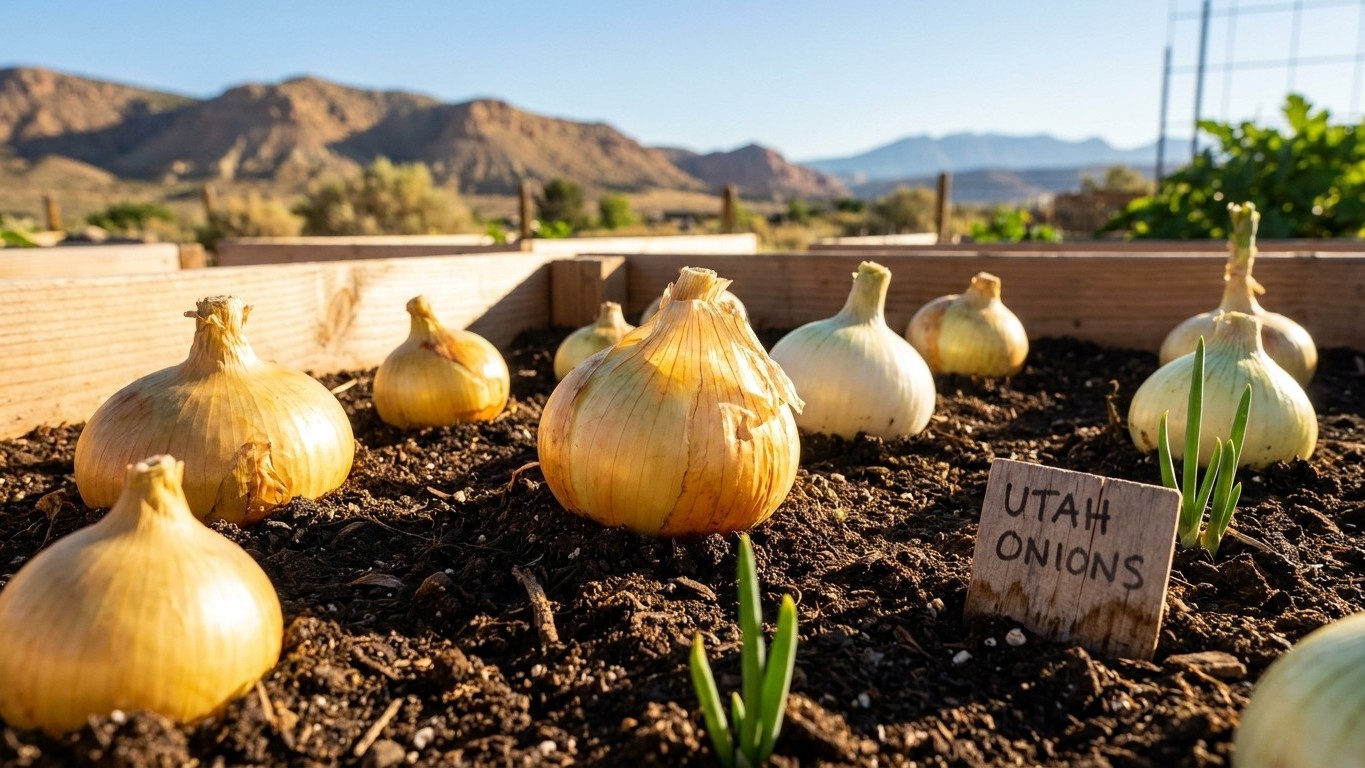

Salt Lake City sits at 40.78 degrees north, and on the longest day of the year it gets 14 hours and 56 minutes of daylight. That single number decides almost everything about growing onions in Utah: it puts most of the state solidly in long-day and intermediate-day territory, and it rules out the short-day varieties sold at big-box stores every spring. Here’s how to pick varieties that actually bulb instead of just growing leaves.
How long your longest day is

The reference point for this page is Salt Lake City, at 40.78 degrees north latitude, where the summer solstice delivers 14 hours and 56 minutes of daylight. That’s the figure an onion plant actually reads. Onions don’t decide to bulb because the soil warms up or because you fed them well. They bulb when the number of daylight hours crosses a genetic threshold built into the variety. Short-day onions switch over at around 12 hours, according to Clemson Cooperative Extension’s Home & Garden Information Center. Intermediate-day types wait for something in the 13-to-14-hour range. Long-day types hold off until they see 14 to 16 hours of light.
At almost 15 hours on the longest day, Salt Lake City clears the threshold for both intermediate-day and long-day onions. That’s the whole story in one sentence: this is long-day and intermediate-day country, and short-day onions are the wrong tool for the job here, no matter how healthy the seedlings look in April.
Utah is not a small, flat rectangle, though. It stretches from the Idaho border down to Arizona, and that’s several degrees of latitude, roughly the difference between Boise and Las Vegas. A gardener in Logan, up near the Idaho line, gets a few more minutes of June daylight than someone in St. George, down in the state’s southwest corner. Those extra minutes matter less than you’d think for the varieties in the middle of this page’s range, but if you’re gardening near either edge of the state, it’s worth checking your own latitude against the ranges below rather than assuming Salt Lake’s number applies exactly to you.
The practical takeaway: before you look at seed packets, catalogs, or nursery six-packs, look at whether the variety is labeled short-day, intermediate-day, or long-day. That label, cross-checked against your daylight hours, tells you more than the picture on the package ever will. Timing matters too, so pair your variety choice with a look at When to Plant Onions in Utah. For a curated list of options that actually bulb here, see The Best Onion Varieties for Utah.
Which varieties bulb in Utah
Nineteen documented varieties have published latitude ranges that cover 40.78 degrees north, which means they’re built to respond to the daylight Salt Lake City actually gets. They split between long-day and intermediate-day types, and both categories work here.
- Ailsa Craig (long-day, 38-60N)
- Barolo (long-day, 38-55N)
- Blush (long-day, 38-55N)
- Bridger (long-day, 35-50N)
- Cabernet (intermediate-day, 35-45N)
- Calibra (intermediate-day, 35-45N)
- Elsye (intermediate-day, 32-45N)
- Expression (intermediate-day, 32-45N)
- Frontier (long-day, 40-50N)
- Monastrell (intermediate-day, 35-46N)
- New York Early (long-day, 38-50N)
- Patterson (long-day, 38-55N)
- Red Carpet (long-day, 40-45N)
- Red Long of Florence (intermediate-day, 38-50N)
- Red Long of Tropea (intermediate-day, 35-48N)
- Rossa di Milano (long-day, 38-50N)
- Scout (intermediate-day, 32-46N)
- Sierra Blanca (intermediate-day, 32-45N)
- Walla Walla Sweet (long-day, 35-55N)
Three more sit close enough to the edge of their published range that they belong in a gray zone rather than a firm yes: Candy (intermediate-day, 33-40N), Safrane (long-day, 42-50N), and Talon (long-day, 42-50N). These may bulb around Salt Lake City, but a reader here is working at the margin of what the variety was bred for, not comfortably inside it.
Now the part that actually saves a gardening season. Nine varieties on the market will not bulb at this latitude, and the failure looks different depending on which direction they miss by.
- Gabriella (short-day, 20-35N)
- Madalyn (short-day, 20-35N)
- Red Rock (short-day, 30-36N)
- Red Sensation (short-day, 25-35N)
- Texas Grano 1015Y (short-day, 25-35N)
- Vidora (short-day, 25-35N)
- White Castle (short-day, 30-38N)
- Powell (long-day, 43-47N)
- Redwing (long-day, 43-65N)
The seven short-day varieties are bred for latitudes well south of Salt Lake City. Planted in Utah, they’ll bulb, but they’ll bulb early, while the plant is still small, because the shorter daylight threshold they’re waiting for arrives here well before the plant has built up enough leaf mass. The result is a small, undersized onion. That’s a variety mistake, not a growing mistake, and no amount of fertilizer fixes it. If you’ve bought a bag of sets at a garden center and gotten golf-ball onions three years running, this is very likely why.
Powell and Redwing fail the opposite way. Both need latitudes north of 43 degrees, which Salt Lake City’s 40.78 doesn’t reach. The day here simply never gets long enough to flip the switch. The plant keeps making leaves all season, waiting for a daylight threshold that never arrives, and eventually the bulb-that-never-formed rots in the ground. No onion at all, not even a small one.
When to plant onions in Utah
Because Utah falls in long-day and intermediate-day territory rather than the mild-winter short-day zone of the Deep South, the planting calendar looks different from what a gardener in Georgia or Louisiana would follow. Southern short-day growers plant in fall and let the onion overwinter. That approach doesn’t apply here. In Utah’s day-length zone, onions go in during late winter to early spring, timed around the last frost rather than the first one.
NOAA’s 1991-2020 climate normals for the Salt Lake City station (USW00024127) put the last spring freeze at 32°F somewhere between April 12 and April 29, and the first fall freeze between October 18 and October 29. Those dates come from NOAA’s 1991-2020 Climate Normals and represent a probability band, not a guarantee. They mark the 30-to-70 percent chance window for a freeze, meaning frost can still show up outside those dates in either direction. Treat them as a planning frame, not a fixed calendar you can plant by blindly.
There’s also the elevation and latitude caveat that runs through this whole page. Salt Lake City sits in a comparatively mild valley. Most of Utah sits higher and colder, especially the mountain valleys and benches away from the Wasatch Front, where both frost dates shift later in spring and earlier in fall. Southern Utah, down around St. George and the Dixie corridor, runs warmer than Salt Lake on both ends. If you garden outside the immediate Salt Lake valley, adjust the window accordingly rather than treating these dates as statewide truth.
Onion transplants and sets tolerate a light frost better than most vegetable starts, which is part of why the long-day and intermediate-day varieties on this page’s list get planted while the ground is still cool. Waiting until the soil feels genuinely warm, the way you would for tomatoes, costs the plant weeks of leaf-building time it needs before the June daylight hours arrive and trigger bulbing.
Sweet onions or onions that keep
What ends up in your kitchen depends on the same chemistry that decides how an onion tastes raw. Pungency in an onion comes from volatile sulfur compounds, and according to University of Missouri Extension’s guidance on onion growing and storage, those same compounds are what protect the bulb once it’s out of the ground. A sweet onion has fewer of them, which is exactly why it tastes better sliced raw on a sandwich and exactly why it turns soft in the pantry within a few weeks. There is no variety that manages both traits well. The trade-off is built into the plant, not a matter of luck or storage technique.
That trade-off tracks with day length across the state. Varieties toward the intermediate-day end of Utah’s range, like Cabernet, Calibra, Elsye, Expression, Monastrell, Scout, and Sierra Blanca, tend to run milder and shorter-keeping. Varieties on the long-day end, including Ailsa Craig, Barolo, Bridger, Frontier, New York Early, Patterson, and Rossa di Milano, tend to run sharper and store longer into winter. Walla Walla Sweet is the outlier worth flagging by name: it’s a long-day onion bred specifically for sweetness, which means it gives up the storage life you’d otherwise expect from a long-day type.
Because Salt Lake City sits comfortably inside both categories’ ranges, a Utah garden can lean either direction depending on what you actually want in March. Plant mostly intermediate-day varieties and you’ll eat well in July and August, but the bin will be empty by Halloween. Lean toward the long-day varieties instead, and the onions won’t taste as sweet fresh off the vine, but they’ll still be sound in the root cellar or a cool basement corner well after the first snow. Most Utah gardeners split the difference: a row of something sweet for summer eating, and a row of something sharper set aside deliberately for the months when the garden itself is dormant.