
Frost eats more Utah pumpkins than any insect, and it does it by arithmetic. A fruit needs 45 to 55 days after its flower opens, and a flower that opens in the wrong week runs out of season. Bugs and beetles chew leaves (they have their own pages on this site). The calendar takes the fruit.
The short answer
The first fall frost window at the Salt Lake station runs October 18 to October 29. That is the band where a 32 F freeze becomes 30 to 70 percent likely, per NOAA NCEI’s most recent 30-year climate normals. Utah State University Extension says pumpkins take 45 to 55 days to mature after flowering, and that they should be harvested with the stem attached, before frost. Put those two facts together and you get a deadline for flowers.
Counting back from frost
Start with the early edge of the window. Forty-five days before October 18 is September 3, and 55 days before it is August 24. Now the late edge. Forty-five days before October 29 is September 14, and 55 days before it is September 4.
The latest a flower can open and still give a ripe pumpkin in Salt Lake’s climate is therefore somewhere between August 24 and September 14. The wide spread is real. The August end assumes a slow fruit and an early freeze, and the September end assumes a fast fruit and a late one. Plan around the early end. Anything after it is a bet, not a schedule.
Pay attention to where the count starts. The 45 to 55 days run from flowering, not from seeding and not from transplanting. A seed sown in late May says nothing by itself about when the fruit will be done. What matters is the day the flower opens. Jot that date on a calendar when you see it, and you have a countdown instead of a guess.
What the window does not tell you
Salt Lake sits in a mild valley, and most of Utah is higher and colder. A garden in a mountain town will see its first freeze earlier than this window, which pulls the flower deadline earlier too. Southern Utah is warmer, so the deadline slides later. This site does not publish frost windows for other parts of the state, so use your own local frost records and run the same subtraction.
If flowers are still opening as the deadline passes, the fruit that follows is unlikely to finish. Will Pumpkins Ripen Before Frost in Utah? covers what to expect from fruit that is still green when the window closes. The wider growing picture lives on the Growing Pumpkins in Utah page.
When to sow here
Sowing is a separate clock from the flower deadline, and it starts with soil rather than air. Utah State University Extension says to sow when the soil reaches 65 F. That is not the last frost date. The soil lags the air by weeks, so a garden can be frost-free and still too cold for seed. The last spring frost window at the same Salt Lake station is April 12 to April 29, and the soil target comes well after it.
Doing the arithmetic
- Start with the last spring frost window: April 12 to April 29. This is the air, and it only tells you when a freeze stops being likely.
- Add the soil lag. No exact number of weeks is published here, because it varies with elevation, exposure and the spring itself. As an illustration only, a two-week lag would push the window to April 26 through May 13. A longer lag pushes it further into May.
- Confirm with a thermometer, not the calendar. The rule is 65 F soil. Sow when the ground gets there, whatever the date says.
- Subtract two weeks if you use row covers. Covers buy about two weeks. In the illustration above, a two-week lag minus a two-week head start lands you back inside the last frost window itself. Seedlings under cover are protected, but they are not immune, so keep a close eye on the forecast.
- Check the result against the flower deadline. Whatever sowing date you land on, flowers need to open by the early part of the August 24 to September 14 window. Sow later, and you leave less room for the fruit to finish.
Why the covers matter more here
Utah’s season is short enough that two weeks is a meaningful slice of it. A cover does not warm the soil as much as it holds heat close to the seedling, and it is the one tool in this list that moves your sowing date earlier. The detail on exact sowing windows by region is in When to Sow Pumpkins in Utah.
What goes wrong here
A short season fails pumpkins in predictable ways. Each one below comes from the same arithmetic, and each has a remedy.
Failures and fixes
- A late flower that never colors. A flower opening after the deadline gives a fruit that stays green when the weather closes in. Count 45 to 55 days from the day the flower opened. If that lands after your local first frost, the fruit is a poor bet. Direct the plant’s energy to fruit that has already set, and do not count on the late ones.
- A fruit caught by frost. Frost is the end of the season, and a fruit still on the vine when it arrives is at risk. Harvest with the stem attached, before frost, as Utah State University Extension advises. When a freeze is forecast inside your window, cut what is mature and bring it in rather than waiting for the vine to finish.
- A vine that dies back before the skin hardens. When the vine goes early, whether from cold, drought or insects, the fruit can be left with a soft skin. Cut with the stem attached and move the fruit to a place where it will not freeze. Leaf-chewing pests make an early die-back more likely, and this site has separate Utah pages on squash bugs and cucumber beetles, so those insects are not described again here. Timing for their arrival is not published here either.
The storage mistake
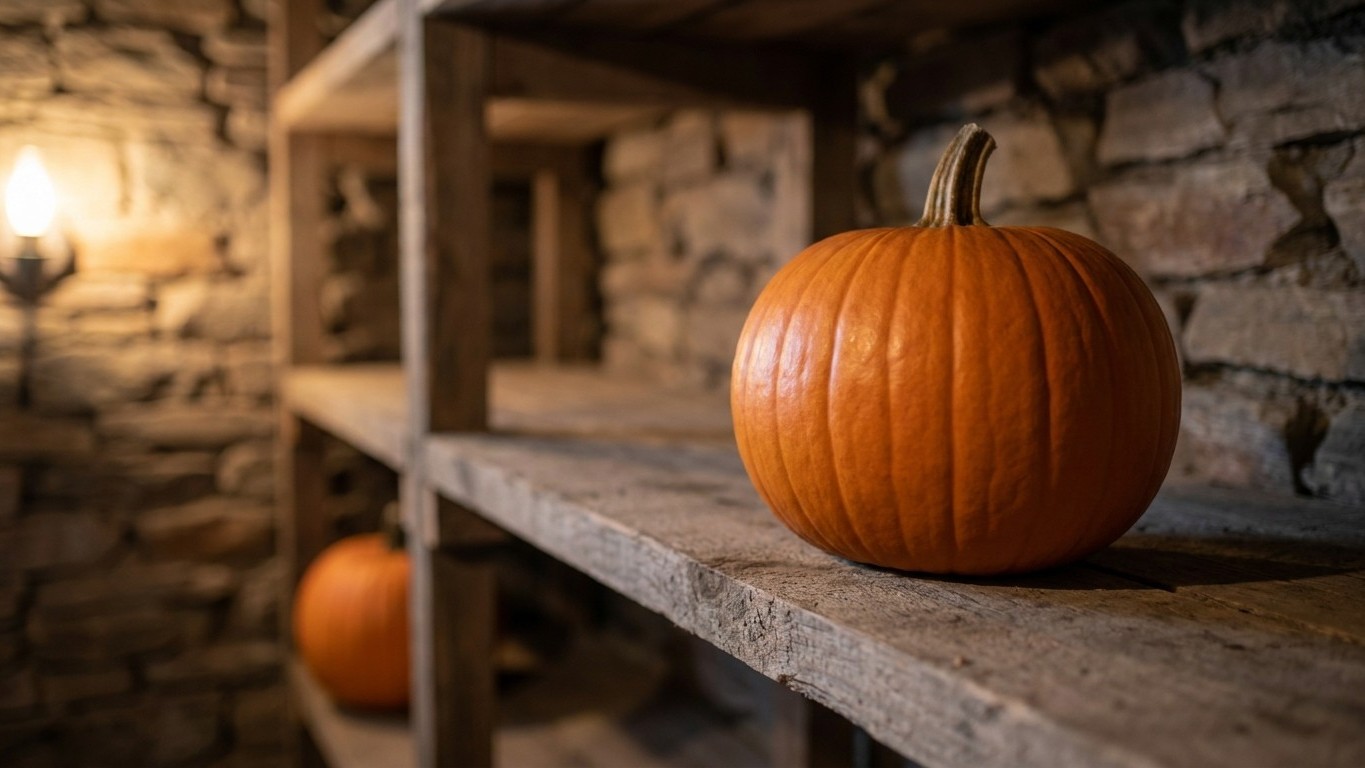
Even a pumpkin that makes it can lose to the wrong shelf. A whole pumpkin keeps for three to six months in a cool, dark spot between 45 and 50 F, according to University of Illinois Extension. The same source says to keep it away from ripening fruit and vegetables such as apples, potatoes and tomatoes. Ripening produce gives off a gas that ages the pumpkin. That makes the porch beside the apple crate one of the worst places for it.
That 45 to 50 F range applies to a whole pumpkin only. It says nothing about a carved one. Utah State University Extension, for its part, gives no storage temperature or keeping time, only to store pumpkins where they will not freeze.
Common questions
Do the 45 to 55 days count from seeding?
No. They count from flowering. Utah State University Extension gives that range as the time to mature after the flower opens, so the number you need is the date of the flower, not the date you planted.
Is 65 F soil the same as the last frost date?
No. The last spring frost window at the Salt Lake station is April 12 to April 29, and soil reaches 65 F weeks after the air stops freezing. Treat them as two separate dates and use a thermometer to find the second one.
How long does a whole pumpkin keep?
Three to six months in a cool, dark location between 45 and 50 F, per University of Illinois Extension. Keep it away from apples, potatoes and tomatoes, which give off a gas as they ripen. The figure covers whole pumpkins only, not carved ones.
Do the Salt Lake dates apply to the rest of Utah?
Only as a starting point. Salt Lake sits in a mild valley, most of Utah is higher and colder, and southern Utah is warmer. Frost dates for other places are not published on this page, so check your local records and subtract 45 to 55 days from the first fall frost the same way.