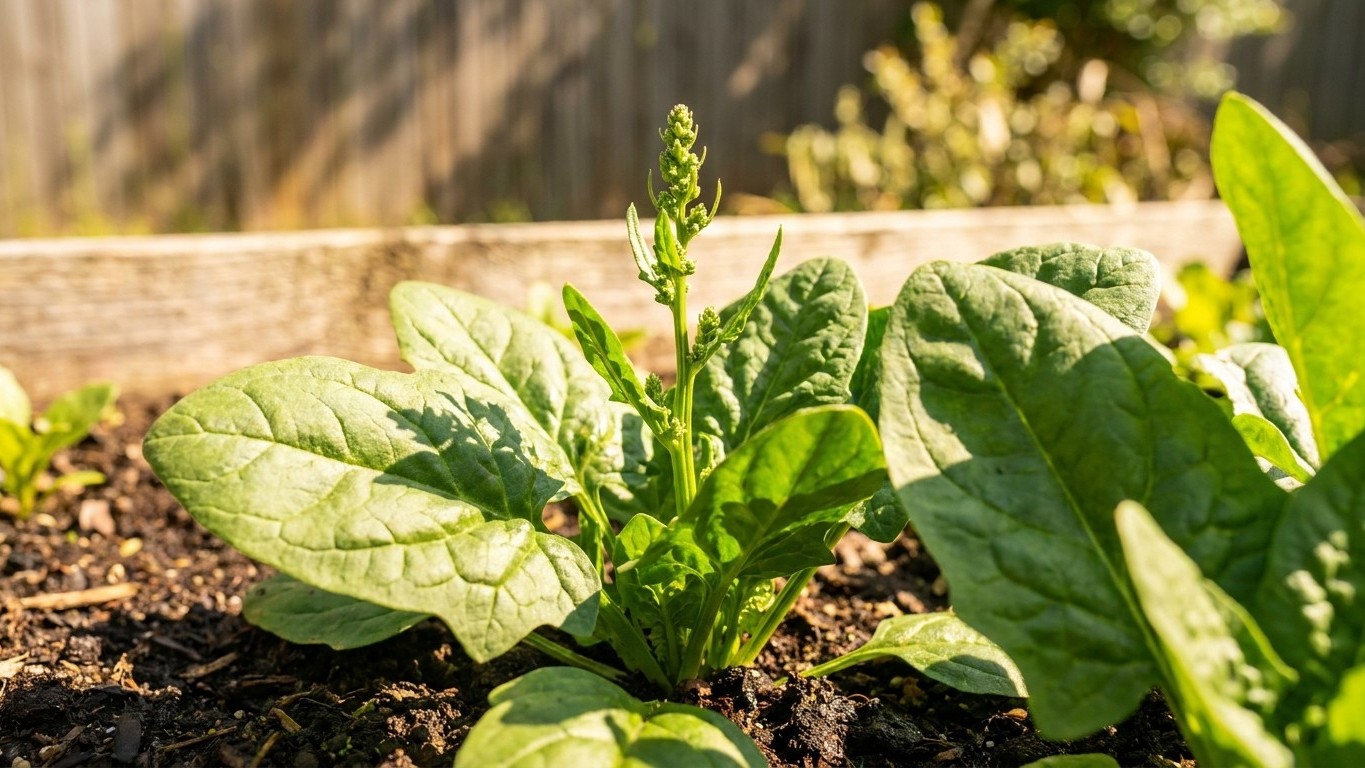

Spinach bolts early almost everywhere in Utah, and the trigger isn’t really the heat wave you’d expect. Salt Lake City’s valley logs 14 hours and 56 minutes of daylight on the longest day of the year, and that day length alone is enough to flip spinach from leaf production into flowering. Add 52.1 days a year above 90°F on top of that, and the crop is fighting two separate clocks at once. The workaround isn’t a better variety. It’s timing the sowing so the plant finishes its life before either clock runs out.
The short answer
Fourteen hours and fifty-six minutes of daylight on the summer solstice, measured at the reference station near Salt Lake City, sets the ceiling for how long spinach can be grown here without bolting. Utah State University Extension is clear that spinach flowers under long days combined with warm temperatures, so once the daylight stretches past a certain point in late spring, the plant is genetically cued to send up a seed stalk no matter how the nights feel. A cool evening in May doesn’t cancel that signal. The day length is doing the work by itself, and it keeps climbing toward that nearly-15-hour peak whether the thermometer cooperates or not.
Heat piles on top of that signal rather than replacing it. USU Extension puts spinach’s comfortable growing range at temperatures that stay below 75°F, and Salt Lake City averages 52.1 days a year at 90°F or hotter. That’s a lot of heat load stacked against a crop that starts struggling well before the mercury even gets that high. So the honest answer to whether spinach bolts early here is both: the lengthening days pull the trigger, and the accumulating heat makes sure the plant bolts fast and turns bitter once it does. Neither factor alone explains the whole picture, and neither one is avoidable through variety choice or garden placement.
USU Extension names four spinach varieties gardeners commonly grow in the state: Bloomsdale, Melody, Teton, and Olympia. The source doesn’t publish bolt-resistance ratings, maturity days, or performance comparisons for any of them, so there’s no verified data here to lean on for picking one over another based on how it handles Utah’s day length. What the source does confirm is the mechanism itself, and that mechanism doesn’t change by variety. Long days plus heat end the spring crop regardless of which seed packet is in the ground.
What this means practically is that Utah gardeners aren’t managing a slow decline. They’re managing two hard deadlines that arrive close together, one set by the calendar and one set by the thermometer, and the only real lever is when seed goes into the soil.
How long the spring window really is
- The last spring frost at the Salt Lake City reference station falls somewhere between April 12 and April 29, based on NOAA’s 1991-2020 climate normals for that station. That range is the anchor point for everything that follows, since USU Extension’s sowing guidance is built around it rather than a fixed calendar date.
- USU Extension recommends sowing spinach two to three weeks before that last frost date. Run the math against the April 12 to April 29 window and sowing lands somewhere between March 22 and April 15, depending on which end of the frost range actually shows up in a given spring.
- From the moment seed goes in, daylight is already working against the crop. Days lengthen steadily through March and April on the way toward the 14-hour-56-minute peak in June, and that climb doesn’t pause for the plant to get established. The bolting trigger is building before the first true leaves even appear.
- Heat arrives on a similar timeline. With 52.1 days a year reaching 90°F at the reference station, the valley’s hot stretch typically starts stacking up well before summer officially begins, and the 75°F growth ceiling gets crossed long before that 90-degree count really ramps up.
- Put those pieces together and the spring window is short by design, not by bad luck. Seed sown in that late-March to mid-April stretch generally has only a handful of comfortable weeks before day length and rising temperatures both push the plant toward flowering. That’s why USU Extension’s advice leans toward harvesting baby leaves early and often rather than waiting for full-size plants that may never get the chance to mature before bolting takes over.
The autumn crop, and when the soil lets you sow
Fall spinach in Utah runs into a different kind of obstacle than the spring crop does, and it shows up before the plant even germinates. USU Extension frames fall sowing as a countdown: plant 50 to 75 days before the date you actually want to harvest. For a realistic harvest target around mid-October, ahead of the first frost window, that countdown puts sowing somewhere between roughly late July and late August, depending on which end of the 50-to-75-day range applies.
Soil still too warm to germinate
The catch is that spinach seed germinates poorly once soil temperatures climb above 80°F, according to USU Extension, and Utah’s valley soil holds onto summer heat well into August given how many days a year cross 90°F in the air above it. That means the earlier part of the sowing countdown, the late-July-to-early-August end, often lines up with soil that’s still too warm for reliable germination. Gardeners frequently end up watching the calendar say “sow now” while the soil itself says otherwise, which narrows the practical sowing window to whenever the ground actually cools rather than whenever the countdown math suggests.
The frost that ends the season
On the other end, the first fall frost at the reference station arrives between October 18 and October 29, based on the same NOAA 1991-2020 climate normals used for the spring date. That gives fall spinach a firm stopping point. Working backward from a harvest target set safely before that frost window, say around mid-October, and counting the full 50 to 75 days back lands sowing in that late-July-through-August stretch. The real constraint is squeezing sowing into the narrow stretch where soil has finally cooled below that 80°F germination threshold but there’s still enough of the 50-to-75-day countdown left before frost shuts things down. In practice, that often means sowing toward the later, cooler end of August rather than the calendar-driven early end.
Common questions
Does shade help spinach avoid bolting in Utah?
USU Extension’s published guidance addresses day length, temperature, and soil conditions, but it doesn’t include data on shade cloth or row covers as a bolting countermeasure. Any claim about how much shade delays flowering here isn’t backed by the source this article relies on.
Is the spring or fall crop more reliable in Utah?
The fall crop avoids the steepest part of the day-length climb, since sowing happens after the summer solstice rather than before it. But it trades that advantage for the germination problem posed by warm soil, so neither season is free of obstacles. It comes down to whether a gardener can time sowing around the last frost in spring or around soil cooling in late summer.
Do all four USU-recommended spinach varieties bolt at the same rate?
USU Extension names Bloomsdale, Melody, Teton, and Olympia as varieties grown in the state but doesn’t publish bolt-resistance comparisons or maturity data for any of them. There’s no verified basis here for saying one holds up longer than another under Utah’s day length and heat.
Why doesn’t a cool summer save the spring crop?
Because the bolting trigger is day length, not temperature alone. USU Extension notes spinach flowers under long days combined with warmth, so even a summer with fewer hot days won’t stop the plant from bolting once daylight passes the point that signals flowering. Heat speeds up and worsens the bolt, but day length starts the process regardless of how mild the season feels.