
In Utah, spinach goes into the ground twice a year: a short spring run sown two to three weeks before the last frost (April 12 to April 29 at the Salt Lake reference station), and a fall crop sown once the soil cools, usually mid-August through early September, timed 50 to 75 days ahead of the first fall frost (October 18 to October 29). Both windows are narrow, and both are set by heat and day length, not by cold.
The short answer
Start with the sky. On the longest day of the year, the Salt Lake reference station sees 14 hours and 56 minutes of daylight. That number matters for spinach in a way that runs backward from what most gardeners expect. Long days don’t extend the season here, they end it. Utah State University Extension is direct on this: spinach bolts under long days and warm temperatures together, and it grows best only where temperatures stay below 75 F. A mild, cool summer at altitude doesn’t buy extra weeks, because the day length alone is enough to push the plant toward flowering once the calendar rolls past the equinox and daylight climbs toward that near-15-hour peak.
So which is the real limiter in Utah, the day length or the heat? Both, and they arrive on the same schedule. Salt Lake averages 52.1 days a year at 90 F or hotter, a heat load concentrated almost entirely in the same stretch, roughly June through August, when daylight is also longest. The two pressures stack instead of canceling out. A gardener at higher elevation in, say, the Wasatch Back or a mountain valley gets some relief from the heat side of that equation, because thinner air and higher ground shed warmth faster after sunset. But elevation doesn’t change the sun’s angle or the length of the day, so the bolting trigger tied to daylight still arrives on roughly the same calendar date statewide. Southern Utah, which runs warmer than the Salt Lake reference point, feels the heat side of the squeeze even harder and gets less relief from either direction.
What this means practically: spinach in Utah isn’t fighting frost, it’s racing the sun and the thermometer at the same time. That’s why the crop is grown as two short shoulder-season windows instead of one long summer run, and why the fall sowing date is fixed by counting backward from autumn’s first frost rather than forward from spring’s last one. The mechanism is the same plant, the same 75 F ceiling, the same daylight trigger, just approached from opposite ends of the calendar.
How long the spring window really is
- Sowing date. Utah State University Extension recommends sowing spinach two to three weeks before the last spring frost. With that frost falling between April 12 and April 29 at the reference station, sowing lands roughly in the last ten days of March through the middle of April, earlier at low elevation, later where cold air pools or where spring arrives late.
- Early growth. Cool soil in late March and April is exactly what spinach wants for germination and leaf development, and it’s the opposite of the problem the fall crop faces. This stretch, from sowing through late April and into May, is the productive core of the spring window.
- The closing trigger. As May turns into June, daylight climbs toward that 14-hour-56-minute peak and temperatures start crossing the 75 F growth ceiling with increasing frequency. Both pressures converge inside the same few weeks, and spinach sown in late March typically bolts by late May to mid-June, sooner in a warm spring, later at elevation or in a cooler microclimate.
- Net usable span. Counting from a sowing date around late March or early April to a bolting date in late May or June leaves roughly eight to ten weeks of harvestable spring spinach in most of Utah. It’s a real window, but it’s short, and it closes on its own schedule regardless of how carefully the garden is watered or shaded.
The autumn crop, and when the soil lets you sow
The fall sowing date isn’t chosen by frost tolerance, spinach doesn’t need protecting from cold in the way a tomato does. It’s chosen by two separate obstacles, one at each end of the season, and they don’t always leave a comfortable gap between them.
Soil still too warm to germinate
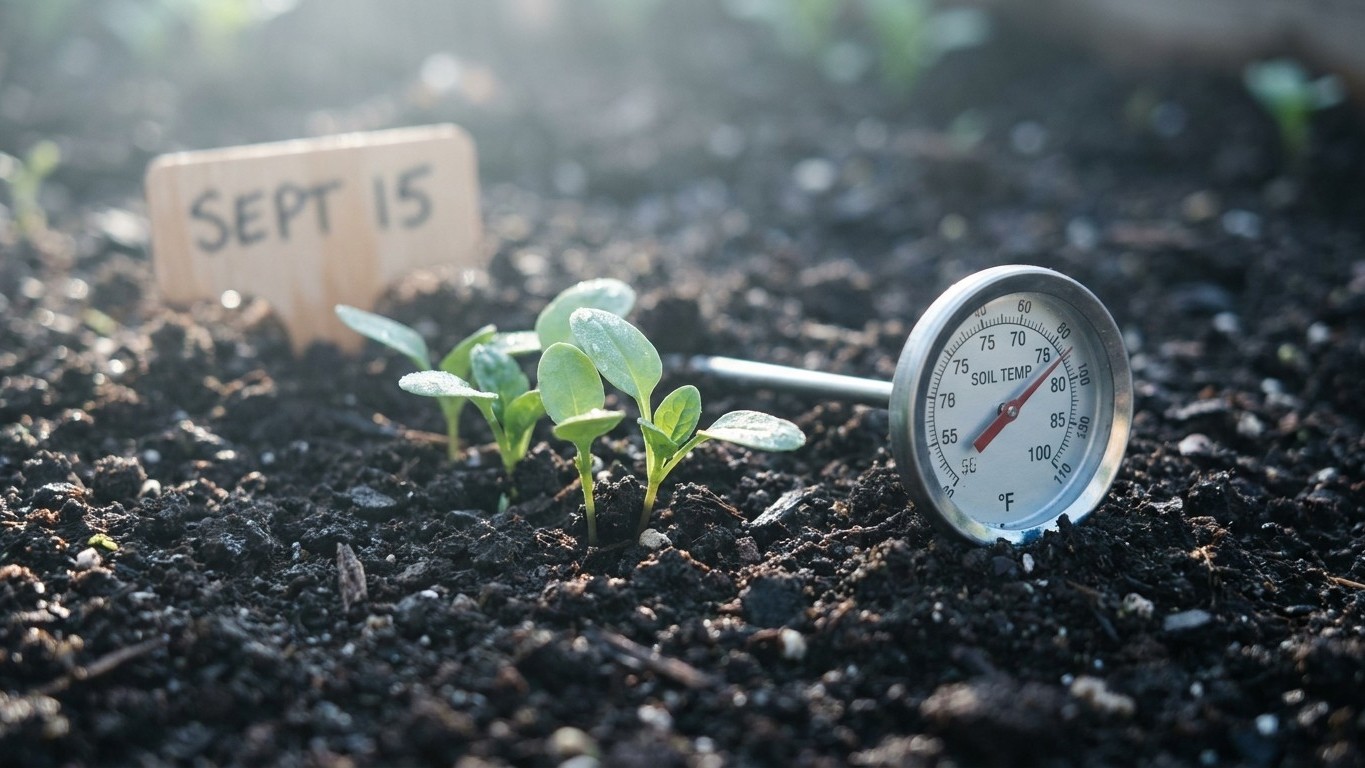
Spinach seed germinates poorly once soil temperature climbs above 80 F, according to Utah State University Extension. Salt Lake’s climate normals show an average of 52.1 days a year reaching 90 F or higher in the air, concentrated in July and August, and soil under full late-summer sun typically holds heat close to or above air temperature through much of that stretch. That means an early-August sowing date, however appealing on paper, often lands on soil that’s still too warm for reliable germination. The practical fix is patience rather than calendar math: wait until soil actually cools, checking it directly if possible, rather than sowing on a fixed date and hoping. Watering deeply and mulching can help pull soil temperature down a few degrees faster as the season turns, but it can’t force germination while soil sits solidly in the 80s.
Counting back from the first fall frost
The other boundary is Utah State University Extension’s rule of thumb for fall crops: sow 50 to 75 days before the date you want to harvest. With the first fall frost falling between October 18 and October 29 at the reference station, counting back 50 to 75 days points to a sowing window running from roughly early August to early September, narrowing toward mid-August once the soil-temperature obstacle above is factored in. That leaves a realistic fall sowing target of mid-August through the first week or two of September for most of the Salt Lake area. Higher, colder parts of Utah see frost earlier and should sow sooner within that range; warmer southern Utah has more room to wait, since both its frost date and its cooling soil arrive later. Utah State University Extension names four spinach varieties commonly grown in the state, Bloomsdale, Melody, Teton, and Olympia, but publishes no maturity-day figures or variety-specific performance data for any of them, so variety choice comes down to seed availability rather than a documented days-to-harvest comparison.
Common questions
Can spinach handle a light fall frost once it’s established? Utah State University Extension’s published guidance for this crop centers on the 50-to-75-day sowing rule and the 75 F growth ceiling; a separate light-frost threshold isn’t part of that guidance, so plan the fall sowing date around the first fall frost window itself rather than assuming extra time past it.
Why not just sow spinach all summer if the plant tolerates some heat? Because two things happen at once past 75 F: growth quality drops and the plant becomes more prone to bolting under Utah’s long summer days, a combination Utah State University Extension flags for this crop specifically. Sowing into that stretch tends to produce a plant that runs to seed quickly rather than a productive stand.
Does elevation change these dates much? The frost dates and daylight figures here come from the Salt Lake reference station, which sits in a comparatively mild valley. Most of Utah is higher and colder, meaning both frost dates arrive earlier there, spring later and fall sooner, which tightens both the spring and fall windows described above.
Is there a way to check if soil is cool enough to sow spinach in late summer? Utah State University Extension’s guidance centers on staying below the 80 F germination threshold; a simple soil thermometer pushed a couple of inches into the bed gives a direct read, which is more reliable than guessing from air temperature or the calendar alone.