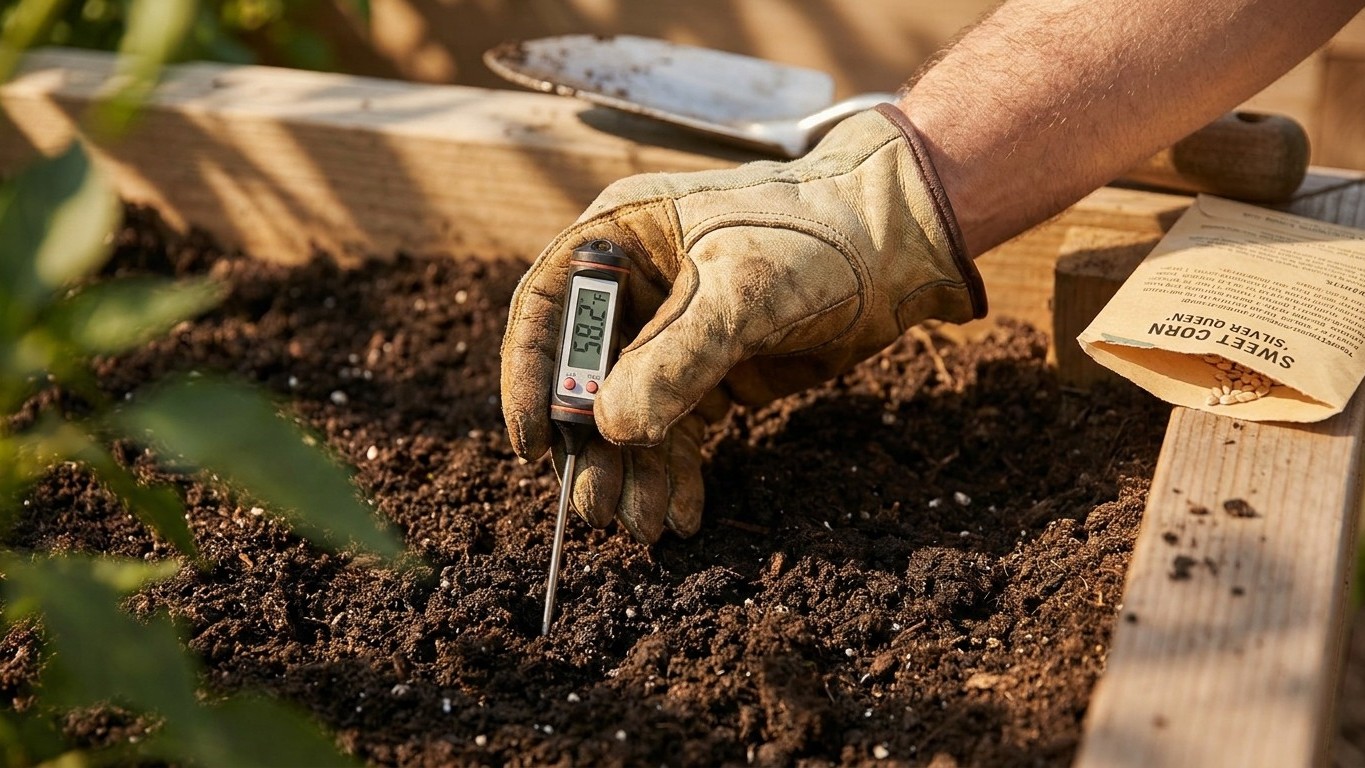

Sweet corn goes in the ground in Utah once soil warms past 60°F, which typically happens weeks after the last spring frost has passed. In the Salt Lake valley, that frost window runs April 12 to April 29, and the first fall frost arrives October 18 to October 29. That gap comfortably covers the 60 to 90 days sweet corn needs from planting to harvest, though the picture shifts fast once you leave the valley floor for higher, colder ground.
The short answer
Here’s the part that trips up a lot of gardeners: the last frost date and the date soil is warm enough for corn are not the same thing, and treating them as interchangeable is the fastest way to lose a planting. Soil lags behind air temperature by design, it’s a slower-moving mass, so even after the last frost has come and gone in mid-to-late April, the ground itself is often still too cool for corn seed to germinate reliably. Utah State University Extension is clear that sweet corn wants soil above 60°F before it goes in, full stop. There’s no published soil-temperature date for this piece, so the only honest advice is to check it yourself with a soil thermometer rather than counting days on a calendar.
What that means in practice is a planting date that sits noticeably later than the frost-free date suggests. If you’re gardening in a spot where the last frost lands April 12, don’t assume you’re clear to plant corn that week. Wait for the soil itself to tell you it’s ready, which for most Utah valleys means pushing into May before seed goes in the ground.
Even with that delay, the math still works in the reference valley. Push planting into May, and you’ve still got roughly five months before the first fall frost on October 18 through October 29. That’s well more than the 90 days the longest sweet corn varieties need, and it leaves margin for a cool stretch or a late start without threatening the harvest.
Summer heat matters here too, not for the sowing date itself but for what happens after. The reference station averages 52.1 days a year at 90°F or hotter, a heavy heat load that drives water demand hard during the weeks corn is tasseling and filling ears. Corn planted on schedule but left to dry out during that stretch will show it in the ears, regardless of how well the sowing date was timed. Consistent watering through the hottest weeks matters as much as getting the calendar right.
None of this holds evenly across the state. Salt Lake sits in a mild valley, and most of Utah runs higher and colder, with a shorter frost-free window on both ends. Southern Utah runs the other direction, warmer and more forgiving. If you’re gardening at elevation, or well north of the valley floor, treat the reference dates as a starting point and push your own timeline later in spring and earlier in fall.
Does a late variety fit here?
Once you know the season’s rough shape, the next question is whether your seed packet’s “days to maturity” actually fits inside it. That number counts from planting, not from the last frost, and it’s worth running the math for both ends of the range gardeners typically encounter.
A 60-day variety
A 60-day sweet corn is the easy case. Even accounting for a delayed planting date, since seed doesn’t go in until soil clears 60°F, there’s a wide cushion before the first fall frost in the reference valley. Planting in May and counting 60 days lands you in early-to-mid summer, months ahead of the October frost window. This is the safer choice anywhere in Utah where the growing season runs shorter than the valley floor, including higher elevations where both frost dates squeeze the calendar from both directions.
A 90-day variety
The 90-day type is where the math gets tighter, and where location starts to matter more than any single planting date. In the reference valley, with its April 12 to April 29 last frost and October 18 to October 29 first fall frost, even a soil-driven May planting leaves enough runway for a 90-day corn to mature before autumn cold sets in. That’s a workable window, not a tight squeeze.
But that math doesn’t travel well across the state. Most of Utah sits higher and colder than the reference station, which means a later last frost, a slower soil warm-up, and an earlier first fall frost squeezing the growing season from both sides at once. In those locations, a 90-day variety does not reliably fit, and pushing it anyway invites a fall frost catching the crop before the ears finish filling. Gardeners outside the mild valley floor should lean toward the shorter end of the maturity range rather than gambling on a long-season variety maturing in time.
What goes wrong here
- Soil sown too cold. Planting on the frost date instead of the soil-temperature date is the single most common mistake. Corn seed sitting in soil below 60°F germinates poorly or not at all, and even a strong-looking stand from a too-early planting often struggles the rest of the season. The fix is simple: test the soil directly rather than relying on the frost calendar, and hold off until it reads warm enough.
- A variety too late for the season. A 90-day corn planted in a high-elevation garden, where both frost dates run against you, can run out of season before the ears are ready. The remedy is matching maturity length to your actual location rather than the state average, choosing a shorter-season type anywhere the growing window runs tight.
- Sweetness lost because two types tasseled together. This one has nothing to do with weather. Utah State University Extension notes that su, se and sh2 sweet corn types lose their sweetness if they tassel at the same time as each other, since cross-pollination between types changes the kernel’s sugar content. There’s no published separation distance for this, so the fix isn’t about feet or rows apart, it’s about timing: stagger plantings, or grow only one type at a time, so different sweet corn types are never shedding pollen in the same window. Corn should also be planted in blocks of three or more rows rather than a single long row, which improves pollination regardless of type.
Common questions
Can I plant sweet corn right after the last frost? Not reliably. The last frost date and the date soil reaches 60°F are different milestones, and soil typically warms weeks after frost risk passes. Check soil temperature directly rather than planting on the frost date alone.
How do I know when to pick the ears? Look for three signs together: dry brown silks, husks that are still moist and green, and milky juice when you puncture a kernel. Any one sign alone isn’t a reliable test; all three together confirm readiness.
Does elevation change my planting date? Yes, substantially. The reference dates come from a mild valley station; most of Utah sits higher and colder, with a later last frost, slower soil warm-up, and earlier first fall frost. Southern Utah tends to run warmer than the valley reference.
Why did my sweet corn turn out starchy instead of sweet? Most likely two different sweet corn types tasseled at the same time nearby, cross-pollinating and altering the kernel sugars. Stagger plantings or stick to one type per season, and grow corn in blocks rather than single rows for reliable pollination.