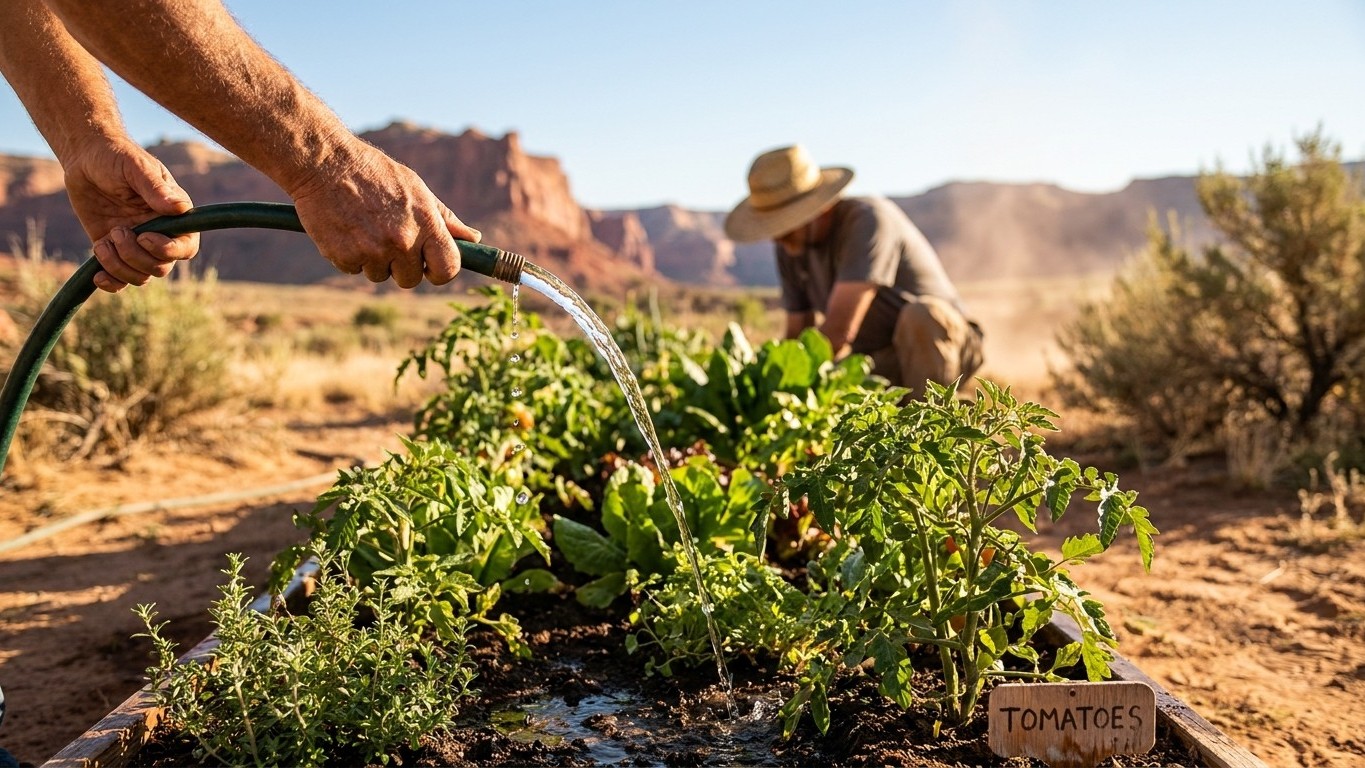

Utah gardens live or die by two numbers: 52.1 days a year that hit 90F or hotter, and a summer sky that hands over almost none of the water a garden bed actually needs. That gap is the whole story, and it’s why watering here isn’t optional maintenance. It’s the main event.
What the climate asks of you

Start with the heat, because it’s the number with a source behind it. The Salt Lake City reference station averages 52.1 days a year at 90F or above, according to NOAA’s 1991-2020 Climate Normals. That single figure rules out cool-season lawns from coasting through July on autopilot and it tells you a vegetable bed left alone for a week in mid-summer won’t just wilt, it’ll cook.
Utah’s summer precipitation pattern is the other half of the equation, and it’s the part most gardeners underestimate until they’ve lived through one dry August. The state’s growing season runs through a stretch where rainfall is sparse and unreliable, arriving in scattered monsoon bursts rather than the steady weekly soakings a garden actually wants. A bed wants roughly an inch of water a week during the growing season. In a typical Utah summer week, the sky simply doesn’t deliver that on its own, which means watering through a dry spell in Utah comes down almost entirely to what the gardener carries out with a hose.
Soil texture changes how far that shortfall goes. On sandy ground, common across much of the Wasatch Front’s benches and southern Utah’s valleys, water drains through fast and leaves little behind for roots to draw on between waterings. On heavier clay, found in parts of the Salt Lake and Utah valleys, water sits longer near the surface, but it also means a single deep soak can carry a bed further than the same amount would on sand. Either way, the summer heat load described by that 52.1-day figure is doing the real work of drying things out, and it’s not evenly spread. Elevation matters too: USDA hardiness zones across the state run from 4a to 9a, a spread wide enough that a garden in a high mountain valley and one in the St. George area are working with different growing seasons entirely, even though both fall under “Utah” on a map.
How much, how often
Deep and infrequent beats shallow and daily, every time, and the reason is root behavior, not tradition. A light daily sprinkle wets only the top inch or two of soil, so roots stay shallow and near the surface, exactly where summer heat bakes them hardest. A deep soak that reaches six to eight inches down pushes roots to chase the water, anchoring them where soil temperature swings less and moisture lingers longer between waterings.
The simplest way to know when to water again is with a finger or a trowel, not a calendar. Push a finger two inches into the soil near the base of a plant. If it comes out dry, it’s time. If it’s still cool and slightly damp, wait. This same principle applies to Watering Pots and Containers in Utah, though pots dry out faster and need more frequent checks. This one habit does more to prevent both underwatering and overwatering than any timer setting.
Adjusting for the ground under your feet
Soil texture changes the schedule, not just the amount. On sandy soil, water moves through quickly and holds little in reserve, so shorter, more frequent soakings work better than trying to stretch the interval. On heavy clay, a single thorough watering can carry a bed for most of a week, but clay punishes impatience: watering or working the soil while it’s still wet compacts it, squeezes out the air pockets roots need, and can drown a plant faster than drought would. Given how little rain falls during Utah’s driest summer stretch, most gardens here are running on irrigation, not on what falls from the sky, so the watering schedule has to be built deliberately rather than left to chance.
- Check soil moisture two inches down with a finger or trowel before turning on any hose or system.
- Water early in the morning, before the heat of the day sets in, so moisture soaks in rather than evaporating off the surface.
- Aim water at the base of the plant and the surrounding soil, never at the leaves, to avoid fungal problems in Utah’s warm, dry air.
- Apply enough to soak six to eight inches deep, roughly the equivalent of an inch of water over the bed, rather than a quick surface splash.
- On sandy soil, shorten the interval between waterings; on clay, lengthen it and let the top inch dry before watering again.
- Reduce frequency, not depth, once fall temperatures ease and the days above 90F taper off toward October.
Restrictions and rules
Watering restrictions are common across Utah, and they shift from year to year and city to city depending on reservoir levels and snowpack. Some water districts limit outdoor watering to specific days of the week during summer months, others set time-of-day rules to cut evaporation losses, and enforcement and penalties vary by municipality. None of that is stable enough to print as a fixed rule here, because a schedule that’s accurate this summer can be replaced by a stricter one the next.
Given how little rain falls during Utah’s driest summer stretch, and how many days each year push past 90F, this is a state where restrictions are genuinely more likely than in wetter parts of the country, not less. That makes it worth checking before a sprinkler timer gets programmed for the season. The most reliable source for current, local rules is the water district serving your address, since Utah doesn’t run watering restrictions as one statewide policy. For general guidance on adapting a garden to local conditions, Utah State University Extension is the state’s land-grant extension service and a good starting point.
Using less
The heat load behind that 52.1-day figure isn’t going away, so the most useful move is cutting how much water a garden needs in the first place, rather than just hauling more of it. A few techniques do most of the work.
- Mulch, two to three inches deep: slows evaporation from the soil surface, which matters most on the sandy stretches where water otherwise drains through fast.
- Drip irrigation: delivers water straight to the root zone instead of wetting leaves and open soil, cutting losses to evaporation and runoff that overhead sprinklers waste.
- Grouping plants by water need: keeps thirsty vegetables and flowers separate from drought-tolerant natives, so no bed gets watered more than the driest-tolerant plant in it actually needs.
- Organic matter worked into the soil: improves how much water sandy soil can hold between waterings, and improves drainage in clay so it doesn’t stay soggy at the root zone.
- Rain barrels, where local code allows them: an inch of rain falling on a 1,000-square-foot roof yields roughly 600 gallons of runoff. In Utah, that math only pays off in the wetter shoulder months; during the driest stretch of summer, when rainfall is scarce, a barrel can sit close to empty for weeks, so it works better as a supplement to spring watering than as a summer solution on its own.
None of these replace a watering schedule built around soil moisture checks, but together they stretch every gallon further, which matters in a state where the sky isn’t sending much help during the exact months a garden needs it most.
Common questions
How often should I water a Utah vegetable garden in summer?
Check soil moisture two inches down every couple of days. On sandy soil that often means watering every other day; on clay, once a week can be enough if the soak is deep. The 52.1 annual days above 90F mean summer stretches without rain can dry beds out fast, so checking beats guessing.
What time of day should I water?
Early morning. It gives water time to soak in before the day’s heat drives evaporation, and it keeps foliage dry going into the evening, which cuts down on fungal issues in Utah’s dry air.
Are there statewide watering restrictions in Utah?
No single statewide schedule applies everywhere. Restrictions are set at the water district or municipal level and change based on drought and reservoir conditions, so checking with the local provider before summer is the only reliable way to know current rules.
Does my part of Utah matter for watering decisions?
Yes. The state spans USDA hardiness zones 4a to 9a, and last spring frost dates around the Salt Lake reference station run April 12 to April 29, with first fall frost October 18 to October 29. Higher elevations and northern valleys run colder and later than these dates, while southern Utah runs warmer, so a schedule built for one part of the state won’t fit another.