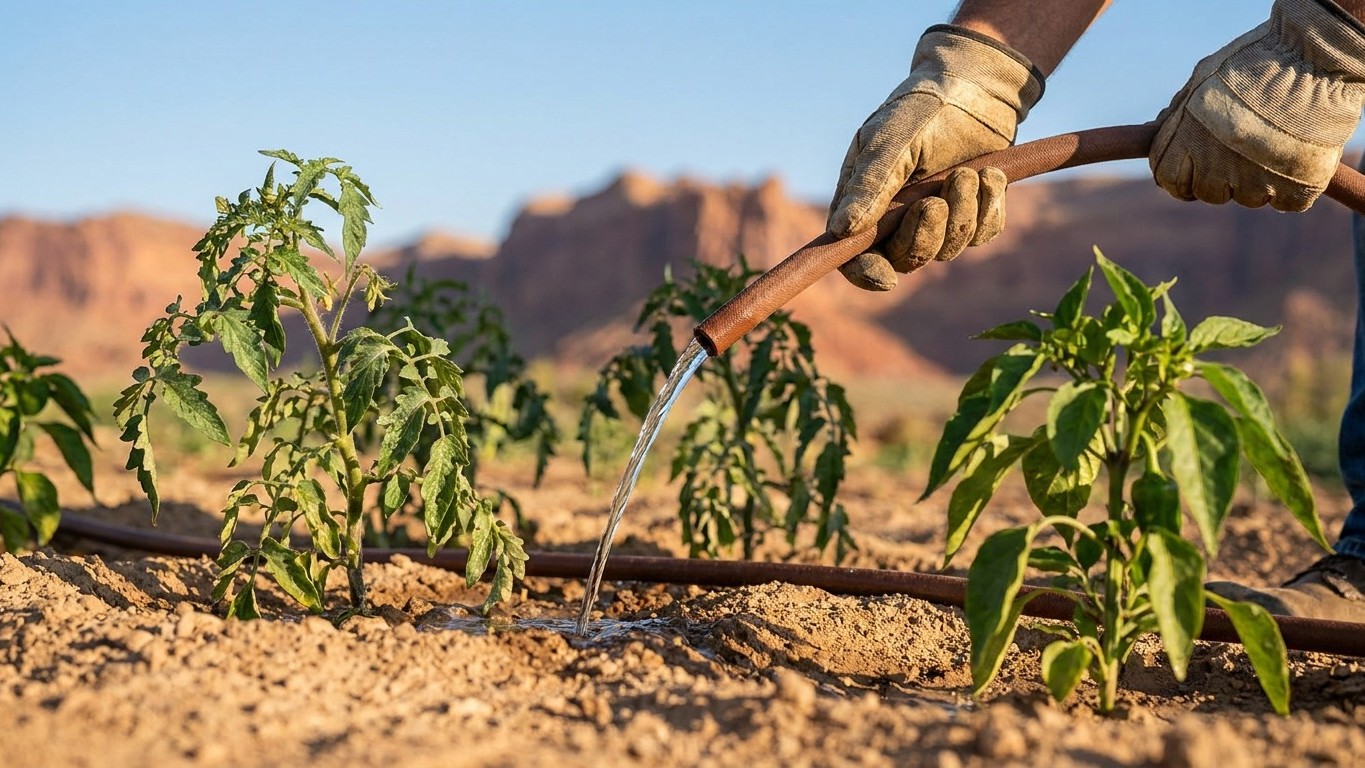

Through Utah’s driest weeks, gardens need roughly an inch of water delivered by hand or by hose, since the sky is offering only a fraction of that. Deep soakings every few days at the base of the plant, timed for early morning, keep roots working while daytime heat pulls moisture out of the soil almost as fast as it goes in.
What changes here

July averages 0.49 inches of rain, the driest month of the Utah summer, while the same reference station logs 52.1 days a year at or above 90 degrees. Put those two numbers side by side and the picture is blunt: the month offering the least water from the sky sits right inside the stretch of the year with the heaviest evaporation load. That’s the month a garden is most on its own.
A vegetable bed or a young perennial generally wants close to an inch of water a week to keep growing without stress. Spread July’s 0.49 inches evenly across the month’s four and a bit weeks and the sky is contributing something like 0.11 inch a week, closer to a passing drizzle than a soaking. That leaves roughly 0.89 inch a week for the gardener to make up with a hose, a can or a drip line, in the same month the air is also pulling moisture back out of the soil at its fastest pace of the year.
How far that supplied inch actually goes depends on what it lands on. On the sandy, gravelly ground common along Utah’s valley benches, water moves through the root zone and drains on within hours, which means smaller amounts applied more often hold up better than one big weekly dose. On the heavier, clay-rich soils found in older irrigated bottomland, that same inch can sit in the root zone for most of a week, useful reserve, but only if the ground gets the chance to dry out between waterings rather than being topped off too soon. Neither soil type makes the arithmetic above optional. It just changes how the water should be broken up.
How to water when it matters
Deep, infrequent watering trains roots to grow downward, chasing moisture that stays in the ground long after the surface has dried out. A quick daily sprinkle never gets past the top inch or two of soil, so roots stay shallow, and a plant with shallow roots has no reserve on the afternoon the thermometer clears 90. Watering at the base rather than overhead sends moisture straight to those roots instead of losing it to evaporation off leaves in dry air, or leaving foliage damp overnight. Morning watering gives the soil surface time to dry before evening arrives, so leaves aren’t sitting wet through the night and the plant enters the hottest part of the day already hydrated rather than playing catch-up.
Checking the soil at root depth matters more than checking the surface. A finger pushed two inches down, or a trowel pulled up for a quick look, tells the real story, the top of the soil can look bone dry an hour after watering while two inches down it’s still holding moisture. On sandy or gravelly ground, that check will show dry more often, which is the cue for shorter, more frequent soakings rather than one long weekly session. On heavy clay, the same check often shows lingering dampness for days, and watering on top of that dampness is how roots end up sitting in water they can’t use, which suffocates rather than feeds them.
One inch of water a week, split across two sessions rather than delivered all at once or dribbled out daily, is a reasonable starting point for most garden soil through Utah’s dry months. It is a starting point only, something to check against what the finger test shows in an actual bed, not a fixed rule that applies the same way to a sandy strip and a clay-heavy corner of the same yard.
- Check moisture two inches down with a finger or trowel before watering; if it’s dry at that depth, water, if it’s still damp, wait another day.
- Water at the base of the plant, at the soil line, rather than overhead, so moisture reaches roots instead of leaves.
- Water in the early morning, before the day’s heat sets in, so the plant carries reserves into the hottest hours rather than losing water to evaporation before it soaks in.
- On sandy or gravelly soil, water in shorter sessions every two to three days, since the ground holds little moisture at a time.
- On heavy clay soil, water once a week in a slower, longer soak, and let the surface dry again before repeating, since clay holds water but drowns roots if watered too soon.
- Start from about one inch of water a week split across two sessions, then adjust based on what the finger test shows in your own bed.
What goes wrong
A little water every day
Daily light watering feels responsible, but it keeps roots parked near the surface, exactly where the soil bakes hardest during a run of 90-degree afternoons. With 52.1 such days a year at the reference station, that shallow root system is asked to survive heat it has no reserves to handle, and it’s often the single costliest habit through a Utah dry spell.
Watering the leaves in the evening
Wetting foliage after sundown leaves it damp for hours with no sun or breeze to dry it. Fungal spores that would otherwise struggle on dry leaves get exactly the window they need, and disease shows up days later with no obvious trigger.
Trusting a rain shower that never reached the roots
July’s 0.49 inches rarely falls as a gentle soak. It tends to arrive as an isolated thunderstorm that wets the top half inch of soil and runs off before it reaches root depth. A shower that looks generous from the porch can leave the ground dry two inches down, which is why the finger test matters more than the memory of rain on the roof.
Skipping mulch under a Utah sun
Bare soil left exposed through 52.1 days of 90-degree heat loses water to the air almost as fast as it’s applied. A layer of mulch slows that loss, keeping the inch just delivered in the ground long enough for roots to actually use it instead of handing it back to the sun by mid-afternoon.
Local help
Utah State University Extension offers site-specific guidance on watering, soil testing and plant selection for local conditions. Watering restrictions, including allowed days and banned hours for irrigation, are set by individual water districts and change from one community to the next. Check with your own water provider before setting a schedule.
Common questions
How much should I water my garden during a Utah dry spell?
Aim for roughly an inch of water a week total, adjusting up on sandy soil that drains fast and down on clay soil that holds moisture longer, and always checking two inches down before adding more.
How often should I water in July, Utah’s driest month?
With the sky contributing only about 0.11 inch a week that month, most of the roughly one inch a week a garden needs has to come from the gardener, split into two to four sessions depending on soil type.
Does mulch really make a difference in Utah’s heat?
Yes. With 52.1 days a year reaching 90 degrees or more, bare soil loses water to evaporation quickly, and a mulch layer slows that loss enough to stretch the time between waterings.
Can I rely on afternoon thunderstorms to water my garden?
Not reliably. Summer storms often wet only the top half inch of soil before running off, so check root depth with a finger rather than assume a storm did the watering for you.