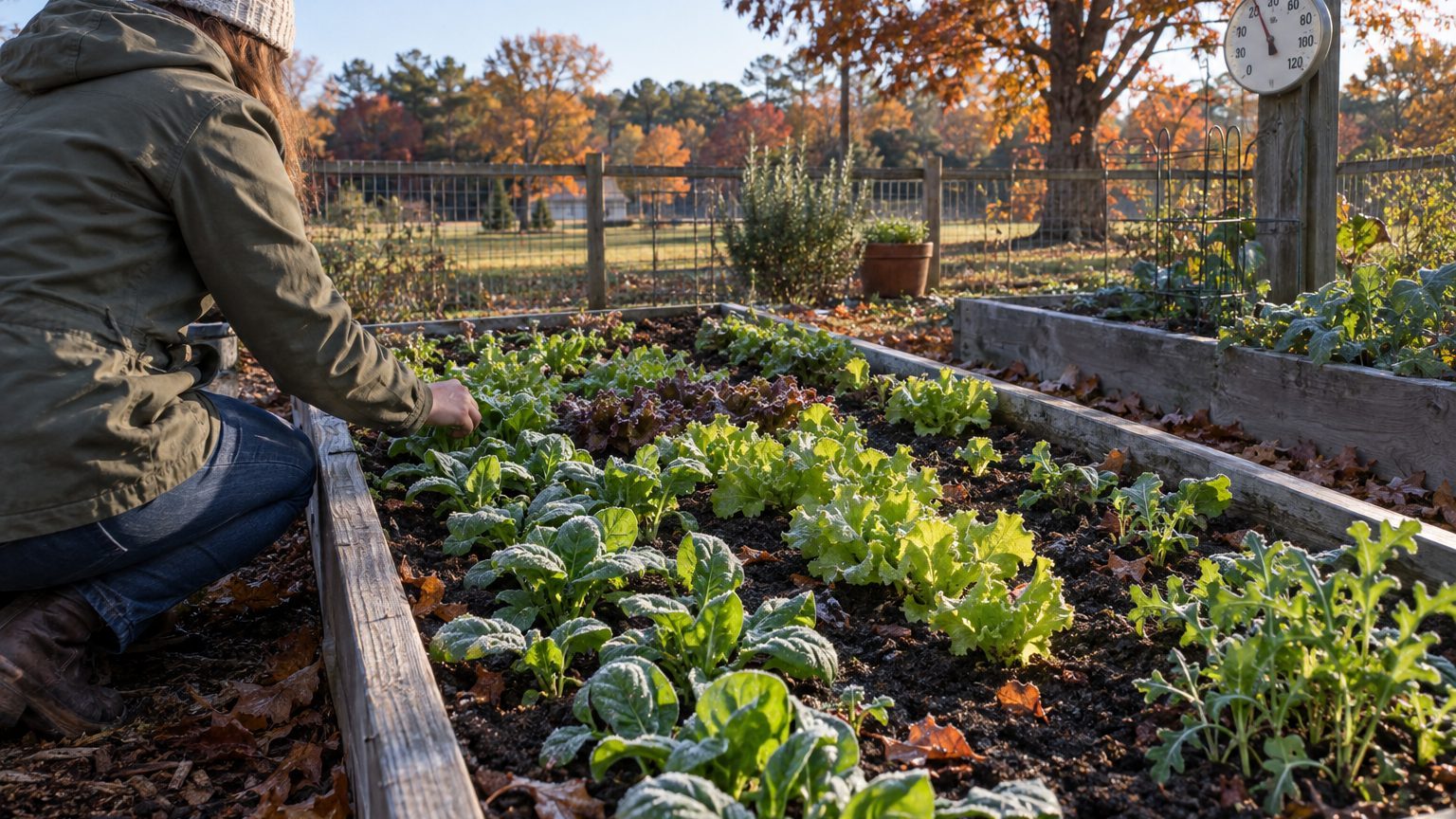

For Salt Lake City, count backward from the first fall freeze, which lands between October 18 and October 29, and sow winter salads before that window rather than after it. Spring sowing, if you want an early crop, lines up with the last freeze window of April 12 to April 29. Those are the Salt Lake valley’s dates. Most of Utah is colder.
The short answer for Utah
Sow winter salads in Utah in late summer, early enough that they have real growth before the fall freeze arrives, and treat early spring as the second window. The anchors for both come from NOAA’s 1991-2020 Climate Normals for the Salt Lake City station (USW00024127): the last spring freeze falls between April 12 and April 29, and the first fall freeze between October 18 and October 29.
What are those dates a probability of? A 32°F freeze, and only that. NOAA publishes the date by which the odds of a freeze at or below 32°F have dropped (spring) or risen (fall) to given levels, and the range quoted here is the 30 to 70 percent band. So April 12 is not “safe” and October 29 is not “late.” Both ends of each range are coin-flip territory, and in any given year the real freeze can land outside them.
Winter salads (corn salad, spinach, claytonia, arugula, mustards, hardy lettuces) are not frost-tender in the way tomatoes are, so the fall date works differently for them. It is not a deadline for keeping plants alive. It is the point after which growth slows hard. A plant sown too late never builds the root and leaf mass to hold through winter, so you end up with seedlings that sit there rather than salad you can cut.
| Marker (Salt Lake City station) | Date range | What it means for sowing |
|---|---|---|
| Last spring freeze (32°F, 30-70% band) | April 12 to April 29 | Spring sowing of hardy salads can begin around and just before this window, once soil can be worked |
| First fall freeze (32°F, 30-70% band) | October 18 to October 29 | Work backward from October 18 to set the latest fall sowing date |
| Mean daily minimum, coldest month | 24.2°F | Typical winter nights go below freezing, so cover decides what survives |
How to count backward
Take the days to maturity printed on the seed packet and subtract them from October 18, the early end of the fall band. A variety rated at 45 days, as an arithmetic example only, points to September 3. Then move earlier, because packet numbers assume spring-style growth, and in autumn the days shorten and plants lag behind the schedule. The earlier you sow within a safe margin, the more cuttings you will get before the plants go dormant.
For a fuller breakdown of which types suit this climate, see The Best Winter Salads for Utah. For the bigger picture of growing salads through the cold months here, Winter Salads for Utah Gardens covers the overall approach.
What will not work here
Slow, full-sized heading crops fail first. Anything that needs a long stretch to mature runs out of calendar when the first freeze arrives as early as October 18. And October 18 is the valley number. A garden that gets its first freeze earlier has even less room, so the same variety that finishes in Salt Lake can stall elsewhere.
Copying Salt Lake dates onto the rest of the state is the second failure. The frost data for this page come from one station on the valley floor. Salt Lake sits in a mild valley, most of Utah is higher and colder, and southern Utah is warmer. This page does not have frost dates for Logan, Park City, Cedar City or St. George. Someone at higher elevation who sows on the Salt Lake schedule will probably be sowing too late. Someone in the warmer south who does the same may be sowing too early, into heat that suppresses germination in lettuce and spinach.
The cold itself is the third problem. The mean daily minimum of the coldest month at Salt Lake City is 24.2°F. That is an average night low, not a record, so many nights will run colder. Winter here is not a grow-outdoors-all-season situation. Hardy greens tolerate a lot of cold, but an uncovered bed of larger lettuces taking repeated nights in the low twenties will look ragged by midwinter. A low tunnel, row cover or cold frame is what separates a bed that keeps producing from one that stops.
Then there is the sowing-into-heat trap. Seed started when the soil is still hot can fail to sprout evenly, and a seedbed in full sun dries out within a day. Give the bed light daily watering for the first stretch, and shade the row with a board or cloth until sprouts show.
Finally, spring sowing is not a substitute for fall. Salads sown in April run into lengthening days and warming soil, and they bolt (send up flower stalks and turn bitter) sooner than the same plants sown in the fall. Spring is for a quick early crop, not for the long winter harvest.
What changes across Utah
Utah does not have a single answer, and the hardiness numbers show why. The USDA Plant Hardiness Zone Map (2023 edition, built on 1991-2020 data) puts the state at 4a to 9a, five full zones from top to bottom. The system is built on one variable only, the average annual extreme minimum temperature, so it says nothing about summer heat or season length. Still, a spread that wide means two Utah gardeners can be working with very different calendars.
Salt Lake City is the reference point here, and the dates above belong to it. Someone in the north or in the mountains should expect to shift earlier in the fall: freeze arrives sooner, and the sowing window closes sooner. At altitude, fast crops such as arugula, mustards and corn salad earn their place, and protection is not optional.
Further south, the shift runs the other way. Fall freezes come later and winters are milder, so sowing can slide later into autumn, and in the warmest areas the main threat flips from cold to heat at germination. The same crop that needs a cold frame in the north may need afternoon shade in the south during the first weeks after sowing.
Look up your zone on the USDA Plant Hardiness Zone Map by ZIP code, and treat the result as one input. Elevation, a south-facing wall, a low spot where cold air pools: each can move a garden by a zone or more from its neighbor’s.
Where to check this for your own county
Utah State University’s land-grant extension program is the right place to go next: Utah State University Extension. It has county offices around the state, and the staff work with local conditions, not statewide averages. Look for a local planting calendar that gives sowing dates for your county, and for any leafy green varieties that have been trialled in your area.
That second item matters more than it sounds. A variety listed as hardy in a seed catalog has usually been tested somewhere else. A trial in your county tells you whether it handled your cold, your wind and your soil. If a county office has a master gardener program or an advice line, ask what has worked for fall-sown greens and what has not.
A county recommendation beats a state one, and this page is the state one. It rests on a single station in the Salt Lake valley and a statewide hardiness range. It can tell you how the calendar works and which direction to adjust, but not the date for your yard. When your county’s extension calendar and this page disagree, go with the extension.
Checking this against your own garden
Your own observation outranks every date above. Two things are worth watching, and neither needs equipment.
- Soil warmth by feel. Push your hand into the bed in the morning. If it still feels warm and dries out fast, germination of lettuce and spinach is at risk, and shade and daily watering help. If it feels cool and damp, you are in good shape.
- The first true leaves. Seedlings first show two seed leaves, then the real leaves. When a fall sowing has its first true leaves before the nights turn cold, it has a good chance of overwintering. If the seedlings are still at seed-leaf stage as freezes begin, your garden’s calendar is later than the one you used, and next year you sow earlier.
Keep a few lines in a notebook: sowing date, when seedlings came up, when you first covered the bed, when you last cut a harvest. After two seasons, that record will be more useful than any statewide calendar, including this one.
Common questions
Can I sow winter salads after the first fall freeze in Utah?
Sowing after the October 18 to October 29 window is a gamble in the Salt Lake valley, and at higher elevations it is a worse one. Seeds may sprout, but growth slows sharply as days shorten, so the plants stay small. Some gardeners sow under a cold frame for tiny early-spring leaves instead of winter harvests, which is a different goal.
What do the frost dates on this page actually mean?
They are NOAA 1991-2020 normals for the Salt Lake City station, expressed as probabilities of a 32°F freeze. The 30 to 70 percent band gives April 12 to April 29 for the last spring freeze and October 18 to October 29 for the first fall freeze. A freeze can still come before or after those dates in any particular year.
Do I need a cold frame or row cover in Utah?
For harvests through the middle of winter, yes in most places. The mean daily minimum of the coldest month in Salt Lake City is 24.2°F. The hardiest greens may survive uncovered, but cover keeps them usable rather than merely alive.
Which hardiness zone is my Utah garden in?
This page cannot say. Utah runs from 4a to 9a on the USDA Plant Hardiness Zone Map, so look yours up on the map itself and then check with your county extension office for the planting calendar that fits it.