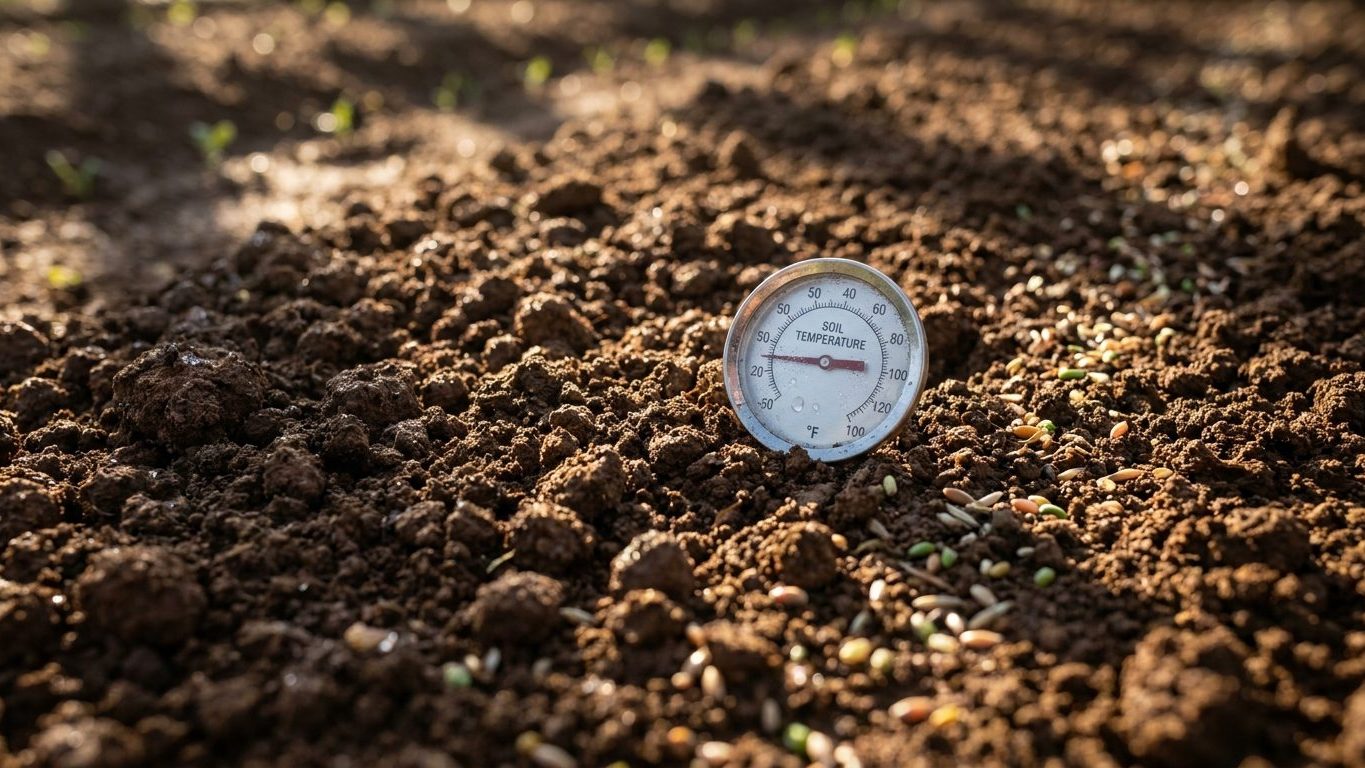

In most of Vermont, cover crop seeding for cool-season species can start once soil temperatures climb into the 50s, typically in mid-to-late May, while warm-season options like buckwheat wait until early June. Fall sowings need six to eight weeks of growth before the first hard frost. The exact window shifts with elevation, so a garden in the Champlain Valley moves weeks ahead of one in the Northeast Kingdom.
When the soil is warm enough in Vermont
Burlington’s last spring frost falls between April 30 and May 10, according to NOAA’s 1991-2020 Climate Normals for station USW00014742. That’s a 30-70% probability band, not a guarantee, and it’s worth saying once: some years the frost breaks the pattern in either direction. Gardeners further from Lake Champlain, up in the Green Mountains or out in the Northeast Kingdom, should expect that date to arrive noticeably later. Burlington sits in the mildest corner of the state, and its frost data doesn’t transfer cleanly to a hillside forty miles east.
Frost date matters, but it’s a stand-in for something else entirely: soil temperature. Air can clear freezing while the ground underneath stays cold and slow. Seeds sown into chilly soil sit and rot before they germinate, so the real question isn’t “has frost passed” but “has the soil caught up.” For most cool-season cover crops, that means waiting until the ground itself has warmed past the mid-50s, which in Vermont usually trails the last frost date by a couple of weeks. Warm-season species that can’t tolerate any cold snap at all, like buckwheat, want the soil warmer still, and gardeners often push that sowing into early June regardless of what the calendar frost date said.
How much seed goes down, and at what rate, depends on the species chosen, the method of broadcasting versus drilling, and the source the seed comes from. That’s not a number this page will guess at. The University of Vermont Extension publishes rate guidance calibrated to the state’s soils and season length, and that’s the reliable source, not a generic figure lifted from a national average.
Termination here is mechanical, not chemical. A cover crop stand gets mowed, crimped, or cut back by hand, or in many cases simply killed by winter cold before spring planting begins. Legumes worked into the mix do return nitrogen to the soil as they break down, but how much depends on the species, how much biomass it built, and when it gets terminated relative to flowering. Rather than attach a number to that process, the honest answer is that the contribution varies enough from one season to the next that a fixed figure would mislead more than it would help.
How long the season lasts here
Subtract the two Burlington frost dates and the growing window runs from around April 30-May 10 in spring to October 3-13 in fall, a stretch of roughly five months at the reference station. That’s a comparatively generous window by New England standards, and it opens options that a shorter season simply doesn’t allow.
With five months to work with, a single garden bed can often support two plantings in one season: an early cool-season cover crop sown right after the soil warms in spring, followed by a summer vegetable crop, followed by a second cover crop sown in late summer or early fall to hold the ground through winter. That second sowing is where a longer season pays off directly, because it turns a cover crop from an afterthought into a working part of the rotation rather than a single bookend.
Shorter growing windows elsewhere in the state change that math. In the Northeast Kingdom or up in the higher elevations of the Green Mountains, where frost arrives later in spring and earlier in fall, the window can be tight enough that a single cover crop planting, timed for fall coverage after the main harvest, is the only realistic option. In that situation, deciding whether to direct-seed or transplant vegetables earlier in spring becomes more important, since every week gained on the front end is a week available for cover cropping on the back end.
Gardeners who want to stack a second sowing into their own five-month window, or figure out whether their local frost dates support it, should look at this site’s succession sowing guide, which walks through timing a second planting once the first crop comes out. The logic scales down from field rotations to a single raised bed without much modification, and Vermont’s Burlington-area window is long enough that most gardeners in the Champlain Valley can make use of it.
Heat and water in Vermont
Extreme heat is not the defining feature of a Vermont summer, and that reshapes which cover crop problems actually show up in the garden. Where other territories spend their cover crop planning worrying about heat stress and drought stress on young seedlings, Vermont’s growing season runs cooler and damper, and that swaps one set of headaches for another: powdery mildew, slower ripening, and fungal disease pressure on crops that sit in humid air without much airflow.
The number that actually governs cover crop decisions here isn’t a summer heat count at all. It’s winter. Burlington’s coldest month averages a daily minimum of 12.9°F, per NOAA’s 1991-2020 Climate Normals, and that single figure decides more about which species belong in a Vermont garden than anything measured in July. A mean minimum in the low teens is cold enough to kill back tender cover crops completely over winter, turning them into a dead mulch layer on the soil surface by spring. Hardier species survive that same cold and keep growing, which means they need to be terminated by hand, by mowing or cutting, before they set seed or get in the way of spring planting.
That distinction flips depending on climate. In a warmer territory, a species that dies back easily in Vermont might overwinter just fine and turn into a weed problem the following spring. In Vermont, the same species is often the easiest choice available, because the cold does the termination work for free. The first fall frost, arriving October 3-13 at the Burlington station, is really what sets the last practical sowing date for a fall cover crop: anything seeded much past that point doesn’t have time to establish enough growth before winter dormancy sets in.
The USDA places Vermont across hardiness zones 3b through 5b, a wide range reflecting how much elevation and distance from Lake Champlain change the local climate. Burlington itself sits toward the milder end of that range, which is one more reason to treat its frost and cold data as a best case rather than a statewide average. Gardeners farther from the lake should assume both a colder winter minimum and a shorter frost-free window than the reference station reports.
Which cover crops suit Vermont
Reasoning from Vermont’s own numbers narrows the field considerably, without ever needing to name a specific variety. A five-month frost-free window at the mild end of the state, paired with a coldest-month minimum near 13°F, points toward species in a few broad categories rather than a single winner.
Cold-hardy cover crop types that survive Vermont’s winter minimum and keep growing into spring make sense where the goal is erosion control and soil coverage straight through to planting time, with termination handled by mowing or cutting once the ground firms up. Species that reliably winterkill at that same temperature suit gardeners who want a self-terminating cover, one that leaves a dead mulch layer by spring without any hand labor at all, which fits Vermont’s cold winters better than it would a milder state where those same species survive and turn into a nuisance.
The humidity and cooler, damper summer air common in much of Vermont also make disease resistance a real consideration, not an afterthought. A cover crop stand that stays damp and tightly packed invites the same mildew and fungal pressure that vegetable gardeners already deal with in a wet Vermont summer, so airflow and spacing matter as much as species selection.
None of that translates into a named cultivar recommendation here, and that’s deliberate. Seed varieties get trialled locally, region by region, and a variety that performs well in a Champlain Valley trial plot may behave differently on a Northeast Kingdom hillside three hardiness zones colder. The only recommendation worth trusting is one built on local trial data, and that’s exactly what the University of Vermont Extension maintains. The same office is the right source for seeding rates calibrated to species and method, since a generic per-acre or per-square-foot number risks wasting an entire season if it doesn’t match local conditions. Naming a brand or a specific seed mix here would substitute a guess for the kind of locally-tested answer a Vermont garden actually needs.