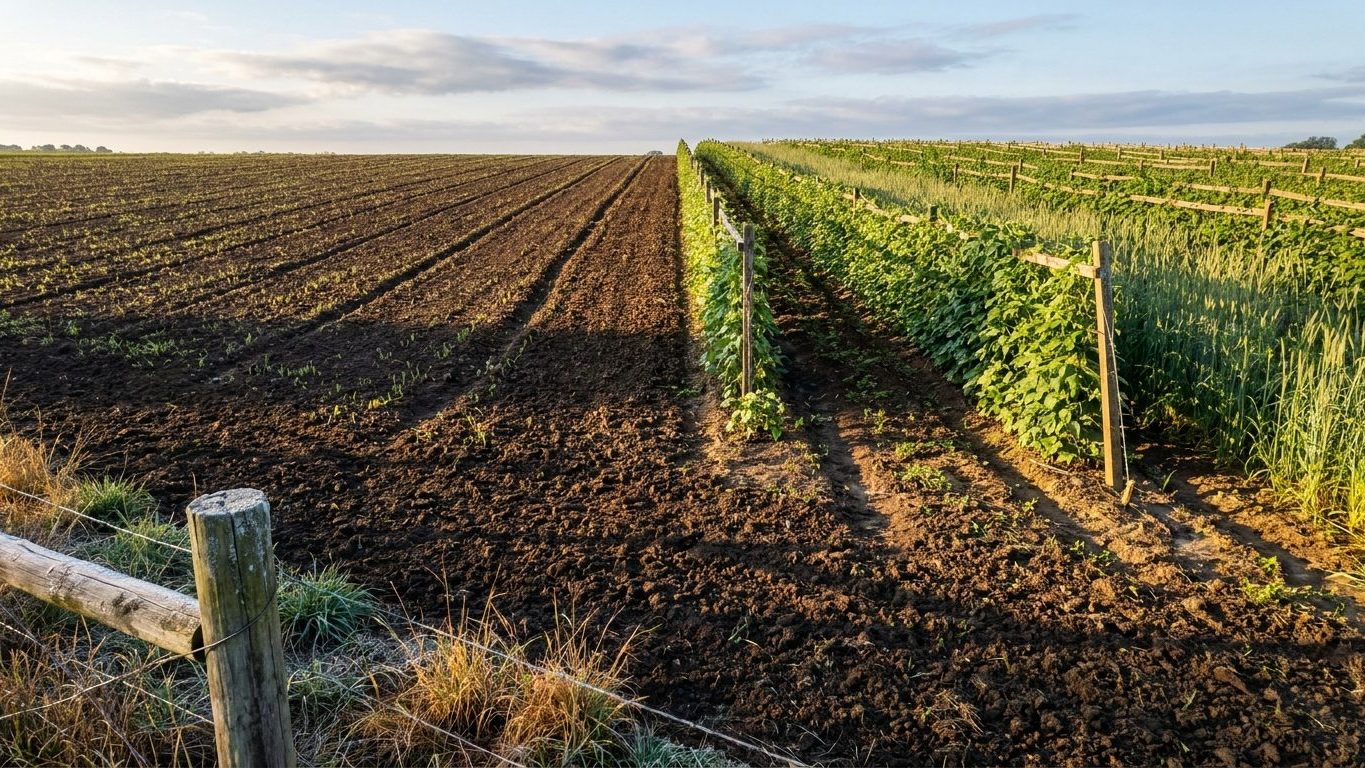

Fall cover crops in Vermont go in the ground between mid-August and the first week of September, timed against the state’s first fall frost of October 3 to October 13. Spring-sown, frost-tender covers wait until after the last spring frost, which lands April 30 to May 10 on the Burlington record. Everything else on this page is about why those windows shift once you leave the shore of Lake Champlain.
The short answer for Vermont
Start with the frost data itself, because it is not a guarantee, it is a probability band. NOAA’s 1991-2020 normals for the Burlington station (USW00014742) put the 32°F freeze risk at 30 to 70 percent between April 30 and May 10 in spring, and the same probability band falls between October 3 and October 13 in fall. That means a frost is genuinely possible on either side of those dates in roughly three years out of ten. Cover crop timing has to build in that margin rather than treat the midpoint as a hard line.
For a fall-sown cover like winter rye, hairy vetch, or crimson clover, the goal is enough top growth and root development before hard freeze to survive winter and hold soil through mud season. Most of these need four to six weeks of active growth before a killing frost settles in. Counting back from the October 3-13 window puts the sowing target at the first week of September for most of the state, with room to push into mid-August if you want heavier fall biomass from oats or field peas that will winterkill on their own.
Spring-sown covers work the opposite direction. Buckwheat, sudangrass, and cowpeas are frost-tender and will not tolerate the last gasp of a Vermont spring. Waiting until after the April 30-May 10 window closes, rather than sowing at the early edge of it, is the safer call given that three-in-ten freeze risk. Oats and field peas tolerate a light frost and can go in a couple weeks earlier than that.
None of this comes from a regional gardening rule of thumb. It comes directly from the Burlington station normals, and Burlington is the mildest reporting point in the state. That caveat matters enough that it gets its own section below.
What will not work here
The coldest month at the Burlington reference station averages a daily minimum of 12.9°F. That single number rules out a category of cover crop before you even get to sowing dates: anything marketed as a winter-hardy legume in warmer states but rated only to zone 6 or above simply will not survive a Vermont winter. Crimson clover, for instance, is a workhorse cover crop in the mid-Atlantic and Southeast, but in much of Vermont it behaves as a winterkill crop rather than an overwintering one. That is not necessarily a failure if you planned for it, but it is a failure if you were counting on spring regrowth and nitrogen release that never comes.
Slow-establishing covers are the other casualty of a short season. Vermont’s frost-free stretch, working from the two frost windows above, runs roughly 146 to 166 days depending on exactly where in the probability bands the actual frosts fall. A cover crop that needs 90 days just to flower, sown in early June after a wet spring delayed fieldwork, can run out of season before it produces the biomass or the weed suppression you planted it for. This is why fast covers like buckwheat, which can bloom in five to six weeks, outperform slower brassicas in a compressed Vermont summer.
Sowing on the assumption that the whole state behaves like the Burlington record is the single most common mistake. The USDA hardiness range for Vermont runs 3b to 5b, a wide spread built on average annual extreme minimum temperatures, not growing season length, but it signals the same thing: a lot of the state is colder than the lakeshore station these frost dates come from. Treating a Champlain Valley sowing date as safe for a hill farm an hour east is how a fall rye planting gets caught by frost before it has rooted in.
Deep planting is a smaller but real failure mode too. Vermont soils are frequently heavy and slow to warm in spring; seed put in deeper than the package recommends, chasing moisture, often rots before germinating in a cold, wet clay seedbed.
What changes across Vermont
A hardiness range of 3b to 5b is not a rounding error, it is close to a three-zone spread inside one small state, and it comes from the average annual extreme minimum temperature, a different measurement than the frost dates used above. What it tells a gardener is blunt: there is no single sowing date for Vermont, only a date for the Champlain Valley and an earlier one for everywhere colder.
The Burlington station sits directly on Lake Champlain, and that lake is doing real work. Large bodies of water release stored summer heat slowly through fall and buffer spring cold snaps, which is why the lakeshore corner of the state consistently posts the latest first-fall-frost dates and the earliest last-spring-frost dates in Vermont. Move away from the water into the Green Mountains, or north and east into the Northeast Kingdom, and both frost dates move against you: spring frost lingers later, fall frost arrives earlier, and the safe sowing window for both spring and fall covers narrows from both ends.
Elevation compounds the effect independent of latitude. A hillside farm at thirteen hundred feet can run measurably colder overnight than a valley floor a few miles away, cold air draining downhill and pooling in low spots, which is its own microclimate wrinkle covered more in the next section. The practical shift for a reader outside the immediate lakeshore is to move fall sowing earlier, toward mid-August rather than the first week of September, and to hold off spring sowing a little longer rather than trusting the state-level date. Shifting your fall sowing target one to two weeks earlier is the simplest adjustment for anyone gardening in the colder two-thirds of the state.
None of this tells an individual reader which of the 3b-5b range applies to their own plot. That requires checking the USDA Plant Hardiness Zone Map directly against a home address, not guessing from a county name.
Where to check this for your own county
Every date on this page comes from one weather station on the shore of Lake Champlain. That is a reasonable statewide anchor, but it is not a county-level forecast, and Vermont’s terrain makes the gap between the two matter more than in flatter states. The University of Vermont Extension, the state’s land-grant extension service, is the next step for anyone who wants a number tied to their own county rather than to Burlington.
Two things are worth hunting for once there. First, a local planting calendar, if the county or regional office publishes one, will already have adjusted for elevation and distance from the lake in a way a statewide frost-date table cannot. Second, look for cover crop variety trial results run in Vermont conditions rather than data pulled from a national seed catalog written for a milder climate. A cover crop bred and tested in Pennsylvania or Ohio carries assumptions about winter survival and season length that do not transfer cleanly to a Northeast Kingdom garden, even if the seed bag lists the same USDA zone.
The honest framing here: a county-specific recommendation from a local extension office will always beat a state-level page, this one included. This article works from the best statewide frost and hardiness data available, but it cannot see your specific frost pocket, your soil drainage, or your elevation. Calling or emailing the county extension office directly is a faster path to an accurate date than extrapolating further from a lakeshore station.
Extension offices also tend to know which seed suppliers stock cover crop varieties actually trialed for New England winters, which matters more in Vermont than in states with a milder hardiness floor.
Checking this against your own garden
Every date above is a normal, an average built from thirty years of records, not a forecast for this particular fall or next particular spring. Your own soil and plants will tell you more about your actual microclimate than any station reading, and none of the following requires equipment you don’t already have.
Soil warmth by feel is the first check, especially for spring sowing. Push a bare hand a couple inches into the bed in the morning; soil that still feels cold and damp, holding winter’s chill, is not ready for a frost-tender cover crop no matter what the calendar says. Waiting for soil that feels closer to room temperature than to refrigerator temperature is a rough but reliable substitute for a soil thermometer.
Watch existing weeds and volunteer plants for their first flush of growth. When lamb’s-quarters, chickweed, or other early germinators start popping up on their own in a given bed, the soil there has crossed a warmth threshold that also suits many spring cover crop seeds. A bed that’s still bare while a neighboring one is greening up is telling you something specific about drainage or sun exposure on that particular patch of ground.
For fall sowing, the first true leaves on whatever you planted are the signal that matters most, not the calendar date you sowed on. A cover crop that’s still at the cotyledon stage a week before the first hard frost hasn’t had the growing window it needed, and that’s useful information for next year’s timing even if this year’s planting struggles. Tracking the date your cover crop shows its first true leaves, year over year, builds a personal record that will end up more accurate for your own yard than any station-wide average.