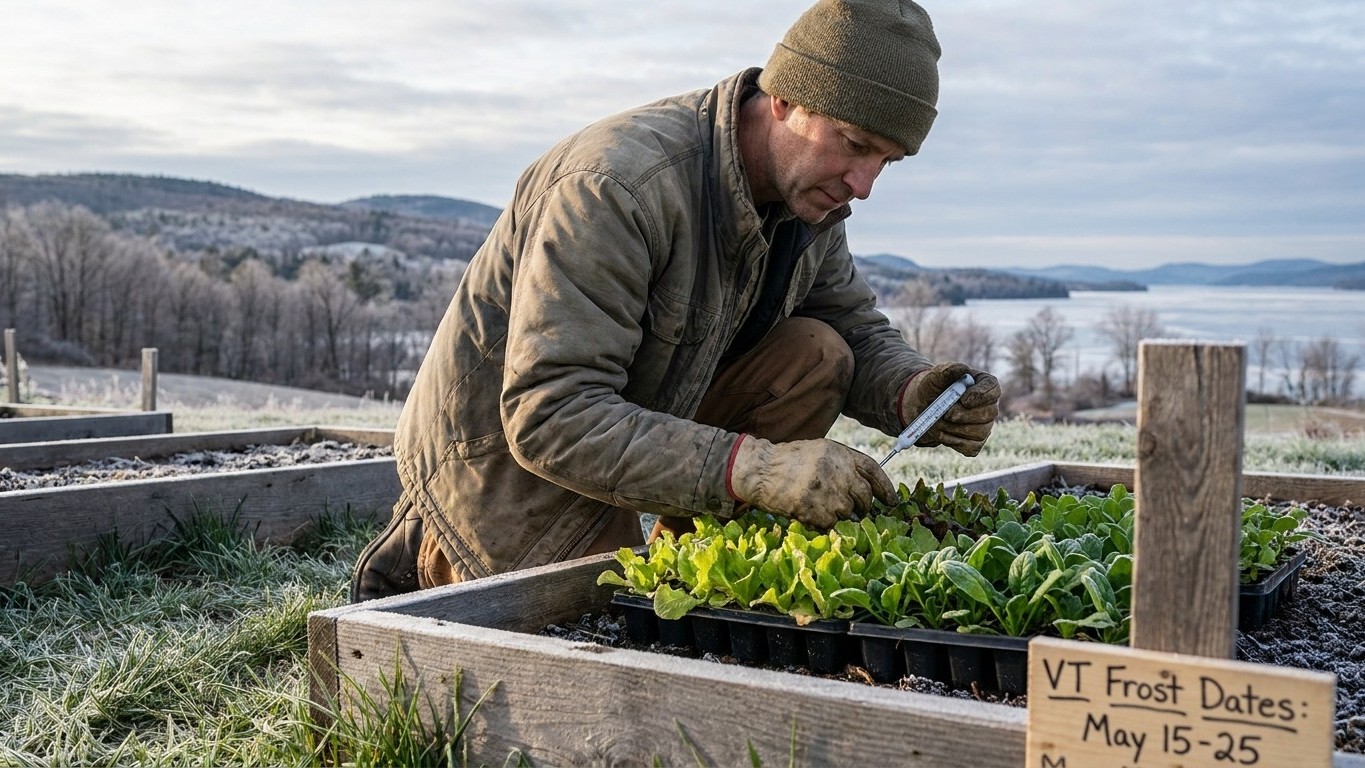

Vermont gardeners work with a short, cool window bookended by real frost risk on both ends. The state spans USDA zones 3b to 5b, and even the mildest corner near Lake Champlain only offers about five months between average frost dates. That number, not the zone map, is what actually decides which crops belong in your plan and which ones you’re gambling on.
How long your season really is

Three figures set the boundaries for everything you plant in Vermont. The state’s hardiness zones run from 3b to 5b under the USDA Plant Hardiness Zone Map, a system built on a single measurement: the average annual extreme minimum winter temperature. At the reference station in Burlington, on the Champlain shoreline, the average last spring frost falls between April 30 and May 10, and the average first fall frost arrives between October 3 and October 13 — a window that also shapes Growing Pumpkins in Vermont and determines When to Carve a Pumpkin in Vermont if you’re growing your own for Halloween.
| Measure | Value |
|---|---|
| USDA Hardiness Zone | 3b to 5b |
| Average last spring frost | April 30 to May 10 |
| Average first fall frost | October 3 to October 13 |
Subtract one date from the other and you get roughly 145 to 165 frost-free days at the reference station. That’s the whole budget. It rules out crops that need a long, steady run of warmth without protection, things like full-season melons or peanuts that Southern gardeners plant without a second thought, though heat-loving crops like peppers can still work with the right head start — see Growing Peppers in Vermont, and warm-season staples like Growing Sweet Corn in Vermont need that same careful timing. It also means anything started from seed outdoors after the last frost date needs to mature well within that window, or it needs a head start indoors — a constraint that’s easier to work around with cool-season staples like Growing Potatoes in Vermont, Growing Carrots in Vermont, Growing Beets in Vermont, Growing Spinach in Vermont, and even Growing Parsnips in Vermont, which actually benefits from a taste of fall frost — or a perennial investment like Growing Asparagus in Vermont that rewards patience for years to come.
Here’s the part that trips people up: those frost dates are averages, not guarantees. NOAA builds them from 30 years of records, and by definition half of those years saw frost later in spring or earlier in fall than the stated date. Planting tomatoes on May 10 because “that’s the last frost date” is planting on a coin flip. A cold snap in late May or an early frost in the third week of September is not rare weather here, it’s just the losing half of the average.
And the state-level range hides real distance. Burlington’s numbers describe the mildest strip of Vermont, right along the lake. Move into the Green Mountains or up into the Northeast Kingdom and the frost-free window shrinks, sometimes by several weeks on each end. Anyone gardening outside the Champlain Valley should treat the dates above as the optimistic case, not the local forecast.
What the summer does to a garden here
Vermont doesn’t get much brutal heat, and that cuts both ways. The reference station averages just 5.4 days a year at 90F or above, a low heat load compared to most of the country. For a lot of crops that’s good news: lettuce, spinach, brassicas and other cool-season vegetables can hold through more of the summer here than they could further south, where a string of 90-degree days pushes them straight into bolting or bitterness.
But low heat load cuts the other direction too. Heat-loving crops, peppers, eggplant, melons, warm-season squash, depend on sustained warm nights to set fruit and ripen on schedule. With only a handful of truly hot days most years, those crops are working against a shorter runway than they’d get in a warmer zone, even within the same frost-free window. A pepper plant that would cruise through a Virginia summer may sit at half its potential yield here simply because the nights rarely get warm enough to push it along.
The winter side of the ledger matters just as much for anything that’s supposed to survive year to year. The coldest month at the reference station averages a daily minimum of 12.9F, and that figure, not the record low and not the monthly average, is what decides whether a perennial, a shrub, or a fruit tree actually makes it through winter here. A plant rated for a zone warmer than what your specific location experiences is a bet against that number, not against the occasional cold snap.
Put together, the shape of a Vermont growing year isn’t one long uniform stretch. It’s a short, cool spring push, a mild midsummer that rarely punishes anything, and a fall that closes down fast once the first frost hits. Gardeners who plan around “hot Vermont summers” are planning for weather the state mostly doesn’t have.
What tends to go wrong in Vermont
The University of Vermont Extension flags a specific set of insects as the ones home gardeners here actually run into, based on Master Gardener and Vegetable and Berry Program reports. A handful of these show up on a predictable schedule, and knowing when to look is more useful than memorizing every pest that’s ever been recorded in the state.
- White grubs (Japanese beetle, European chafer, oriental beetle larvae): active underground in spring and again in late summer/early fall, feeding on lawn and garden bed roots; adult Japanese beetles emerge and skeletonize leaves through midsummer.
- Colorado potato beetle: appears as soon as potato and eggplant foliage emerges in late spring, with larvae stripping leaves through early summer.
- Flea beetles: show up early, right after seedlings and transplants go in, peppering young leaves with small shot-holes just as plants are most vulnerable.
- Spotted wing drosophila: a midsummer to late-summer problem, targeting ripening soft fruit like raspberries and blueberries as they color up.
Vermont’s extension list also includes leek moth, Swede midge, green stink bug, Asian jumping worms, boxelder bug, dark-winged fungus gnats and spongy moth, all pests the state actively tracks. None of these are guaranteed to show up in any one garden. If something’s chewing, boring, or discoloring a specific plant, the fastest path to an answer is identification through your county office, not a guess based on a general list.
Where to check before you plant
Everything above describes Vermont at the state level, anchored to a single reference station on Lake Champlain. That’s useful for a baseline, but Vermont covers real distance in elevation and latitude, and a planting calendar built for Burlington can run three weeks or more ahead of what’s realistic in the Northeast Kingdom or up in the Green Mountains. Treat the frost dates and zone range here as the mild-case scenario, not your local instructions.
The University of Vermont Extension is the land-grant service for the state, and it’s the source behind the pest list and the gardening guidance cited above. Its Master Gardener program and county offices track local frost patterns, pest pressure, and soil conditions at a resolution no state-wide average can match. Before locking in a planting date or picking a variety rated at the edge of your zone, a quick check with your county extension office is worth more than re-reading the state figures. They see what’s actually happening on the ground this season, not what a 30-year average says should happen.