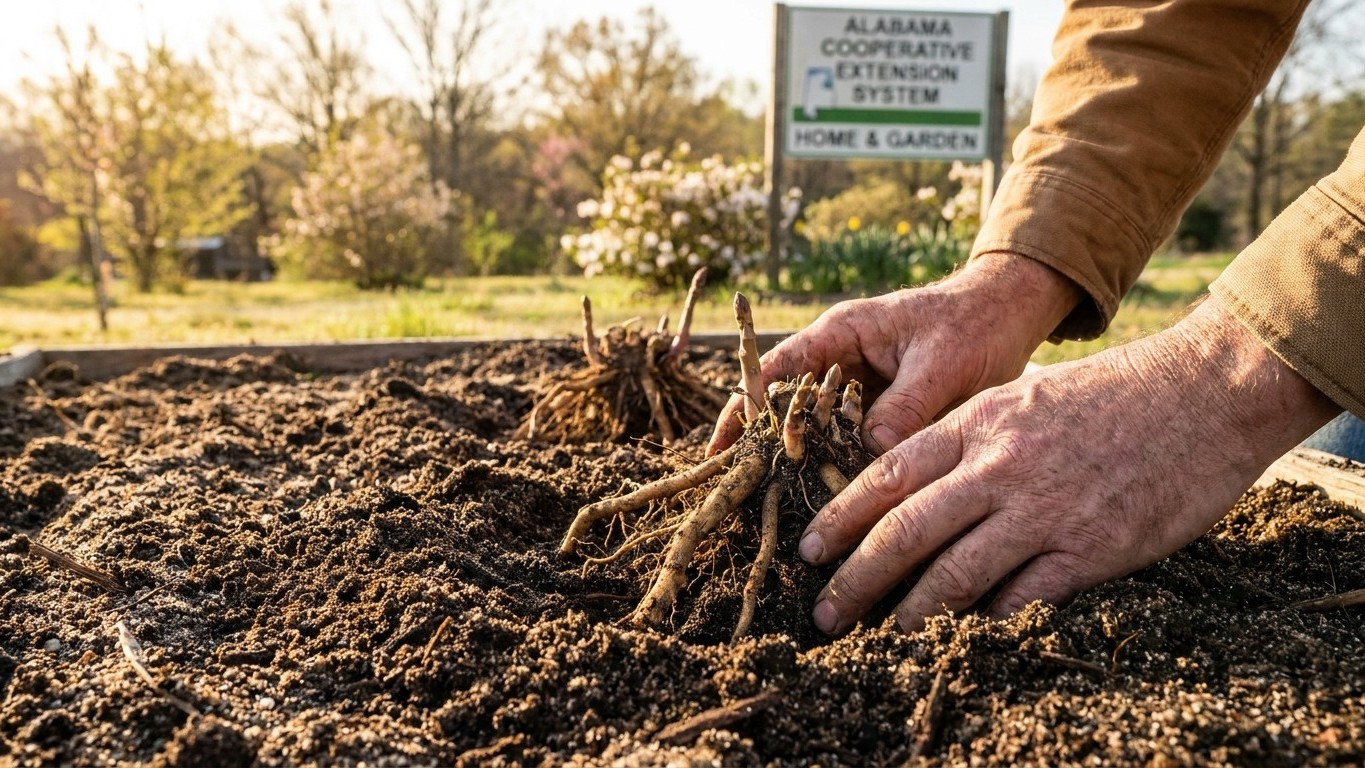

In most of Virginia, asparagus crowns go into the ground in early spring, once the soil has dried out and warmed up after the season’s last hard frost, roughly the tail end of March into early April along the coast, and later inland and in the mountains. But the date is only half of it. Asparagus is one of the few vegetables that, once planted, stays put for a decade or more, which makes the soil under that calendar date the real question.
The short answer
Asparagus crowns are set into shallow furrows, about 8 inches deep, and Utah State University Extension is blunt about what happens after: no harvest at all in year one, none in year two, and only in year three does cutting begin, four weeks that first harvest year, then six weeks, then eight weeks once the planting is fully mature. After that, a well-kept bed keeps producing for 10 to 15 years. That span is the number that should drive every decision made before a single crown touches the soil.
The one soil requirement given for this crop isn’t about fertility, and it isn’t about pH. It’s drainage. Most soils will do, provided they drain well. That’s a low bar, but an absolute one: a bed that sits in standing water for even part of a wet spring will rot crowns that were supposed to still be producing when today’s kindergartner graduates high school.
What Virginia’s ground tends to do
The soil USDA lists as representative of Virginia is the Pamunkey series, an Alfisol, a forest soil of moderate fertility that holds nutrients reasonably well. Its surface layer runs to a loam-to-silt texture, about 50 percent sand, 11 percent clay and 39 percent silt, with organic matter around 1.2 percent and a surface pH near 6.2, slightly on the acid side. Critically for asparagus, it’s classed as well drained.
That’s a favorable starting point for a 15-year commitment. A soil built more of sand and silt than heavy clay sheds water rather than holding it, which is exactly the profile a crown needs sitting under it for over a decade. But the Pamunkey series is one mapped soil standing in for the whole state, not a verdict on any one backyard. River-bottom ground, hill-country clay, and any lot a builder has scraped, graded or filled can behave nothing like it. A gardener unsure what they’re standing on should run a simple check before committing a bed: dig a hole about a foot deep, fill it with water, and time how long it takes to drain. If water is still sitting there hours later, the answer isn’t to skip asparagus, it’s to raise the bed, mounding soil 8 to 10 inches above grade, or work in enough organic matter to open up a heavy structure before the crowns go in, not after.
Will the summer here water it for you?
An Asparagus Bed has a simple watering rule, and it changes as the planting ages: 1 to 2 inches every other week for the first two years while roots are establishing, then 1 to 2 inches every three weeks once the bed matures. Virginia’s summer rainfall comes close to covering that, but not evenly across the season.
Matching rainfall to the bed’s schedule
- Establishment years (year one and two): The bed asks for roughly 1 to 2 inches every two weeks, which works out to somewhere around 2 to 4 inches a month through the growing season.
- June, the driest month: Normal rainfall for June at this reference station runs 4.15 inches for the whole month, enough on paper to cover a young bed’s biweekly need, but only if it falls as gentle, spaced-out rain rather than a single storm.
- July and August, wetter months: July averages 5.76 inches and August 5.09 inches, both comfortably above what a young bed needs in an average month.
- Mature bed (year three onward): Once the every-three-week, 1-to-2-inch rule applies, summer’s roughly 15.0 inches across June, July and August, part of a 46.6-inch annual total, is more than enough on average. The risk shifts from too little water to a soil that rarely gets to dry out between storms.
- Why the monthly total can still mislead: A single thunderstorm that drops 2 inches in an afternoon mostly runs off a loam-to-silt surface rather than soaking down to root depth, so a “wet” month on paper can still leave a bed thirsty for a stretch of days in between.
- The practical fix: A rain gauge on the actual bed, checked weekly, settles the question faster than any regional average. Supplement with a slow, deep soak whenever two weeks pass without close to that 1-to-2-inch mark, especially through June.
When to put the crowns in
Crowns go into the ground in early spring, once soil is workable and the risk of a hard freeze has mostly passed. For the reference station behind these normals, coastal Virginia Beach, the average window for the last spring frost falls around March 20 to April 3, call it late March into the first days of April, since a mean frost date is built from thirty years of records, not a guarantee for any single spring. That coastal window is also the mild end of the state: gardens in the Blue Ridge and southwest Virginia should expect the safe planting window to land weeks later.
Furrows for the crowns run about 8 inches deep, and the roots aren’t buried all at once. Standard practice is to lay the crown in the furrow, cover it with just enough soil to nearly bury it, then fill the furrow in gradually as shoots emerge, adding roughly 2 inches of soil back every other month across the first year until it’s level with the surrounding bed. Rushing that backfill smothers young growth; leaving the furrow open too long exposes tender shoots to a late frost.
Crowns versus seed
Buying crowns is the faster route: a one-year-old crown already carries the root mass a plant needs to reach that year-three harvest. Starting from seed adds time on the front end, since seedlings need to grow to crown size before they can be set out and start that same three-year clock. It’s worth considering mainly for a gardener who wants a specific variety not sold locally as crowns.
Variety options, by sex
Utah State University Extension names four varieties, distinguished only by whether the plant is all-male or a mix of male and female. No flavor, yield or regional preference is published for any of them.
| Variety | Type |
|---|---|
| Jersey Giant | All-male |
| Jersey Knight | All-male |
| UC 157 F1 | Male and female |
| Purple Passion | Male and female |
The source draws no conclusion from that distinction, so treat all four as equally valid choices for a Virginia bed that drains well enough to plant.
Common questions
Can I plant asparagus in clay soil in Virginia?
Only if that clay drains. The soil requirement for this crop is drainage, not texture, and the soil representing the state as a whole (the Pamunkey series) is a well-drained loam-to-silt, not a heavy clay. If a garden’s actual ground holds water for hours after a soak test, raising the bed or working in organic matter before planting is the fix, not skipping the crop.
How long before I can harvest asparagus after planting crowns?
No harvest happens in year one or year two. Cutting starts in year three, for four weeks that first harvest year, then six weeks the following year, then eight weeks once the bed is fully mature.
How do I know when to stop cutting each spring?
Stop when most of the spears coming up are thinner than a pencil, a sign the crown’s stored energy for that season is running out. It isn’t tied to a fixed week count; a strong, established bed can hold a full eight-week harvest, while a younger or stressed one may signal it’s done sooner.
Should I plant crowns or start from seed for a Virginia bed?
Crowns are the faster path to that year-three harvest, since they already carry a year’s worth of root growth. Seed adds an earlier stage: seedlings first need to reach crown size before the same three-year clock even starts, which mainly makes sense for a gardener chasing a variety not available locally as crowns.
Some gardeners also time this by the Moon: when to plant asparagus by the moon, as almanac tradition rather than fact.