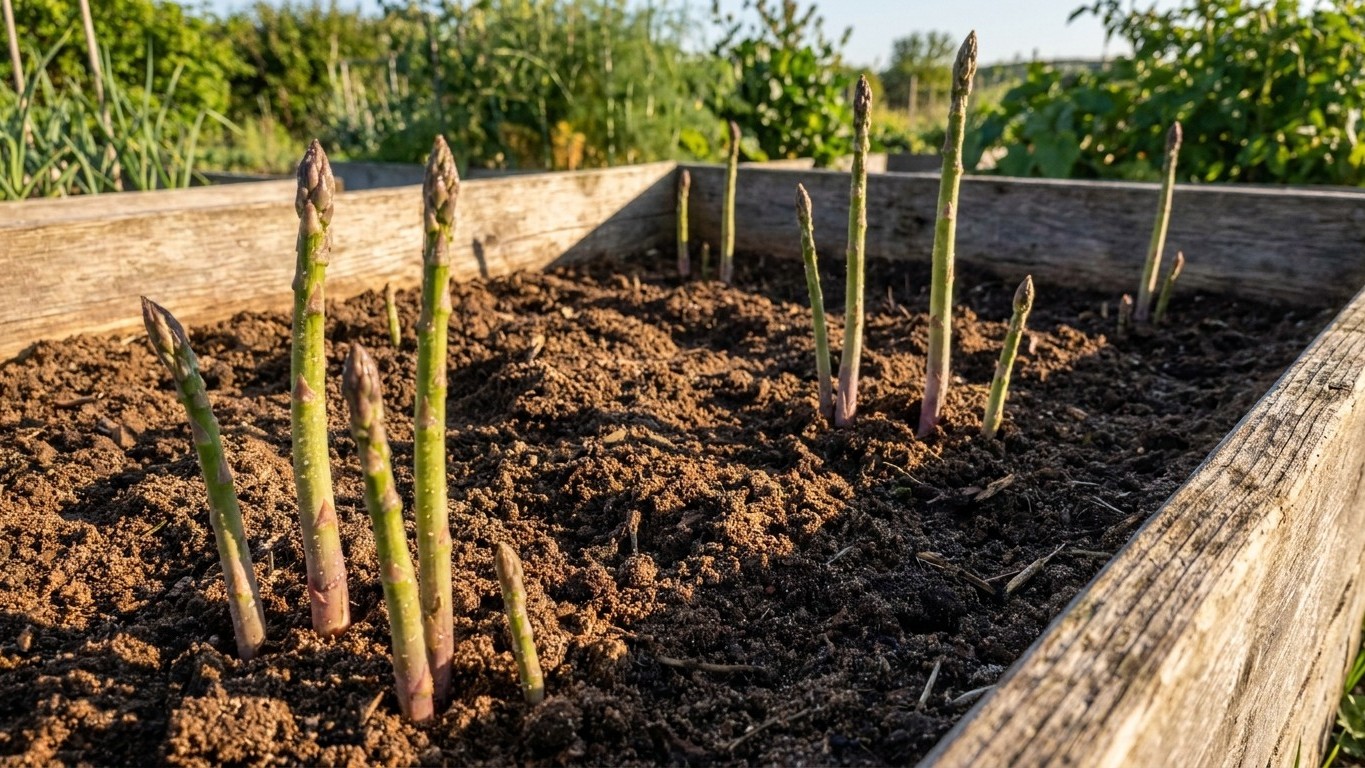

Yes, in most of Virginia the ground under a proposed asparagus bed will hold up for the full ten to fifteen years the crop expects, because the soil USDA treats as representative of the state is well drained by its own classification. That’s the only requirement the University of Utah Extension attaches to asparagus. Whether any one backyard matches that representative soil is a separate question, and it’s worth checking before the crowns go in the ground.
The short answer
USDA’s benchmark for Virginia is the Pamunkey series, an Alfisol built from about 50 percent sand, 11 percent clay and 39 percent silt in its surface layer, with organic matter around 1.2 percent and a surface pH near 6.2. USDA lists it as well drained. That single word carries more weight than the exact texture numbers, because Utah State University Extension’s guidance on asparagus is almost indifferent to soil type: “most soils will do provided they are well drained.” A loam with this much sand in the mix sheds excess water rather than holding it around the crowns, which is exactly what a plant meant to stay put for a decade and a half needs.
That matters here more than it does with almost anything else grown in a home garden. An annual vegetable that sits in soggy clay for one bad season is a nuisance you fix next year with a different bed. an Asparagus Bed sited in the same soggy clay is a mistake that follows the gardener for ten to fifteen years, because established crowns aren’t easily moved once they’re producing. The site decision, unusually, is close to a permanent one.
None of this means every Virginia garden sits on Pamunkey soil, or anything like it. The Pamunkey series is USDA’s representative pick for the state, drawn from an average of its mapped components, not a survey of individual back yards. River bottom ground tends to run heavier and wetter. Ground in hill country can be shallower and rockier. And any lot where a builder scraped topsoil and brought in fill dirt may drain nothing like the natural profile this series describes. The organic-matter figure here, at 1.2 percent, reads as ordinary cultivated topsoil rather than a peaty or boggy layer, which is a reasonable sign for a garden bed, but it’s still a regional average and not a reading of any specific plot.
What a gardener actually does with this information is simple. Dig a hole roughly a foot deep after a rain, fill it with water, and time how long it takes to drain. If water is still standing after several hours, the ground is holding onto moisture the way a heavier soil would, whatever the regional average says. In that case the fix isn’t giving up on asparagus, it’s raising the bed, working in extra organic matter over a season or two, or shifting the planting a few feet to higher, sandier-feeling ground on the same property. A soil test through a local extension office will also confirm what’s actually under a specific bed, rather than what a statewide series suggests it might be.
Will the summer here water it for you?
Asparagus has a fairly specific watering rhythm, and it changes as the bed matures. In the first two growing seasons, when crowns are establishing roots, the guidance calls for 1 to 2 inches of water every other week. Once the bed is producing, from the third year on, that eases to 1 to 2 inches roughly every three weeks. Whether a gardener needs to run a hose depends entirely on whether summer rain is filling that gap on its own.
- Young bed, first two years: the target averages out to roughly half an inch to a full inch of water per week. Reference-station data for the region puts June rainfall at 4.15 inches for the month, July at 5.76 inches and August at 5.09 inches, which spread over roughly four-week months works out to something close to 1 to 1.3 inches per week on average. On paper, that meets or beats the young bed’s need most weeks.
- Established bed, year three onward: the lower target, around a third to two-thirds of an inch weekly, is comfortably covered by that same average rainfall in a typical June, July or August.
- The catch is distribution, not total volume. Summer rain in this region tends to arrive as thunderstorms rather than a steady drizzle, and a single downpour running off a dry bed doesn’t soak in the way a slow, even rain does. June is the driest of the three summer months at 4.15 inches, so it’s the month most likely to leave a young bed short if the rain comes as one or two big storms instead of several smaller ones.
The practical habit worth building is checking a rain gauge on the actual property every week or so through summer, especially in the bed’s first two seasons. If a week has passed with under half an inch recorded locally, that’s the signal to run a hose rather than trust the monthly average, since a regional normal from 1991 through 2020 describes what a season usually does, not what it did last Tuesday.
When to put the crowns in
Asparagus crowns go into the ground in early spring, set into furrows about 8 inches deep. In this part of Virginia, the mean date of the last spring frost falls somewhere around March 20 to April 3, based on 1991-2020 freeze-probability data from the coastal reference station near Virginia Beach. That’s a mean, not a guarantee, so “around” is doing real work in that sentence: some years will run colder later into spring, others will warm earlier, and a gardener working from this window should still watch the local forecast before committing crowns to open furrows.
It’s also worth remembering that this frost window describes the mild end of the state. Virginia Beach and the coastal plain warm up earlier than inland Virginia, and gardeners in the Blue Ridge or in the southwestern part of the state should expect their own last frost to land noticeably later, which pushes the planting window back by weeks rather than days. Nothing in the published data here supplies an exact adjustment for those regions, so a local extension office remains the better source for a frost date specific to higher elevation or inland ground.
Once crowns are set into that 8-inch furrow, the furrow isn’t backfilled all at once. The recommended approach fills it in gradually over the course of the year, adding about 2 inches of soil roughly every other month as the young shoots grow, rather than covering the crowns completely on planting day. That staged backfilling gives the emerging spears room to push through loose soil instead of forcing their way up through a deep, compacted fill.
Seed is the alternative route, though it asks for more patience. Starting from seed adds time before the plant reaches the size of a purchased crown, which pushes the whole schedule, including the first harvest, further out. Most home gardeners choose crowns for exactly that reason: a one-year head start on a crop that already asks for a three-year wait before the first cutting.
Common questions
How long until an Asparagus Bed can actually be harvested?
Not in the first year, and not in the second. Utah State University Extension is specific on this: no harvest at all until the third year. Cutting spears earlier weakens the crowns before they’ve built the root reserves the bed depends on for the following decade of production.
Once harvest starts, how long does the cutting season run?
It builds gradually rather than opening at full length. The third year’s harvest window runs about 4 weeks, extending to roughly 6 weeks the following year, then to about 8 weeks once the bed is fully established. The signal to stop cutting for the season isn’t a date on the calendar, it’s the spears themselves: when most of what’s coming up is thinner than a pencil, that’s the bed telling you to let it grow into fern for the rest of the season instead of continuing to cut.
Which asparagus varieties are worth planting?
Utah State University Extension names four: Jersey Giant and Jersey Knight, both all-male varieties, and UC 157 F1 and Purple Passion, which are male and female. The source doesn’t rank them on flavor or yield, and it gives no reason to prefer one over another, so that choice comes down to what’s available locally rather than a documented performance difference.
Does Virginia soil need a pH adjustment before planting asparagus?
There’s no published pH target for asparagus in the source used here, so no specific number should be treated as a rule for this crop. The Pamunkey series carries a surface pH around 6.2, but that describes the state’s representative soil series, not any individual garden, and it isn’t a substitute for testing the actual bed. A standard soil test through a local extension office remains the way to know what’s under a specific plot before committing it to fifteen years of asparagus.