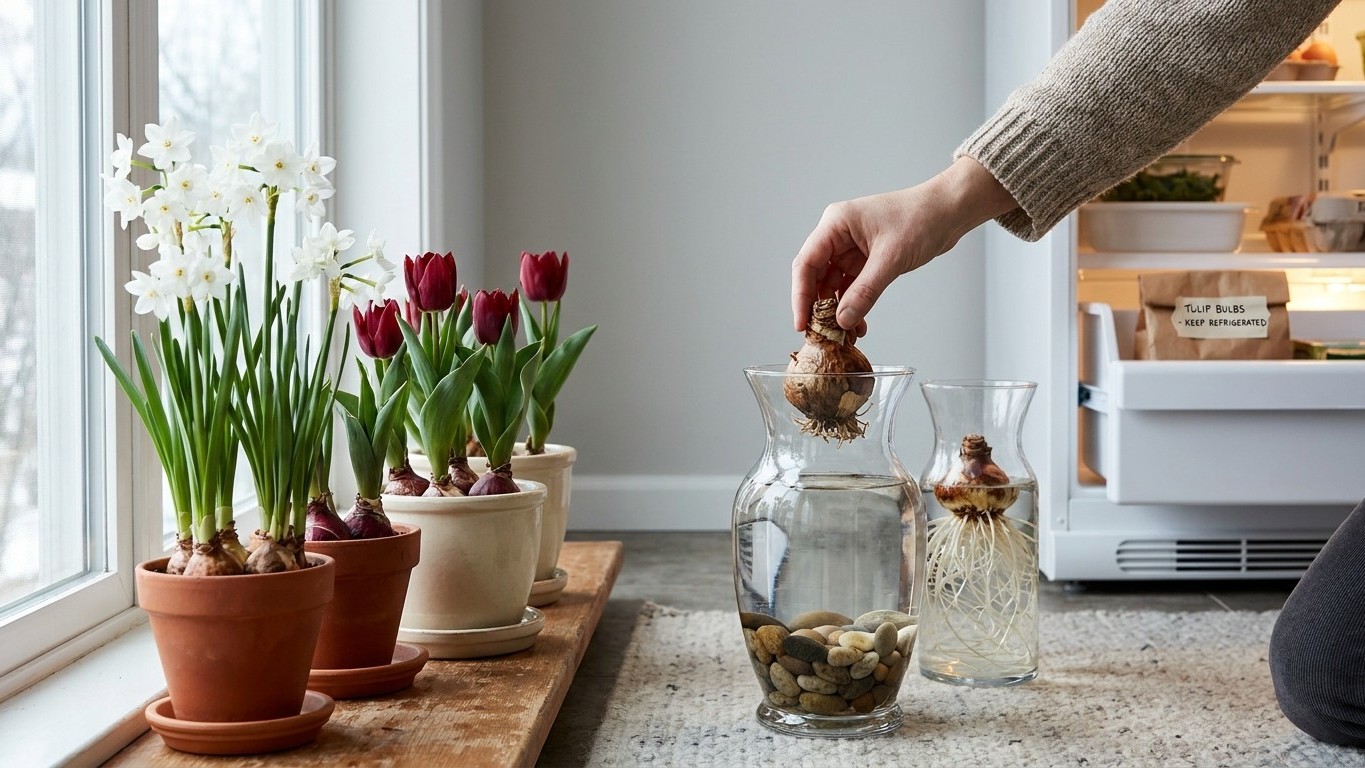

Forcing spring bulbs indoors in Washington means chilling them artificially, in a refrigerator drawer or an unheated space, for the twelve to fourteen weeks a bulb needs below 45°F, then bringing them into warmth and light to bloom on the gardener’s schedule instead of the calendar’s. Seattle’s winters already deliver enough cold for garden beds. Indoors, forcing is about timing and control, not about rescuing a bulb from a climate that lacks winter chill.
Why this matters in Washington

The mean daily minimum temperature during the coldest month at the Seattle reference station runs 37.1°F, according to NOAA NCEI Climate Normals for 1991-2020. That number matters because a spring bulb needs roughly twelve to fourteen weeks with temperatures under 45°F to break dormancy and set up flowering. At 37.1°F, western Washington’s winter sits comfortably below that ceiling. A tulip or crocus planted in a garden bed near Seattle gets its chilling requirement met by the ground itself, without any help from a gardener.
That changes what “forcing” actually solves here. In a genuinely mild-winter climate, forcing indoors compensates for a season that never gets cold enough on its own. Washington isn’t that. Forcing here is a scheduling tool: it lets someone move the bloom date indoors, ahead of when the same bulb would flower outside, and enjoy color during the gray stretch of the year when little else in the yard is doing anything. The bulb doesn’t need the fridge or the garage to survive. It needs it to bloom on demand, in a pot, on a windowsill, weeks before its outdoor cousins even break ground.
Containers flip the problem. A pot sitting outside all winter freezes clear through, roots and all, in a way garden soil rarely does, since the ground insulates itself and only the top layer typically freezes hard. The USDA Plant Hardiness Zone Map (2023, built on 1991-2020 normals) puts Washington across an enormous range, from 4a to 9a. That spread covers everything from cold interior valleys and higher elevations to the milder pockets around Puget Sound. A bulb rated hardy for a zone 6 bed can die in a zone 6-rated pot left outdoors in a colder part of that range, because the container offers none of the insulation the ground does.
So the practical takeaway splits in two directions depending on what a reader is actually trying to do. Anyone forcing bulbs to bloom indoors in a heated home doesn’t need to worry about Washington’s winter being too mild, it’s cold enough. Anyone trying to overwinter a potted bulb outdoors, without bringing it inside, is the one who needs to think hard about which part of that 4a-9a range they’re standing in.
How to do it here
The steps below assume the goal is an indoor bloom, not an outdoor container left to fend for itself through winter.
- Pick the bulb and count backward from the date a bloom is wanted. Most spring bulbs need twelve to fourteen weeks of cold below 45°F before they’re ready to grow, plus another two to three weeks of warmth to finish opening.
- Pot the bulbs in a shallow container with drainage holes, using fresh potting mix rather than garden soil. Set the noses just at or slightly above the surface, and space bulbs close but not touching.
- Water once, thoroughly, until it runs out the drainage holes, then let the pot drain fully before moving it.
- Find the cold spot and check it with a thermometer rather than guessing. A refrigerator crisper drawer works reliably, but keep it away from ripening fruit, since the ethylene gas fruit gives off can kill the flower bud forming inside the bulb before it ever emerges. An unheated garage can also work, provided it stays above freezing; in the colder stretches of the state’s hardiness range, that’s worth confirming rather than assuming.
- Check the pot weekly through the chilling period and keep the mix lightly moist, never soggy, the entire time.
- Around the twelve-week mark, look for roots showing through the drainage holes and a pale shoot an inch or two tall. That’s the signal the chilling requirement has been met, not a fixed date on a calendar.
- Move the pot to a cooler, dimmer spot indoors for about a week to let the shoot green up gradually, then set it in full light at normal room temperature. Bloom typically follows within two to three weeks.
- If the plan is instead to overwinter a potted bulb outdoors rather than force it, the pot needs to behave as if it were rated at least two USDA zones hardier than the bulb itself, or it needs to be moved into an unheated garage and mulched heavily for the winter.
Which bulbs are worth it
Not every bulb rewards the effort of a twelve-week wait in a refrigerator drawer. The ones that force well tend to have short chilling requirements, sturdy short stems, or both. The ones that sulk usually ask for a longer chill, grow tall enough to flop over in a lightweight pot, or simply weren’t bred with container life in mind.
Bulbs that force reliably here
- Paperwhite narcissus: no chilling period required at all, blooms in three to four weeks straight from potting, and since it’s rarely hardy outdoors in most of Washington anyway, it’s a one-season purchase regardless. Forcing it costs nothing in the long run.
- Hyacinths: a strong fragrance, a short sturdy stem that stands up in a pot without staking, and a chilling window in the twelve to fourteen week range.
- Crocus: short stems, a shorter chilling requirement than most tulips, and good results in shallow bowls.
- Muscari (grape hyacinth): compact, reliable, and forgiving of slightly uneven chilling.
Bulbs that tend to sulk
- Tall trumpet daffodils: long stems that flop without staking once brought into a warm room.
- Darwin hybrid tulips: a long chilling requirement, often fourteen to sixteen weeks, paired with a tall stem that struggles in a lightweight indoor pot.
- Large ornamental alliums: both the height and the chilling demand work against a container timeline.
What goes wrong, and when you can still fix it
Leaves but no flower
This means the chilling period was cut short. Leaf growth needs less cold than flower formation, so a bulb can push green growth even when the flower bud inside never finished developing. There’s no fix this season. Let the foliage grow, let it die back naturally, and if the species is hardy outdoors in the reader’s part of Washington, plant it in the garden rather than trying to force it again next winter.
A flower on a stem too short to see
This happens when the bulb was moved into warmth and light before the chilling weeks were fully logged. The stem-elongation phase gets cut off early, so the flower opens low and half-hidden among the leaves. Nothing brings the stem back up once this happens. Let the bloom finish for what it’s worth, then treat that bulb as spent for forcing purposes going forward.
Rot in the pot
Rot during the long chilling weeks almost always traces back to drainage, either no drainage holes, or a pot left standing in a saucer of water for weeks at a time. Once the bulb base has gone soft, it’s finished for this season, there’s no rescuing it. The fix applies only to the next attempt: drainage holes, and a pot that never sits in standing water during the chilling period.