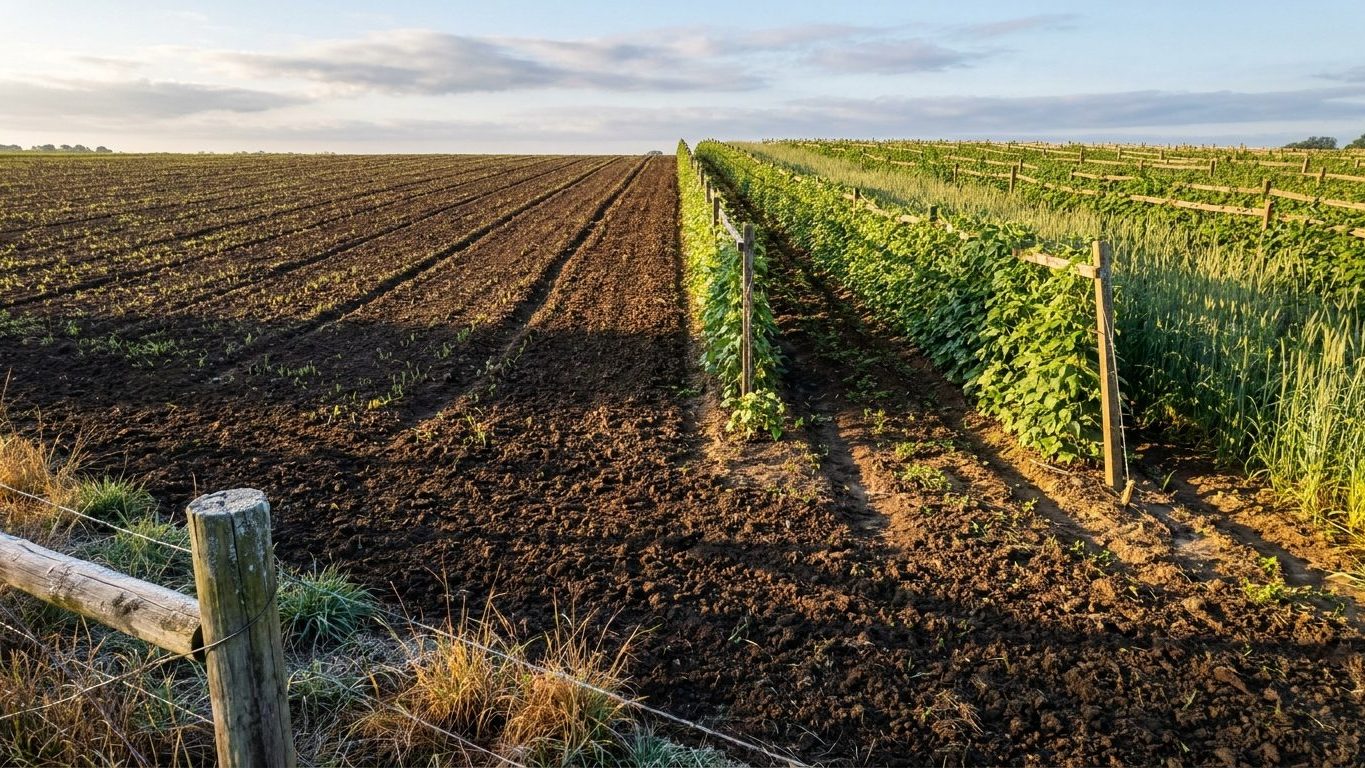

Virginia gardeners get one clear planting target: mid-August through mid-October for fall cover crops like cereal rye and crimson clover, timed to establish before the first fall frost. Spring seeding exists too, but it’s the secondary window here, not the primary one.
The short answer for Virginia
Sow cereal rye, crimson clover, or hairy vetch between August 15 and October 15, giving the crop at least four to six weeks of root and top growth before the ground goes cold. That target comes directly from the first fall frost window for this region: November 10 to November 24, based on NOAA’s 1991-2020 Climate Normals at the Oceana station near Virginia Beach. This is a probability band, not a single date. NOAA calculates it from decades of 32°F freeze records, and the range marks where the odds of a freeze fall between 30 and 70 percent on any given day. Sow after mid-October and you’re racing a coin flip you can’t control.
Fall window vs. spring window
Spring sowing exists for a narrower set of crops, mostly oats and field peas planted as a quick soil-builder ahead of summer vegetables. The relevant marker there is the last spring frost window, March 20 to April 3 at the same station. Because that window sits so early in the year, soil is often still too wet and cold in the Coastal Plain to work it properly, let alone in the Piedmont or mountains where frost lingers weeks longer. Most Virginia growers skip spring cover cropping altogether and instead terminate whatever was seeded the previous fall, then plant directly into the residue. If you do sow in spring, treat the frost window as your starting gun, not a guarantee that the soil is ready. Check workability first; the calendar date is secondary to what the dirt actually tells you.
Either way, the frost dates cited here are specific to the Oceana reference station near the coast. They describe the mildest part of Virginia’s climate. Inland and upland growers need to shift both windows earlier in fall and later in spring, a point covered in more detail below.
What will not work here
The biggest mismatch in Virginia is winterkill that doesn’t happen. Growers pick oats specifically because a hard freeze is supposed to kill the crop over winter, leaving a clean mat of residue by spring with no tillage or herbicide needed. That plan depends on cold. But the mean daily minimum temperature in Virginia’s coldest month sits at just 31.6°F at the reference station, barely below freezing on an average night. In the milder Coastal Plain and Tidewater counties, oats can limp through winter instead of dying outright, leaving a green, seeding mess that competes with whatever gets planted next. If you’re counting on winterkill for termination, treat it as a possibility, not a plan, and have a mower or crimper ready as backup.
Late sowing is the second failure point. Hairy vetch and crimson clover need real time, generally four to six weeks of active growth, to build the root mass that gets them through winter and produces the nitrogen payoff in spring. Sow in late October instead of September and you’re asking a slow-establishing legume to root itself in soil that’s already cooling toward the November frost window. The plant survives some years and dies back to almost nothing in others, and there’s no way to tell in advance which year you’ll get.
Virginia’s humid summers create a third problem that has nothing to do with cold. Dense, closely spaced seeding of clover or vetch, the kind of rate that works fine in a drier climate, traps moisture at the soil surface long enough for fungal disease to take hold before the crop even canopies. Widening the row spacing or dropping the seeding rate a notch costs you a little biomass, but it costs less than losing a stand to damping-off in a wet September. Anyone treating this state’s summer humidity like a minor detail is setting up a fall replant.
What changes across Virginia
Virginia is not one growing climate. The USDA Plant Hardiness Zone Map places the state across a spread of 5a to 8b, built entirely on average annual extreme minimum temperature. That’s one of the widest internal ranges of any state on the East Coast, and it means a single sowing date is close to useless without knowing where in that range a given county sits.
| Region | Approximate zone character | What shifts |
|---|---|---|
| Coastal Plain / Tidewater | Warmer end, near 8a-8b | Longest fall window, latest frost, mildest winters |
| Piedmont | Mid-range, roughly 7a-7b | Frost arrives noticeably earlier than the coast |
| Blue Ridge / Southwest highlands | Cooler end, down to 5a-6a | Spring frost lingers weeks longer, fall frost comes weeks sooner |
The practical effect: a gardener at higher elevation in the southwest or along the Blue Ridge should shift the fall sowing window earlier, often by two to three weeks compared to the coastal dates above, and should expect spring soil to stay workable later into April. None of the frost or zone data cited here can tell an individual reader which zone their own property falls into. The zone boundaries follow elevation and terrain closely enough that two farms ten miles apart can sit in different bands. Checking the current USDA hardiness zone map by ZIP code is the only reliable way to place your own garden inside this spread, rather than assuming the coastal figures above apply everywhere in the state.
Where to check this for your own county
Virginia Cooperative Extension, run jointly by Virginia Tech and Virginia State University, is the authority to check next: ext.vt.edu. State-level frost windows and hardiness zones, the kind covered on this page, describe averages across the whole commonwealth. A county-level recommendation from Extension will almost always beat that, because it accounts for local elevation, soil type, and the specific varieties that have actually been trialed nearby.
Look for two things once there. First, a local planting calendar, if the county office publishes one, that adjusts the fall sowing window for local frost timing rather than the coastal dates used here. Second, variety trial results or recommendations specific to cover crops grown in that county’s soil and rainfall pattern, since a legume that performs well in sandy Tidewater soil can behave differently in Piedmont clay. Extension services generally organize their guidance by crop type rather than issuing one blanket calendar for every planting, so search specifically for cover crops or small grains rather than a generic gardening calendar that may not cover them at all.
This page gives the state-level picture: the frost probability bands, the hardiness zone spread, the failure points tied to Virginia’s humidity and mild winters. It’s a starting point for planning, not a substitute for what your county office knows about the specific fields nearby. If county-level guidance is available and it conflicts with the dates above, follow the county guidance. It’s working from finer-grained data than a single coastal reference station can provide.
Checking this against your own garden
No calendar substitutes for what the soil and the plants are actually doing on your own property, and three simple checks tell you more than any date range. First, feel the soil itself before sowing. Ground that’s still cold and clumps in a tight, wet ball when squeezed isn’t ready for seed no matter what the calendar says; soil that crumbles and falls apart is workable. Second, watch for winter annual weeds germinating nearby, chickweed and henbit are common ones in Virginia. Their emergence is a rough biological signal that soil temperatures have dropped into the range where cover crop seed will germinate too, and it often lines up with your specific microclimate than a regional frost date does.
Third, once the cover crop is up, check for the first true leaf pair forming on seedlings, not just the initial sprout. That stage tells you the plant has moved past its most fragile point and is building the root system that determines whether it survives winter. If true leaves haven’t formed within two to three weeks of sowing, the planting went in too late or into soil too cold to support fast growth, and it’s worth noting for next year rather than assuming this year’s stand will catch up.