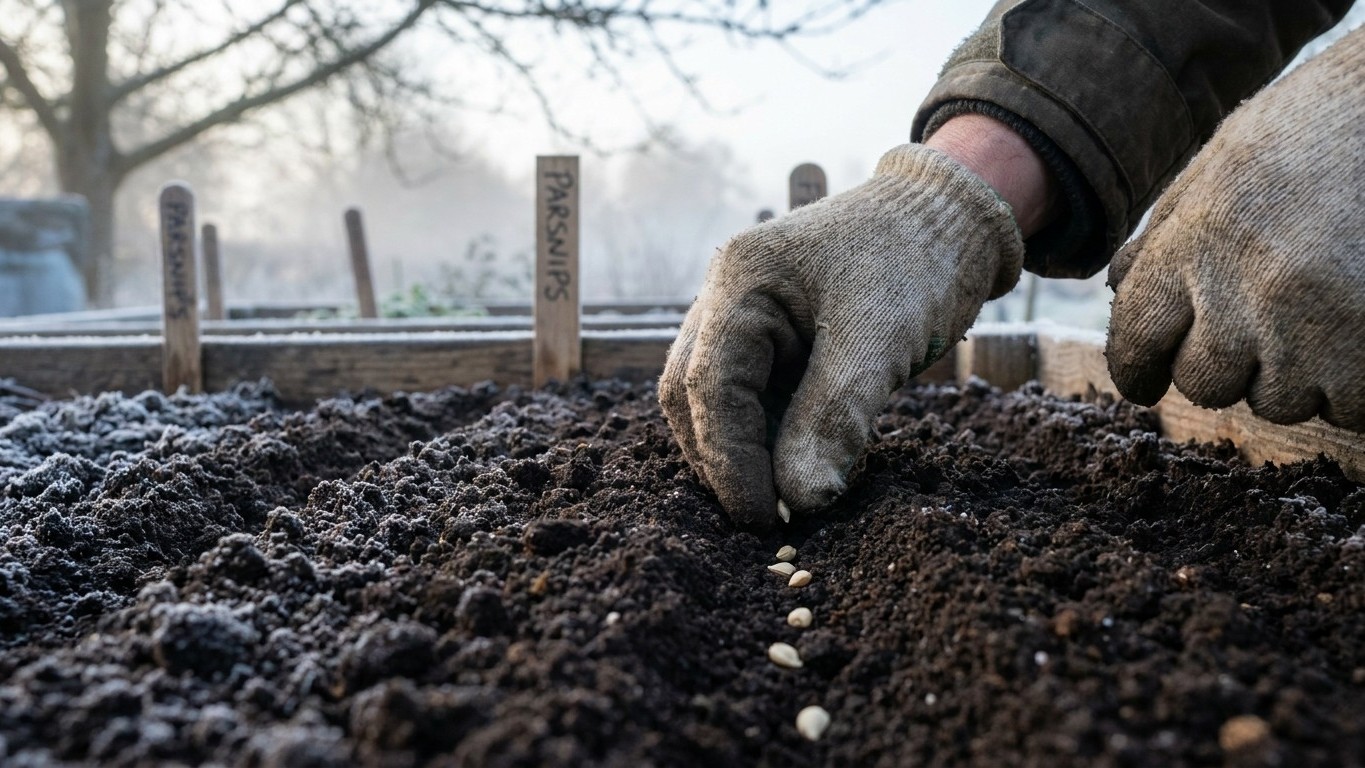

Sow Parsnips in coastal Virginia between roughly March 6 and March 20, two to three weeks ahead of the average last frost. That timing lets seedlings emerge before the ground warms too much, and it leaves a long stretch of frost-free growing time before the crop needs its cold snap to turn sweet. Inland and mountain gardens should push both ends of that window later and earlier.
The short answer
The number that actually decides whether parsnips are worth planting in a given corner of Virginia isn’t the zone map. It’s the mean minimum temperature of the coldest month. At the Virginia Beach reference station, that figure sits at 31.6°F. That’s the average low during January, not a record cold snap, and not a single hard freeze. It’s the typical nighttime floor across the coldest four weeks of the year.
A number that close to the freezing line matters for parsnips in a specific way. This crop doesn’t need protection from cold. It needs exposure to it. Parsnip roots convert stored starch into sugar only after several weeks of genuinely frosty weather sitting in the ground. A mild winter, even one that never threatens the plant, can leave a parsnip crop fully grown and completely bland.
At 31.6°F average low, coastal Virginia sits right at the edge of that requirement. Some winters will deliver enough consistent cold to sweeten the crop properly. Others, especially warmer years, may hover just above the threshold long enough that the roots stay starchy. This isn’t a hardiness question, since parsnips tolerate cold far below freezing without dying. It’s a flavor question, and the coastal climate answers it inconsistently.
Move away from the coast and the picture shifts. Inland valleys and especially the Blue Ridge and southwest Virginia run colder overnight, arrive at frost weeks earlier in fall, and hold onto them longer into spring. Gardeners in those regions are working with a climate that delivers the sustained cold parsnips actually want. Coastal growers can still succeed, but they’re playing closer to the margin.
None of this changes when to sow. The sowing calendar is set by frost dates, not by how cold January gets. What the 31.6°F figure changes is expectation: a coastal Virginia garden can grow a full-sized parsnip on schedule and still hand you a root that tastes more like a bland carrot than the sweet, nutty vegetable parsnips are supposed to be. Waiting through as many frosty weeks as the calendar allows, rather than harvesting at first opportunity, becomes the only lever available to coastal gardeners chasing that flavor.
Does the season fit?
Parsnips need 100 to 120 days from the day they’re seeded in place, not from transplanting, since this crop doesn’t tolerate root disturbance well enough to be started indoors and moved. Laying that requirement against Virginia’s frost calendar shows exactly how much room there is to work with.
- Sowing window: with the last spring frost falling between March 20 and April 3 at the coastal reference station, sowing two to three weeks earlier lands the seed in the ground somewhere between roughly March 6 and March 20.
- Germination delay: parsnip seed is slow. Expect 14 to 21 days before seedlings break the surface, which pushes visible growth into late March or early April, even though the seed went in weeks earlier.
- Minimum maturity: counting 100 to 120 days forward from the March sowing date puts the earliest possible harvest somewhere in mid-June to mid-July.
- Frost-sweetening wait: reaching minimum maturity by early summer doesn’t mean harvesting then. The roots need to sit through frosty weeks, so most gardeners leave them in the ground until after the first fall frost, which arrives between November 10 and November 24 at the coastal station.
- Total window available: from last spring frost to first fall frost, coastal Virginia offers roughly 221 to 249 frost-free days. Against a 120-day minimum requirement, that’s a comfortable margin, with months to spare even after accounting for slow germination.
- Inland adjustment: gardens in the Blue Ridge or southwest Virginia should expect a later last frost and an earlier first frost, which shortens this window. The coastal margin doesn’t automatically carry inland, so those gardeners should sow at the earlier edge of the window and avoid delaying.
For coastal and Piedmont Virginia, the season fits with room left over. The tight spot isn’t the growing season at all, it’s whether enough cold weather arrives before the ground freezes solid enough to block harvest.
What goes wrong here
- Forked roots from heavy or stony ground: parsnips send a single taproot straight down, and anything that deflects it, compacted clay, rocks, or a hardpan layer, splits the root into forks. Virginia’s clay-heavy soils in the Piedmont are a common culprit. The remedy is double digging the bed to at least 12 to 15 inches before sowing, removing stones as they turn up, or working in enough sand and compost to loosen the profile.
- Forked roots from overwatering: this is a separate cause from soil texture, and it happens even in loose, sandy beds. Excess moisture encourages shallow lateral roots to compete with the taproot, producing the same forked result in soil that would otherwise grow a clean root. The fix is steady, moderate watering rather than heavy, irregular soaking, especially once seedlings are established.
- A season that runs out: sowing late, whether from a delayed spring or simply procrastination, eats into the 100-to-120-day requirement and can leave roots undersized when cold weather arrives. Sowing at the early edge of the two-to-three-week pre-frost window, rather than the late edge, builds in a buffer against this.
- A winter too mild to sweeten: at a coastal mean minimum of 31.6°F for the coldest month, some years simply won’t deliver enough sustained frosty weather to convert starch to sugar. There’s no soil fix for this one. The only response is leaving roots in the ground through as many cold snaps as the winter offers and accepting that flavor will vary year to year in the mildest parts of the state.
Some gardeners also time this by the Moon: when to plant parsnips by the moon, as almanac tradition rather than fact.
Common questions
Can parsnip seed be started indoors and transplanted in Virginia?
No. Parsnips are sown directly in place because the taproot doesn’t recover well from transplant disturbance. Any attempt to start seed indoors and move seedlings typically produces stunted or forked roots.
How long does parsnip seed take to germinate in Virginia soil?
Expect 14 to 21 days before seedlings emerge. This is slow compared to most garden vegetables, and gardeners who dig up the row after a week or two, assuming the seed failed, often re-sow over seedlings that were already on their way up.
Does the coastal frost date apply to the whole state?
No. The March 20 to April 3 last-frost window and the November 10 to November 24 first-frost window come from a coastal reference station near Virginia Beach. The Blue Ridge and southwest Virginia see a later last frost in spring and an earlier first frost in fall, narrowing the growing window in those regions.
If parsnips grow to full size, are they automatically sweet?
No. Size and sweetness are separate outcomes. A parsnip can reach full size within the 100-to-120-day window and still taste starchy if it hasn’t been exposed to several weeks of genuinely frosty weather. Sweetness depends on frost exposure, not on how large or mature the root has become.