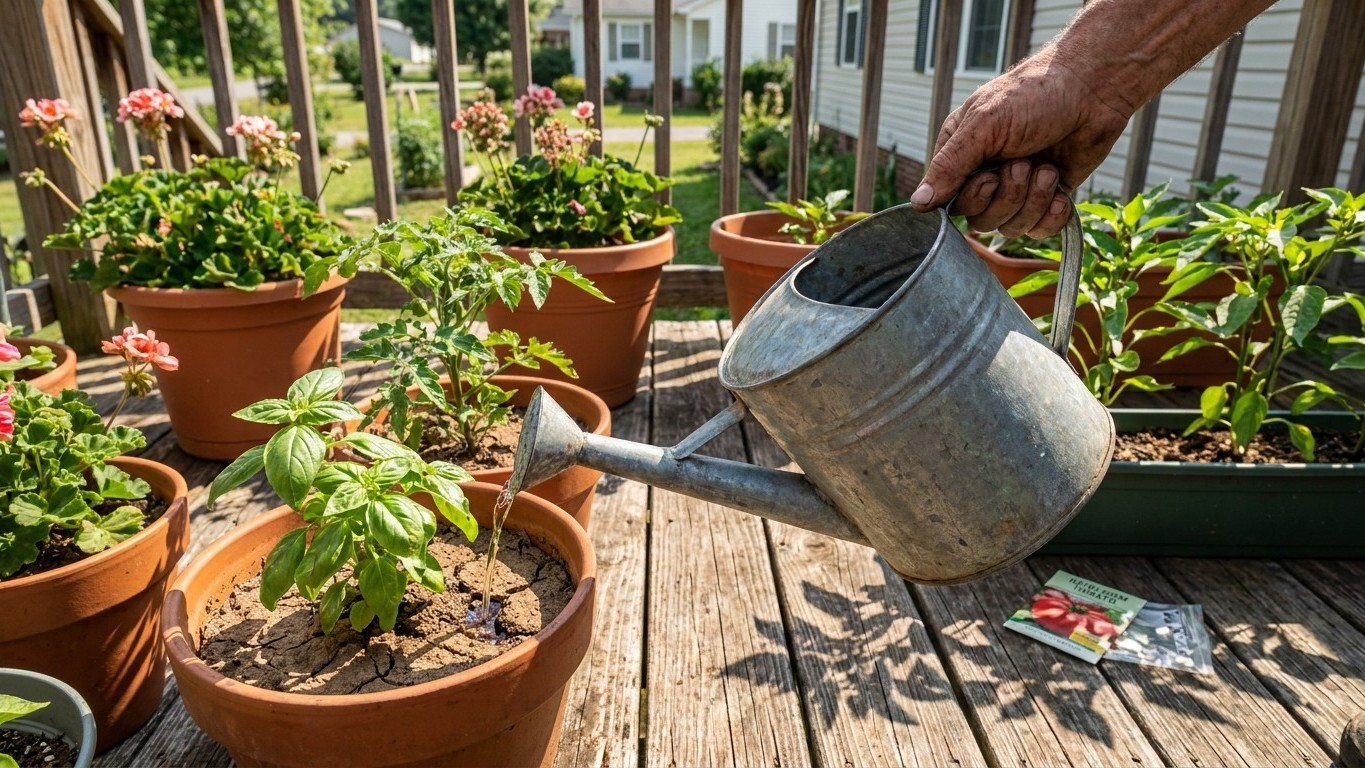

West Virginia containers need watering more often than garden beds in the same yard, because a pot holds only a few gallons of soil against a sky that drops just 3.75 inches in the driest month and a summer that hits 90F on 16 days a year. That gap between demand and rainfall is the whole story.
What changes here

Two numbers set the terms for every pot on a West Virginia porch or patio. August, the driest summer month at the reference station, averages 3.75 inches of rain. And the state logs 16.0 days a year at or above 90F. Put together, they mean the stretch when heat stress peaks for a container plant is also the stretch when the sky offers the least help. That’s not a coincidence gardeners can wait out. It’s the exact window where hand watering has to fill the gap.
Run the arithmetic on a standard bed and the shortfall becomes concrete. A vegetable bed or a flower border wants roughly an inch of water a week to keep growing without stress. Spread August’s 3.75 inches evenly across the month’s four-plus weeks, and an average week in that month delivers about 0.85 inches from the sky, close but not quite the inch the bed is asking for. In a ground bed, that quarter-inch deficit is manageable; the soil under it holds a reserve. A container has no such reserve. Potting mix in a pot dries from top to bottom within a day or two under 90F heat, regardless of what’s happening in the yard’s native soil, because there’s no surrounding earth to buffer it and no deep root zone to draw from. The 0.85-inch figure tells a ground gardener they’re close to fine. It tells a container gardener almost nothing, because pots lose water on their own schedule, driven by heat and airflow more than by the calendar month.
June and July run wetter, at 4.72 and 5.38 inches respectively, which matters for a different reason: those are also the months when a container left in full sun during a run of 90F days can go from soaked to bone-dry in under 48 hours, rain totals for the month notwithstanding. A wet month on paper doesn’t mean a wet week for a pot on a south-facing deck.
How to water when it matters
The method for a container is not the method for a garden bed, and the reasons are mechanical, not habit. Watering deeply and less often trains roots to grow down and out through the full volume of the pot, which is the only reserve the plant has. Watering the base rather than the foliage keeps leaves dry, since wet leaves overnight are what fungal disease waits for. Morning watering gives the plant hours of daylight to use what it took in before evaporation and heat set to work on the surface again.
Checking the soil at the root zone, not just the surface, is what separates a plant that’s actually thirsty from one that just looks it. A finger pushed two inches into the potting mix, or a wooden chopstick pulled back out, tells the truth a dry-looking crust on top does not. Potting mix is built to drain fast, which is good for roots but means the surface can read dry while the middle two inches down still hold water, or the reverse during a heat run.
Given the 16.0 days a year at 90F or above and the modest 3.75 inches of August rain, a reasonable starting point for most containers in West Virginia is a deep watering, until water runs from the drainage holes, roughly every other day during the hottest stretches, checked and adjusted against the finger test on the reader’s own pots and their own mix.
- Check the mix two inches down with a finger before deciding to water, not by looking at the surface.
- Water at the base of the plant, slowly, until water runs from the drainage holes.
- Water in the morning, so the plant has the full day to draw on it before evening.
- During stretches at or near 90F, plan on checking every other day rather than assuming a weekly schedule holds.
- Ease back to twice a week once temperatures drop below the mid-80s and rainfall picks up, as it does in June and July.
What goes wrong
A little sprinkle every day
A light daily splash wets only the top inch of the mix. Roots follow the water, so they stay shallow near the surface, where the same 90F heat that drives 16 days of stress a year bakes them fastest. The plant ends up thirstier under a daily routine than under a deeper, less frequent one.
Watering the leaves at night
Wet foliage left overnight, especially in the humid stretch of a West Virginia summer, is an invitation to fungal disease. The base needs the water, not the canopy, and morning is the window that lets any splash on leaves dry out before dusk.
Trusting the rain to have handled it
A summer thunderstorm can look soaking from a window and still leave the container dry two inches down, since a hard, fast rain runs off a full pot faster than it soaks in. The only way to know is the finger test, not a glance at a wet driveway.
Skipping the mulch
A bare surface on a container gives the sun a straight shot at the moisture just delivered. A thin layer of mulch on top of the mix slows that loss, which matters most during the 16 days a year when 90F heat is doing its worst work on evaporation.
Overwatering in the wetter months
June and July bring more rain, 4.72 and 5.38 inches respectively, and a container without good drainage holes can sit soaked long enough to drown roots that never got the chance to dry. The fix isn’t watering less in principle, it’s checking drainage and skipping a scheduled watering when the mix is already wet from a recent storm.
Local help
West Virginia University’s Extension Service is the state’s land-grant resource for gardening questions specific to local conditions, including container and bed watering guidance. Find it at extension.wvu.edu. Watering restrictions during dry stretches vary by water utility and county, so check current rules with the reader’s own local water provider rather than assuming a statewide standard applies.
Common questions
How often should I water container plants in West Virginia during August?
Check the mix two inches down every other day during hot stretches, since August’s 3.75 inches of average rainfall doesn’t reliably reach a container’s root zone, and water deeply when the mix has dried at that depth.
Do West Virginia’s 16 days above 90F really matter for potted plants?
Yes. Those days drive the fastest moisture loss of the year in a small volume of potting mix, which is why containers need closer attention during heat runs than during cooler, wetter stretches like June.
Can I rely on summer rain to water my containers for me?
Not reliably. A storm can leave the surface looking wet while the mix two inches down stays dry, since containers drain fast and shed a hard rain rather than absorbing all of it.
What’s the single biggest watering mistake for containers in this state?
A light daily sprinkle that never reaches the root zone, paired with skipping mulch, both of which leave roots shallow and exposed right when 90F heat is working hardest against them.