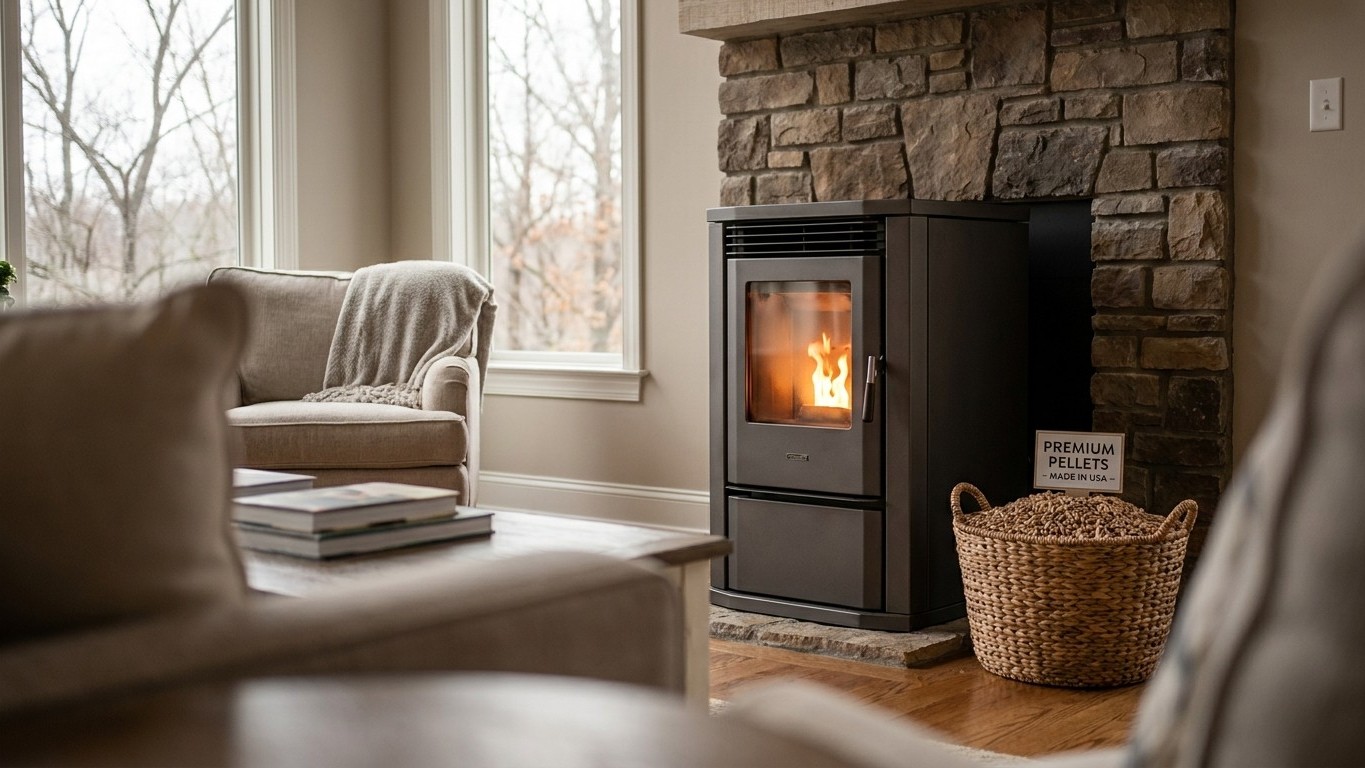

A pellet stove in Newfoundland and Labrador is heating almost every day of the year, not just through a cold snap in January. The province’s reference station shows demand for warmth in every single month, which changes what “buying pellets for winter” even means here. Expect a stove that runs long rather than hard, a storage plan that has to survive damp coastal air, and a backup plan for when the power goes out, because a pellet stove without electricity is just a cold metal box.
How hard the winter works here

At ST JOHN’S A, the reference station for the province, Environment and Climate Change Canada’s 1981-2010 climate normals put the annual heating demand at about 4,755 heating degree days below 18 C. That single figure is the whole story of what a winter costs here: it measures, day by day, how far below 18 C the air sits, then adds it all up. Double the degree days somewhere else, and you’d roughly double the fuel needed to keep the same house at the same temperature. This number does not translate into an American heating degree-day figure, different base temperature (18 C here versus 65 F on US sites), different unit, different averaging period. Treat it as a St. John’s number, full stop, not a stand-in for the whole country or a match for a similar-sounding US city.
What makes this station unusual is not just the size of the number but its shape across the year. The normal mean daily temperature at ST JOHN’S A never climbs above the 18 C base in any month, including August, the warmest month, which averages 16.1 C. That means there is no clean “start” to the heating season here, because by this measure it never fully stops. Demand peaks hard in January, at 698 degree-days for the month, with February (646) and March (638) close behind. But even July and August, the quietest months, still register 85 and 76 degree-days respectively. A stove here isn’t seasonal equipment brought out for three cold months; it’s a year-round appliance that simply works harder in winter and lighter in summer.
This is one station, and Newfoundland and Labrador is not one climate. St. John’s sits on the Avalon Peninsula, moderated somewhat by the Atlantic. Push north or west, into central Newfoundland or across the Strait of Belle Isle into Labrador, and winters run colder and longer than what this figure describes. A reader in Labrador City or Goose Bay should treat the St. John’s number as a floor, not a ceiling, and check their own regional normal before budgeting fuel. The mechanism stays the same everywhere: more degree-days, more fuel, same house.
How many tons a winter takes here
No published source breaks pellet consumption down by ton, per province, and for good reason: two houses on the same street in St. John’s can burn twice as much as each other depending on how they’re built and how they’re heated. What you can do is work the math yourself, using the same logic behind the degree-day figure above. A standard bag of wood pellets weighs 40 pounds. Fifty bags make a ton. From there, consumption tracks the heat your house actually needs to lose to the outside air and replace, which is exactly what degree-days measure.
Three things move that number more than anything else:
- How well the house holds heat — insulation, air sealing, window quality, and whether the house is a tight new build or a drafty older Newfoundland saltbox.
- Whether the stove is the only heat source or a supplement — a stove backing up baseboard heaters or a furnace burns far less than one carrying the whole house through a St. John’s January.
- The setting it runs at — a stove left on a low, steady burn sips fuel compared with one cycling on high to fight a cold snap.
Given how much those three variables shift the answer, the only estimate worth trusting is one you generate yourself. Count the bags you burn through your first full winter, from whenever you start running the stove in autumn through the last burn in spring, and use that total as your baseline going forward. Adjust it slightly for a colder or milder year using the degree-day pattern above, since January and February will always be your heaviest months and July and August your lightest. One measured season on your own house beats any number printed on a page, including this one. For the national breakdown of how consumption scales with degree-days and house size across colder and milder regions, see our guide on how many pellets a winter takes.
Buying and storing them in this climate
Given that heating demand here never really drops to zero, the safest rule is simple: buy ahead of the months where degree-days climb fastest, rather than waiting for the cold to arrive. Demand jumps from October (329 degree-days) into November (449) and then into the January-March stretch that carries the bulk of the season’s total. Waiting until a hard frost sets in to place an order is exactly when a regional cold snap can empty dealer shelves across the province, and it’s also the worst time to buy on price, since pellets are typically cheapest when demand is low, in the shoulder months rather than mid-winter.
Storage matters as much as timing, and it matters more in this climate than in a dry inland one. Wood pellets are compressed sawdust, held together by the natural lignin in the wood rather than any added glue, which means they have no tolerance for moisture. Damp air swells them, and once they swell they crumble back toward sawdust and lose the clean, dense burn they’re made for. Newfoundland’s coastal humidity and its wet winters make this a real risk, not a theoretical one: a garage or shed with a concrete floor that sweats in a thaw, or a storage area exposed to salt-laden sea air, can quietly ruin a pallet of pellets over a season without anyone noticing until the bags are opened.
Raised storage off a concrete floor, a dry interior space rather than an exterior shed, and bags kept sealed until use all matter more here than in a dry climate. When comparing suppliers, compare price per ton rather than per bag, since that’s the only figure that lines up across different package sizes and delivery arrangements. For the full national storage and quality standards, including how to judge pellet quality before you buy a season’s supply, see our guides on pellet storage and pellet quality.
What a winter outage means here
A pellet stove is not a wood stove, and the difference shows up the moment the power goes out. Pellet stoves rely on an electric auger to feed fuel into the firebox and an electric fan or blower to move heat into the room. Cut the power and the fire has no way to keep feeding itself or pushing warmth out, no matter how many tons are sitting in the hopper. That single dependency is the trade-off for the convenience and steady burn a pellet stove offers over a traditional wood stove, and it matters most in exactly the climate described above.
Cross that electrical dependency with the degree-day figure from earlier and the stakes become clear. In January, with 698 degree-days of demand and temperatures that don’t let up, a power outage that knocks out a pellet stove is a genuine heating emergency, especially in a household using it as the main heat source. In August, with only 76 degree-days on the books, the same outage just means an evening without the stove running, not a crisis.
Statistics Canada’s 2023 survey of primary heating systems shows where most Newfoundland and Labrador households actually stand when that happens: 56% of homes rely on electric baseboard heaters as their main heating system, 9% use a forced-air furnace, 8% a heat pump, and 6% a boiler with hot-water or steam radiators. Heating stoves aren’t broken out as a separate main-heating category in that survey, and the figure for them wasn’t published as a reliable estimate, which means the data doesn’t say no one heats this way, only that the sample wasn’t large enough to report a number. What the numbers do make clear is that most households here already depend on electricity for their primary heat, baseboard heaters above all, which means a widespread outage in a hard winter threatens the furnace or baseboard heat just as much as it threatens a pellet stove running as backup. Instead of guessing at generator size or battery capacity, check the wattage listed on your stove’s appliance label, and see our national guide on what a power outage means for a pellet stove for how to plan around it.