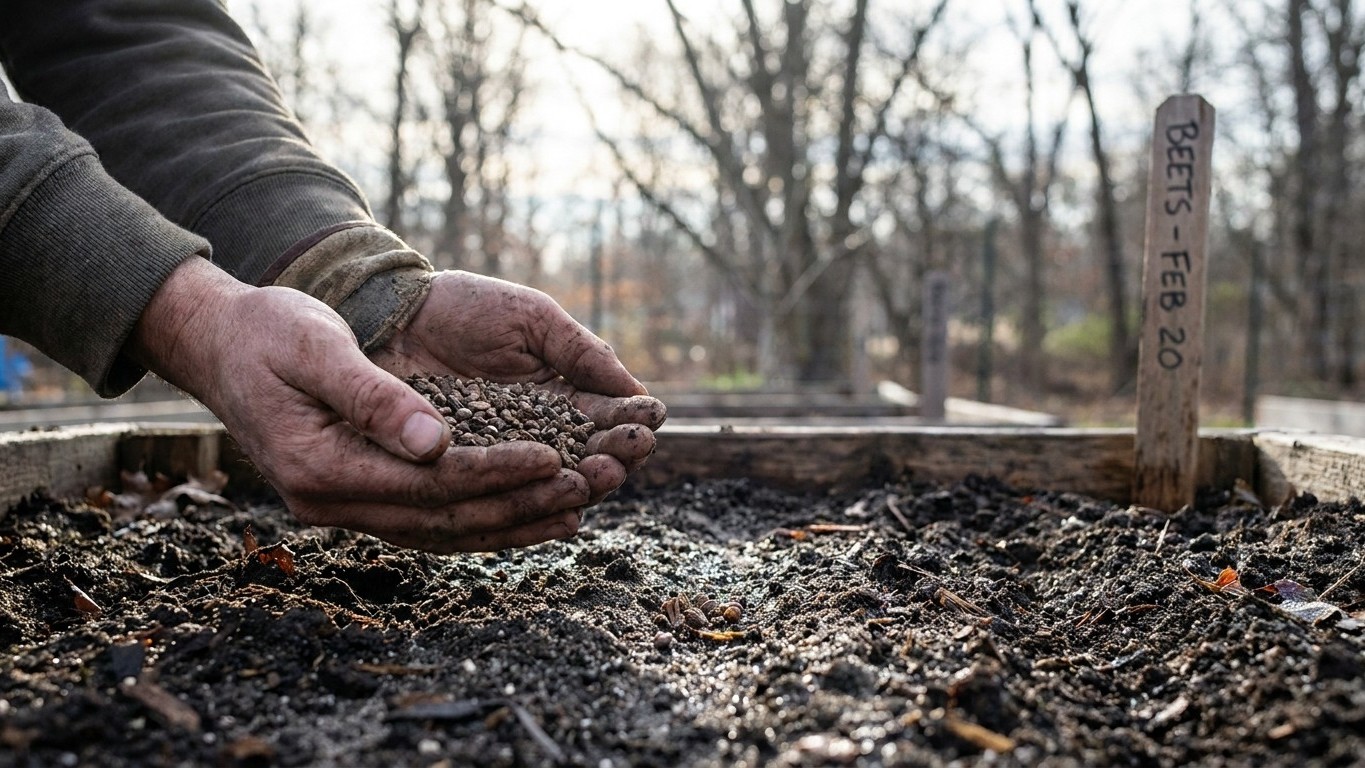

Sow beets in West Virginia two to three weeks before the last spring frost, which for the Charleston area falls between April 9 and April 23. That puts most direct seeding somewhere in the back half of March into early April, with a second window in mid to late summer for a fall crop. Elevation and local frost pockets shift that window in either direction, so treat the date as a starting point, not a calendar lock.
The short answer
West Virginia’s official state soil, the Monongahela series, tells you something useful before you even pick up a trowel. It’s an Ultisol, old, heavily weathered, and leached of a lot of what plants want. The surface horizon runs strongly acid, with a pH around 5.0, and the texture is a loam to silt mix: 27 percent sand, 18 percent clay, and 54 percent silt, carrying about 3.0 percent organic matter. It’s classed as moderately well drained. None of that is a death sentence for a beet, but it’s not the deep, loose, well-drained ground beets prefer either. Utah State University Extension describes the ideal beet bed as deep, sandy, and well-drained, rich in organic matter, amended with no more than 1 inch of composted material per 100 square feet. A soil that’s mostly silt with a fifth clay, sitting on the acid side of neutral, needs some correction before it behaves like that.
That acidity matters more than gardeners usually expect. Beets aren’t as touchy as, say, blueberries, but a pH near 5.0 locks up nutrients that would otherwise be available, and root vegetables in particular tend to show it as slow, uneven growth rather than dramatic leaf symptoms. A soil test and, if needed, lime worked in ahead of sowing is the practical fix, and it’s cheap insurance against a season of stunted roots.
On the heat side, the specific count of days each year that a reference city in West Virginia crosses 90 F isn’t published in the data behind this page, so no number is given here. What is documented is the mechanism: Utah State’s Extension work ties woody, tough beet roots to heat above 85 F arriving on top of water stress. That’s a combination, not a single trigger, and it’s worth holding onto that distinction as you plan a sowing date, because the two halves of it (heat and dryness) don’t always show up together in the same week.
None of this describes every backyard in the state. West Virginia’s terrain runs from river bottoms to steep hollows to reclaimed mine ground, and it holds hundreds of distinct soil series, not one. The Monongahela series is the state’s symbolic soil, mapped and measured by USDA NRCS, but it’s a representative starting point for thinking about drainage and acidity in this region, not a stand-in for the dirt in your own raised bed. A soil test remains the only way to know your actual pH and texture.
The six weeks that decide it here
Sowing two to three weeks before the last frost date puts the first six weeks of a beet’s life, germination through early root development, inside a fairly predictable stretch of West Virginia’s spring. Given the state’s last-frost window of April 9 to April 23, that six-week clock is running through late March, April, and into May across most of the lower elevations, with hill country and higher ground starting later.
Appalachian spring in this part of the country doesn’t move in a straight line. It swings: a stretch of cold, saturated soil can give way within a couple of weeks to a dry, sunny run that pulls moisture out of the top few inches fast, especially in ground that leans silty rather than sandy. That’s exactly the texture profile the Monongahela series carries, 54 percent silt against just 27 percent sand, which means the surface can dry out and crust between rain events even while deeper soil stays damp. A beet seedling’s shallow young roots don’t reach that deeper moisture yet. They’re stuck dealing with whatever the top couple of inches are doing.
This is where the bolting risk concentrates. Utah State’s Extension guidance is direct on the mechanism: water stress during those first six weeks pushes beets toward premature flowering, meaning the plant bails on root development and runs to seed instead. In West Virginia’s spring pattern, that risk sits squarely in any dry snap that lands during germination and early leaf growth, not later in the season when the plant has a deeper root system to draw on. A week without rain in April, on a silty surface that’s already prone to crusting, is enough to trip that switch if nobody’s watering.
The practical takeaway isn’t complicated, even if the timing is: know that your six-week window, once you’ve picked a sowing date, is going to include at least one likely dry stretch somewhere in West Virginia’s spring, and plan to water through it rather than assuming spring rain will handle things on its own.
What goes wrong here
- Bolting from a dry spring stretch. A beet sown two to three weeks before the April 9 to April 23 frost window spends its first six weeks in a spring that can flip from wet to dry with little warning. Water stress during that stretch triggers premature flowering. Remedy: check soil moisture in the top 2 inches every few days after sowing and water rather than wait for rain, especially if a dry, sunny run sets in.
- Woody roots from summer heat plus dry soil. Once a spring-sown crop is maturing into early or mid-summer, heat above 85 F combined with water stress toughens the root. This is a separate failure from bolting, tied to the growing months rather than the germination window. Remedy: keep watering consistent through hot stretches rather than tightening up once the plant looks established.
- Acidic ground limiting nutrient uptake. The state’s representative surface soil runs strongly acid, around pH 5.0, which is lower than beets do their best work in. Remedy: test your own soil’s pH before sowing and lime if it comes back acidic; don’t assume the state figure is your figure.
- Silty surface crusting over young seedlings. At 54 percent silt in the reference soil, a heavy rain followed by sun can bake a crust that a fine beet seedling struggles to push through. Remedy: keep the seedbed loose at sowing depth and consider a light mulch layer to buffer the surface.
- Over-amending instead of correcting structure. Utah State’s guidance caps composted organic matter at 1 inch per 100 square feet. Piling on more doesn’t fix a silty, acidic bed and can throw off the balance you’re aiming for. Remedy: stick to the recommended rate and let a soil test, not guesswork, guide any further correction.
Common questions
Can I sow beets earlier than two to three weeks before the last frost in West Virginia?
The two-to-three-week window is the guideline that keeps the first six weeks of growth inside a manageable stretch of spring. Sowing much earlier pushes germination into colder, wetter soil and doesn’t shorten the risk of a later dry snap during that same critical window.
Does elevation change the sowing date across the state?
Yes, and meaningfully. The April 9 to April 23 frost window is drawn from a river-valley station. Higher ground and mountain hollows across West Virginia freeze later in spring and earlier in fall, so gardeners at elevation should push their sowing date later than the valley window suggests.
How do I know if my garden soil matches the Monongahela series described here?
You likely don’t need to guess. A basic soil test will give you your actual pH and a sense of texture, which is the only reliable way to know if your ground behaves like the state’s representative soil or nothing like it. River bottoms, hill soils, and any yard that’s been graded or filled can differ completely from the mapped series.
Is bolting the same problem as woody roots?
No, and it helps to keep them separate. Bolting comes from water stress early, during the first six weeks after sowing, and means the plant flowers instead of building a root. Woodiness comes later, from heat above 85 F combined with dry soil during the growing season, and means the root itself turns tough and fibrous. Watering consistently addresses both, but they happen at different points in the plant’s life for different reasons.