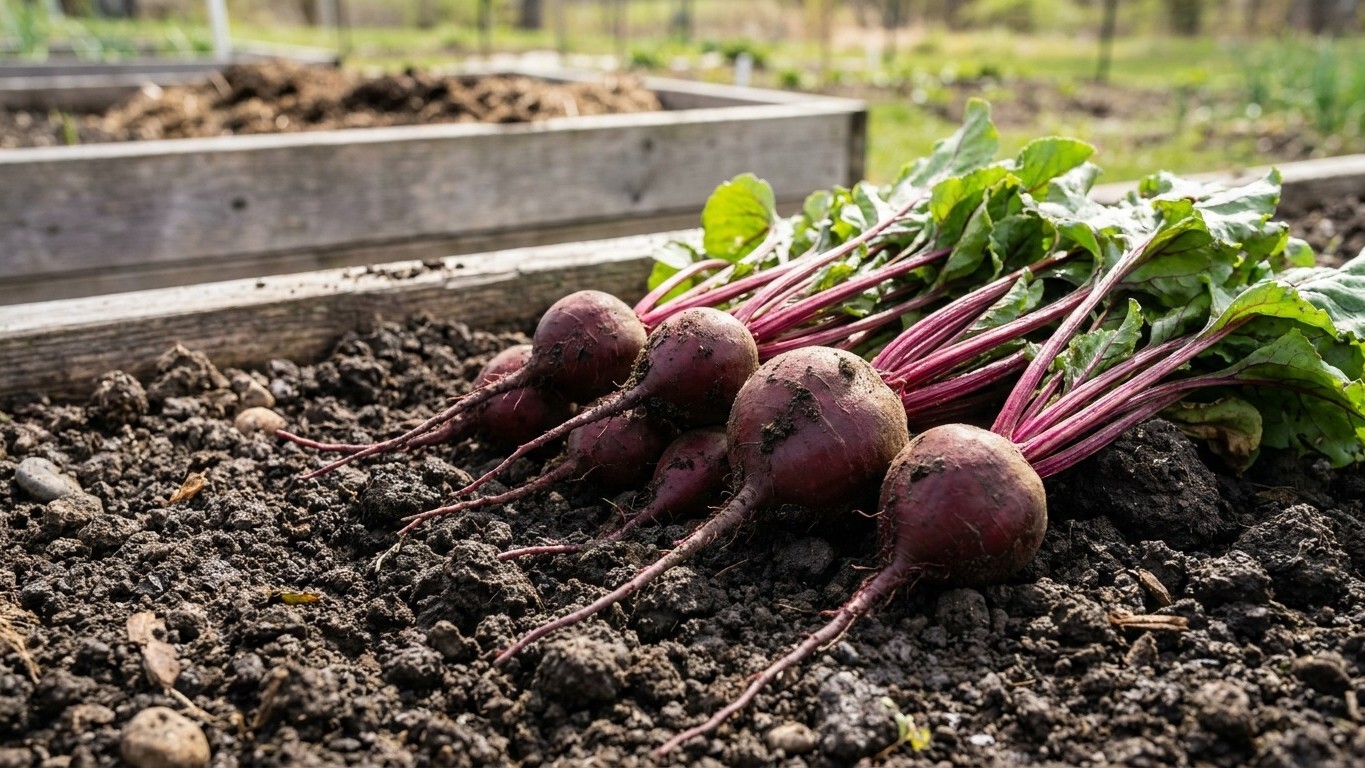

Beet Soil in West Virginia starts with the state soil, the Monongahela series, which is a strongly acid silt loam that drains only moderately well, and beets want the opposite: deep, sandy, well-drained ground loose enough for a taproot to push through without forking. When to Sow Beets in West Virginia comes down to timing planting 2 to 3 weeks before the last frost, keeping the first six weeks consistently watered, and not letting roots sit in heat above 85 F once they’re stressed for water.
The short answer
The Monongahela series carries 27 percent sand, 18 percent clay and 54 percent silt in its surface horizon, with a pH around 5.0 and organic matter near 3.0 percent, according to USDA NRCS Soil Survey Geographic Database records for the series’ major components. It drains moderately well, not freely. That combination, heavier and siltier than beets prefer, and running acid rather than neutral, is the reason a lot of West Virginia gardens fight the crop harder than the seed packet suggests they should.
Beets, per Utah State University Extension, want deep sandy soil rich in organic matter, and they tolerate amendment with up to about 1 inch of composted organic matter per 100 square feet, no more. A Monongahela-type bed, silt-heavy and moderately drained rather than free-draining, holds water longer after a storm than a beet root wants. That’s not a disaster on its own, but it changes how a gardener has to manage moisture: less about adding water and more about making sure the bed sheds what it doesn’t need, through raised rows or worked-in compost, so roots aren’t sitting wet one week and cracked dry the next.
The acidity matters too. A surface pH near 5.0 is strongly acid, and that number is specific to this mapped series, not a promise about any one backyard. A state spans hundreds of soil series, and the Monongahela series is a starting point for talking about the region’s ground, not a diagnosis of what’s under a particular garden. Some West Virginia gardens sit on river-bottom alluvium that drains fast and runs closer to neutral; others sit on hillside clay that barely drains at all. The only way to know which one a reader has is a soil test, not a state average.
On heat, the sourced threshold that matters for beets is 85 F: combined with water stress, heat above that point is what turns a root woody, according to Utah State University Extension. A specific count of days West Virginia’s valleys or ridges spend above 90 F in a typical year isn’t part of the data available for this page, so it won’t be guessed at here. What can be said plainly is that river valleys such as Charleston’s run warmer and more humid through summer than the state’s higher ridgelines, and that gap is exactly why a fixed statewide answer to “will my beets go woody” doesn’t exist. The soil type and the local heat pattern both have to be checked against the specific piece of ground in question.
The six weeks that decide it here
Sow beets 2 to 3 weeks before the last frost and the first six weeks of growth land inside a fairly narrow, known window for a Charleston-area garden: the last spring freeze there falls somewhere between April 9 and April 23, per NOAA’s 1991-2020 climate normals for station USW00013866. That puts a beet sown at the earlier edge of the recommended window into a bed still shaking off winter in late March, and one sown at the later edge into early-to-mid April ground. Either way, the first six weeks of a West Virginia beet’s life happen in the state’s most unpredictable stretch of weather, when a cold, damp week can be followed by a sudden warm, dry one and back again.
That swing is the whole problem. Utah State University Extension is specific on this point: water stress during the first six weeks is what causes beets to bolt, meaning the plant skips root formation and jumps straight to flowering. A West Virginia spring that turns dry for even a week or two right after seeding, which happens often enough in the hill country and river valleys alike, can be enough to push a stressed young beet toward premature flowering instead of a root worth harvesting. This is a separate failure from the heat-driven woodiness that shows up later; bolting is an early-season, water-driven problem, not a late-season, heat-driven one, and treating them as the same issue leads to the wrong fix at the wrong time.
Elevation adds another layer worth flagging clearly, even though the Charleston frost dates are the only sourced numbers here. Charleston sits in a river valley, and NOAA’s own data for that station comes with a real caveat: higher ground across the state tends to freeze earlier in fall than a valley station does. That doesn’t change the spring sowing math directly, but it’s a reminder that a gardener at 2,500 feet on a ridge is working with a different frost calendar than one down along the Kanawha, and the six-week window that matters for bolting risk starts and ends on a different date depending on where the garden actually sits.
What goes wrong here
- A dry snap right after seeding. A week or two without rain in the first six weeks is enough to stress a young beet into bolting, per Utah State University Extension. The fix is steady moisture through that window specifically, not just “watering the garden” in general: mulch to hold what rain does fall, and don’t let the bed dry out between waterings during that early stretch.
- Ground that mimics the Monongahela series: acid, silty, only moderately drained. That pH near 5.0 and that drainage class slow root growth and can leave beets sitting in wetter soil than they want after a storm. A soil test, not the state average, tells a gardener whether lime is actually needed on their own ground.
- Heat plus thirst later in the season. Once temperatures push past 85 F, a beet that’s also short on water turns woody at the root, according to Utah State University Extension. This is a separate failure from spring bolting, and it calls for a separate fix: keep watering through the hotter stretch of the growing period, rather than assuming early-season care covers the whole crop.
- Over-amending with compost. Beets tolerate up to about 1 inch of composted organic matter per 100 square feet. More than that pushes growth toward leafy top and away from a clean, single root, and it can encourage forking in ground that’s already siltier than beets prefer.
- Sowing on a transplant calendar instead of a seeding one. Beets go into the ground as seed, not as transplants, and the 60- to 80-day maturity window that’s typically quoted for the crop counts from that seeding date. Counting days from anything else, a transplant date, a germination date, throws off the harvest window and can leave a root in the ground through exactly the hot, dry stretch that causes woodiness.
Checking this against your own county
Everything above starts from a single mapped soil series and a single weather station in a river valley. Neither one is a substitute for what’s actually under a specific garden bed or what the local frost calendar looks like a few hundred feet higher or lower than Charleston. West Virginia University Extension is the state’s land-grant extension service, and it’s the direct way to get a soil test read for an actual county, along with local guidance on frost timing that accounts for elevation rather than a single valley station. Before amending for pH or planning a sowing date off the numbers on this page, a county-level check through WVU Extension is the next real step.
Common questions
How long do beets take to mature in West Virginia?
Beets typically run 60 to 80 days from seeding, not from transplanting, since the crop is sown directly in the garden rather than started elsewhere and moved. Counting from any other date throws off the harvest window.
Which beet varieties handle West Virginia’s heat and soil best?
Utah State University Extension lists several standard beet varieties for home gardens but doesn’t rate any of them for heat tolerance, bolting resistance, or performance in acid, silty soil. Variety choice for a specific West Virginia garden is better answered through WVU Extension’s local guidance than through a generic list.
When should beets go in the ground in West Virginia?
Sow 2 to 3 weeks before the last spring frost. For the Charleston area, that frost falls between April 9 and April 23 based on NOAA’s 1991-2020 climate normals; gardens at higher elevation should check their own local date rather than use the valley figure.
Does West Virginia’s state soil mean my garden is too acidic for beets?
Not necessarily. The Monongahela series has a surface pH near 5.0, but that’s a representative figure for one mapped soil, not a measurement of any individual yard. River bottoms, hillside ground, and any lot a builder has graded or filled can all differ sharply from the state soil. A soil test is the only way to know an actual number.