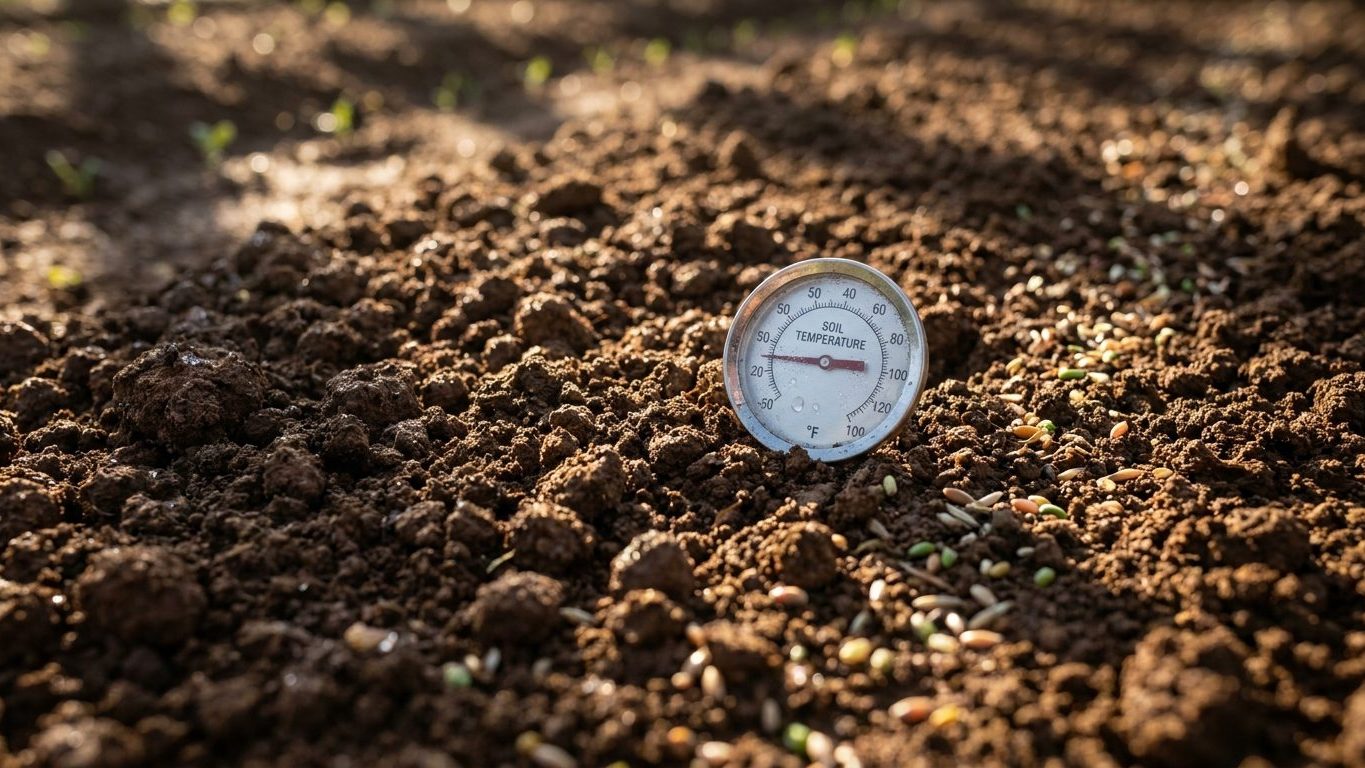

West Virginia gardeners can seed cool-season cover crops like cereal rye, oats, and crimson clover from late summer into fall, and warm-season options such as buckwheat or sorghum-sudangrass once the soil has fully warmed past the last spring frost. The right window depends less on the calendar date than on soil temperature and on how each species handles this state’s winter cold, which varies sharply between river valleys and mountain ridges.
When the soil is warm enough in West Virginia
Ask five gardeners in West Virginia when to plant a cover crop and you’ll get five different calendar dates, because the calendar isn’t actually the thing that matters. At the Charleston station (USW00013866), NOAA’s 1991-2020 Climate Normals put the last spring frost somewhere between April 9 and April 23, a 30-70% probability band, not a guaranteed cutoff. That’s the frost. Soil temperature is a separate measurement, and it lags behind air temperature by weeks.
Frost dates tell you when the air stops dropping to 32°F often enough to kill tender growth. Soil warms on its own schedule, driven by sun angle, soil color, drainage, and whether the ground is bare or still carrying old mulch. A patch of clay that stayed soggy through March can sit ten degrees cooler than a sandy raised bed twenty feet away, even on the same afternoon in mid-April. That gap is exactly why “plant after last frost” is a rule of thumb, not a guarantee. Some years the frost risk passes and the soil is still too cold for a seed like buckwheat or sorghum-sudangrass to germinate reliably; other years a warm March pushes soil temperature ahead of the frost calendar entirely, though that’s the less common pattern.
The practical fix is patience layered on top of the frost date, not instead of it. Once the region has cleared the April 9-23 window with no frost in the short-range forecast, warm-season cover crops can go in as soon as the top few inches of soil feel warm to the touch, rather than merely frost-free. Cool-season species run the other direction. Oats, cereal rye, winter peas, and crimson clover tolerate cool, even cold, soil and are usually sown from late summer through fall, well ahead of the first frost, so they can establish roots before winter dormancy sets in.
What actually sets the seeding rate
How much seed goes down per bed depends on the species itself, on whether you’re broadcasting by hand or drilling in rows, and on whether the goal is a thick weed-smothering mat or a lighter stand you’ll turn under quickly. Those variables shift the right rate enough that a number pulled from a generic chart can waste an entire season of seed. West Virginia University Extension (extension.wvu.edu) publishes county-specific guidance and can walk through rates for the exact species and method you’re planning, which is worth doing before you buy seed by the pound.
Termination follows the same logic as timing: mechanical, not chemical, on this site’s terms. Mowing a stand before it sets seed, crimping it flat at flowering, cutting it back with a scythe or string trimmer, or simply letting a hard freeze do the work are the four tools that matter. Which one fits depends on the species and on what’s being planted next, but none of them involve a spray can.
How long the season lasts here
Put the two frost windows next to each other and the growing season’s real shape appears. The last spring frost falls between April 9 and April 23; the first fall frost, at the same Charleston station, arrives between October 18 and November 1. Stack the earliest possible end against the latest possible start, or the reverse, and the frost-free stretch runs somewhere between about 178 and 206 days, depending on where your particular spring and fall land within those bands. Call it roughly six months, with two or three weeks of slack on either side.
That’s a meaningfully long window compared to higher, colder pockets of the state, but the caution attached to these dates matters: Charleston sits in a river valley, and the ridges and higher elevations across West Virginia freeze earlier in fall and thaw later in spring. A garden at 3,000 feet in the Allegheny Highlands should expect a shorter season than these numbers describe, not the same one.
What six months buys you
Six months is enough to run more than one cover crop through the same bed in a single year, which changes the math on the whole project. A fast-establishing summer species like buckwheat can go in after the spring frost risk clears, get mowed or turned under after six to eight weeks, and still leave enough season for a fall-sown cool-season crop like cereal rye or crimson clover to root in before the first fall frost between October 18 and November 1. That second sowing is what turns a cover crop from a one-time soil patch into an actual rotation.
In territories where the frost-free window runs closer to four months, that second sowing usually isn’t realistic, and gardeners have to choose between a summer cover crop and a fall one rather than running both. West Virginia’s roughly six-month window generally allows both, at least in the valleys, which also changes whether transplanting cover crop starts indoors is worth the trouble versus direct-seeding twice. The site’s succession sowing guide walks through how to sequence two cover crops in the same bed without the second planting crowding out the first.
Heat and water in West Virginia
Summer heat-day counts and rainfall totals aren’t part of the measured record for this page. Rather than guess at a number, here’s what’s true instead: those figures vary enormously across a state where elevation swings from river valleys near 600 feet to ridgelines above 4,000 feet, often within the same county. A number pulled from one station wouldn’t describe the other reliably anyway.
What’s actually decisive for cover crops isn’t the hottest week of July. It’s winter. The coldest-month mean minimum at the Charleston reference station is 26.1°F, per NOAA’s 1991-2020 Climate Normals, and that’s the figure that decides which species survive the cold here and which die back into a usable mulch on their own. USDA places the state across hardiness zones 5a to 7a, built on the average annual extreme minimum temperature, a range wide enough that a planting choice tuned to Charleston’s milder valley climate can fail on a ridge fifty miles away.
That distinction matters more for cover crops than for most garden plants, because the goal usually isn’t survival, it’s a controlled death. A species that dies back cleanly at 26°F, leaving a flat brown mat of residue by February, does exactly what a gardener wants: it protects the soil all winter, then gets out of the way before spring planting without a single pass with a mower. A species that shrugs off 26°F and keeps growing has just turned into a maintenance problem, something that needs to be mowed, crimped, or cut down by hand before it goes to seed or tangles into the next crop’s roots.
Oats as the clearest example
Oats make the point cleanly. In a territory where the coldest month rarely drops below the mid-20s, oats reliably winterkill, collapsing into a weed-suppressing mulch with zero labor. Push that same species into a warmer zone, say the milder end of zone 7, and the coldest-month minimum sometimes stays high enough that oats limp through winter alive, turning what was supposed to be a self-terminating cover crop into one more thing to cut down by hand in spring. West Virginia’s 26.1°F coldest-month minimum, at least at the Charleston reference point, sits solidly in oats-as-mulch territory, though gardeners at higher, colder elevations should expect that outcome even more reliably, not less.
Humidity works on the other side of the ledger. A cool, damp West Virginia summer, especially in the mountain valleys where fog settles overnight, tends to slow ripening and invite powdery mildew and other fungal disease on cover crops left standing too long rather than mowed or turned under promptly. That’s a reason to terminate on schedule rather than let a stand linger past flowering, independent of whatever the thermometer says.
Which cover crops suit West Virginia
None of this points to a single best cover crop, and it shouldn’t. It points to a short list of traits worth matching against this territory’s actual conditions, one type at a time.
The roughly six-month frost-free window, bookended by the April 9-23 and October 18-November 1 frost dates, favors cover crop types that establish fast rather than ones that need a long runway. Cool-season legumes and small grains sown in late summer have plenty of time to root in before the first fall frost, and warm-season broadleaf types sown after the spring frost window closes still have a full season to build biomass before fall. Species that need a longer establishment period than that are working against the calendar here, not with it.
Winter hardiness is the second filter, and it runs in the opposite direction from most garden decisions. Across most of this territory, a coldest-month minimum near 26°F favors cover crop types built to winterkill cleanly, leaving a mulch instead of a stand that needs mechanical termination in spring. Types that shrug off that cold and keep growing aren’t necessarily wrong, but they commit a gardener to mowing, crimping, or cutting them down by hand before spring planting, and that’s worth knowing before the seed goes in the ground, not after.
Disease resistance matters more here than in drier territories, because humid summers and foggy mountain valleys give fungal disease more opportunity on any cover crop left standing past its prime. Types with better airflow characteristics or a looser canopy structure tend to hold up longer before a mid-season mowing becomes urgent.
Why this page won’t name a variety
What this page deliberately won’t do is name a specific cultivar. Variety performance inside any of these types shifts by trial, by county, and by year, in ways a general guide can’t track responsibly. West Virginia University Extension (extension.wvu.edu) runs the variety trials that actually apply to this state’s growing conditions, and its county offices can match a cultivar to a specific elevation, soil, and frost pattern in a way no general article can. Refusing to guess here isn’t a gap in this guide, it’s the correct answer: a cultivar recommendation without local trial data is a guess wearing the costume of advice.