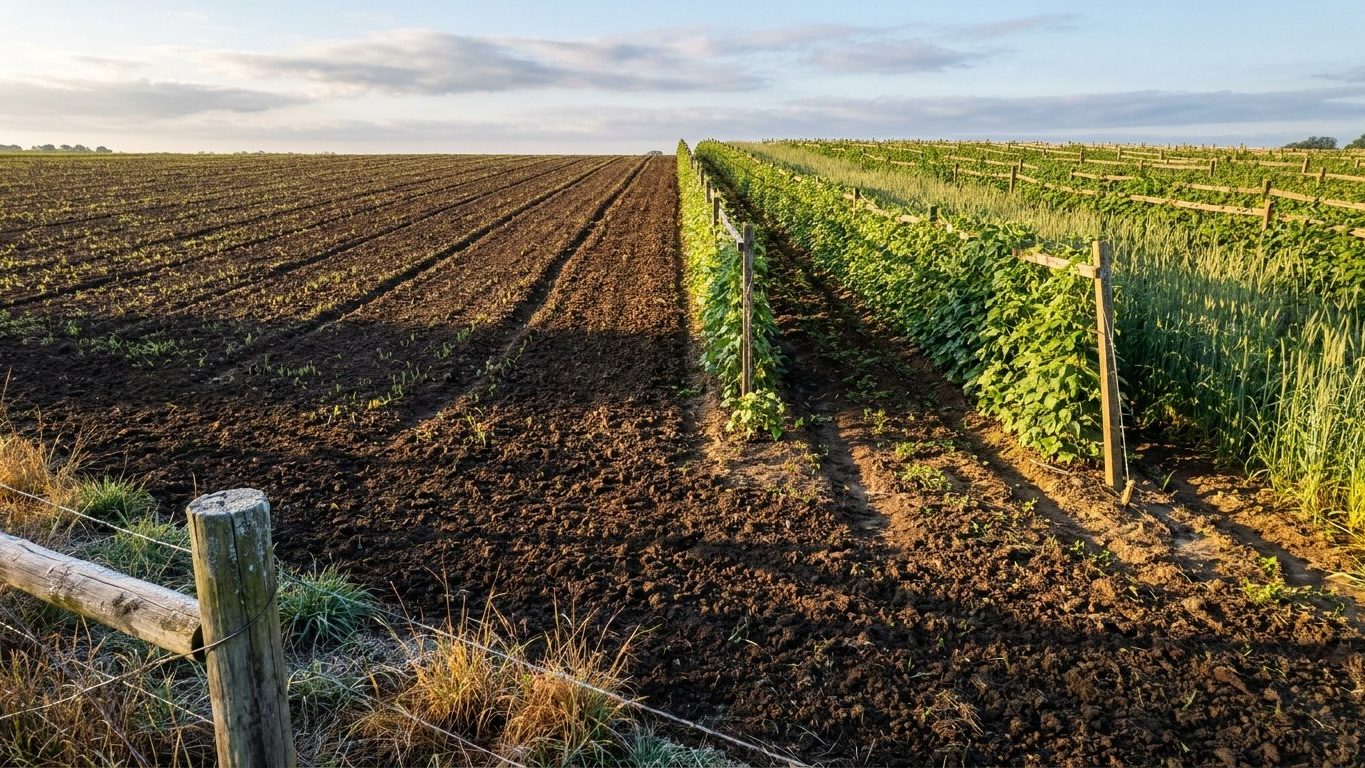

In West Virginia, sow winter-hardy cover crops like cereal rye, crimson clover, or hairy vetch between early September and early October, and save warm-season options like buckwheat for after mid-April. Both windows come from the state’s frost data, and elevation changes them fast once you leave the river valleys.
The short answer for West Virginia
Cover crops split into two calendars, and West Virginia’s frost dates set both of them. The state’s first fall freeze, measured at the Charleston reference station, lands between October 18 and November 1. Winter-hardy species need roughly four to six weeks of top growth before that freeze locks them into dormancy, which pushes the practical sowing window back to early September through early October. Wait past that, and cereal rye or crimson clover go into the ground with too little root mass to survive a hard winter or hold soil through spring runoff.
That October 18 to November 1 range is not a guarantee. It is a 30 to 70 percent probability band for a 32°F freeze, built from three decades of NOAA climate normals at station USW00013866 in Charleston. Half the years in that dataset saw a freeze land somewhere inside that window, and the other half fell outside it, either earlier or later. A reader north of Charleston or up in elevation should expect the earlier end of that range, sometimes well before it, based on the same NOAA 1991-2020 Climate Normals.
The spring side of the calendar works the same way. Charleston’s last spring freeze falls between April 9 and April 23, also a 30 to 70 percent probability band. Warm-season covers like buckwheat or sorghum-sudangrass germinate poorly in cold soil and get knocked flat by a late frost, so most growers wait until the back half of that window, or into early May, before committing seed to the ground. Sow winter-hardy cover crops between early September and early October if you take one date away from this page; it is the window that fits both the fall freeze data and the growth time these species need.
None of this replaces a county-level calendar. Charleston sits in a river valley, and the state’s elevation swings mean these dates shift by weeks depending on where you actually garden. Treat the Charleston numbers as the state’s center point, not a promise for every county.
What will not work here
The number that disqualifies more cover crop choices in West Virginia than any other is the winter cold, not the frost dates. The coldest month here runs a mean daily minimum of 26.1°F, measured at the Charleston reference station. That is not the record low; it is the average low night through the coldest stretch of winter, and it is the figure that decides whether a plant survives here at all, not just whether it gets nipped once. A species bred for milder winters, or a legume mix chosen because it worked in a warmer state, is gambling against a cold snap that repeats most years, not an outlier.
Buckwheat fails for a different reason: timing, not cold tolerance. It is a summer annual killed outright by the first light frost, and growers who try to stretch it into a fall cover crop lose the stand before it does any good. The same logic runs in reverse for anyone who sows a winter-hardy legume too early, in high summer heat, expecting it to hold until fall; hairy vetch and crimson clover germinate fine in warm soil but tend to bolt or burn out before the season they were meant to cover through winter even arrives.
Waiting too long into October is the mistake that shows up most in West Virginia specifically, because the state’s elevation means many counties freeze well before the Charleston valley does. A rye or vetch stand seeded in mid-October in a river-bottom county might establish fine; the same date in a mountain county can mean seed germinating into soil that is already cooling toward dormancy, with no real root system built before growth stops. The plant is not dead, but it is not doing the soil-holding, nitrogen-fixing job it was planted for either.
Watering schedules built for other climates fail here too, just less dramatically. West Virginia’s humidity means close-spaced, thick-seeded cover crop stands can mat and mold in a wet fall rather than drying between rains, which matters more for growers used to arid-state spacing advice than for anyone already gardening in Appalachian humidity.
| Cover crop type | Season it belongs in | What fails it in WV |
|---|---|---|
| Cereal rye, hairy vetch, crimson clover | Fall-sown, overwinters | Sowing after the fall frost window closes; too little root growth before dormancy |
| Buckwheat, sorghum-sudangrass | Warm-season, summer only | Any frost; also sown too early into cold spring soil |
| Oats, field peas | Fall-sown, meant to winterkill | Not a failure if it dies in the 26.1°F cold; that is the intended outcome |
What changes across West Virginia
West Virginia is not one garden, and the USDA Plant Hardiness Zone Map makes that plain: the state spans zones 5a to 7a, a two-zone range built from average annual extreme minimum temperatures. That is a wide spread for a state this size, and it means the Charleston frost dates in this article describe the valley floor, not the whole state. A grower in the eastern panhandle’s lower elevations sits closer to the 7a end, with a longer, milder season. A grower up in the mountains of Pocahontas, Randolph, or Tucker County territory sits closer to 5a, with a shorter season and colder winter lows than the 26.1°F figure recorded at Charleston.
What that means practically: the fall sowing window described above, early September through early October, is a starting point for the valley, not a fixed date for the state. Higher-elevation and northern gardeners should treat their own first frost as arriving earlier than Charleston’s October 18 to November 1 range, and sow their winter-hardy cover crops earlier to compensate. There is no single state-wide date that covers a 5a garden and a 7a garden equally well.
The reverse holds in spring. A 7a valley garden may see safe soil temperatures for buckwheat or other warm-season covers well before a 5a mountain garden does, even though both are technically in West Virginia and both are referencing the same state page. The state’s hardiness zone range spans 5a to 7a, and that gap is the reason a single calendar can only ever be a starting estimate.
This page cannot tell an individual reader which zone their own garden sits in. That takes checking the USDA Plant Hardiness Zone Map directly, entering a ZIP code, and reading the result for that specific location rather than assuming the state average applies.
Where to check this for your own county
The Charleston-based dates on this page are a state-level estimate, not a county recommendation, and a county recommendation beats a state one every time. West Virginia University runs the state’s land-grant extension service, and it is the source built to close that gap: extension.wvu.edu.
Once there, look specifically for two things. First, a local planting calendar for cover crops, which will reflect the frost dates and growing season length for your actual county rather than the Charleston valley figures used here. Second, variety trial results for cover crop species grown in your region of the state, since a crimson clover or rye variety that performs well in the eastern panhandle may not be the one your county’s extension agent recommends for a colder, higher-elevation site.
It helps to understand what these local resources typically look like, even outside West Virginia. Clemson Cooperative Extension in South Carolina, for example, publishes species-specific calendars like its HGIC 1219 tall fescue maintenance calendar, which times cool-season lawn work in one half of the year and warm-season work in the opposite half. The lesson for a West Virginia reader is not the fescue dates themselves, since that calendar is built for a different state and a different crop; it is the pattern. Extension services publish one calendar per species, not one blanket date for every plant, and a WVU cover crop resource should be read the same way, matched to the exact species being sown rather than treated as one-size-fits-all.
Check your own county’s WVU extension office before locking in a sowing date, especially if that county sits well outside the Charleston valley in elevation or latitude. This page gives the state-wide pattern; the county office gives the number that actually applies to the soil in front of you.
Checking this against your own garden
Every date on this page is a probability, not a promise, and the most reliable calendar is the one your own garden is already writing. Soil warmth by feel is the first check: before sowing buckwheat or another warm-season cover, push a bare hand two or three inches into the bed. If it feels cold and heavy rather than loose and faintly warm, the soil has not caught up to the calendar yet, regardless of what date the Charleston frost data suggests.
Watch what is already growing nearby as a second signal. Volunteer weeds pushing up new true leaves in a garden bed or field margin mean the soil has warmed enough for germination in general, which is a reasonable proxy for whether a cover crop seed will sprout too, especially in a spring that is running ahead of or behind the average.
The third check is your own first frost, tracked with nothing more than a thermometer or a weather app tied to your actual location rather than the nearest airport station. If frost consistently arrives at your garden a week or two before or after the Charleston range, that gap is real information about a microclimate, whether it is a cold hollow that pools frost early or a south-facing slope that holds heat longer than the valley floor. Note the date of your own first light frost this year and compare it against the October 18 to November 1 range; that single comparison tells you more about next year’s sowing window than any state-wide chart, including this one.