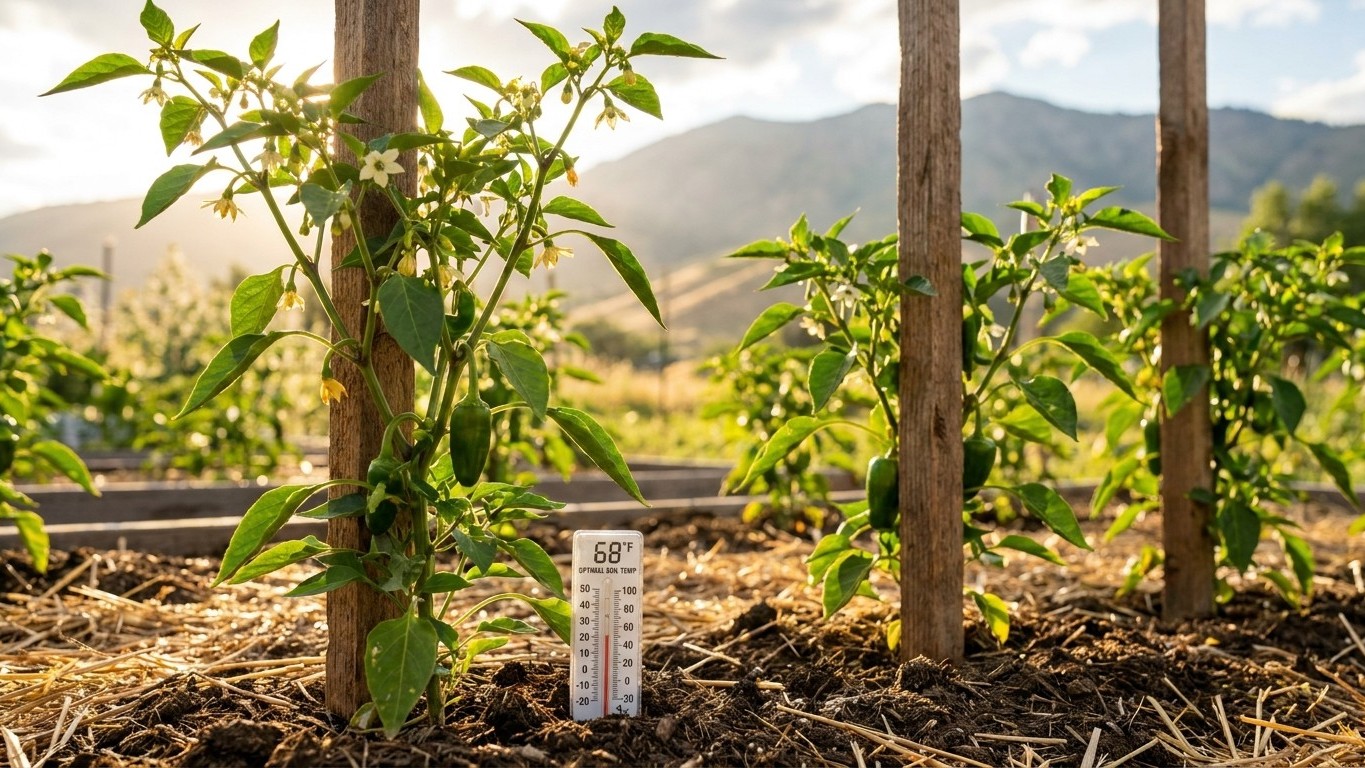

West Virginia peppers ripen reliably in most seasons, but the window is tighter than the calendar suggests. Charleston averages just 16.0 days a year at or above 90°F, which keeps most of the summer below the point where pepper flowers stop setting fruit. The real work is timing: starting seed indoors early enough, waiting for warm soil, and watching your own nighttime lows, since summer night minima aren’t tracked on this site. Get those three right and even a short West Virginia season finishes a full crop before fall freeze.
The short answer

Sixteen days sounds like nothing, and across a full growing season it mostly is. But those 16.0 days rarely land one at a time. They tend to bunch up in mid-to-late July and August, when a ridge of high pressure parks over the region for a week or more. During that stretch, pepper blossoms can drop without setting fruit at all, because sustained heat above 90°F interrupts pollen viability. A gardener who counts only the seasonal average and assumes an easy summer can be caught off guard by a five- or six-day heat run right when the plants are loaded with flowers.
That’s one end of the failure window. The other end matters just as much, and it gets overlooked because it happens in cooler weather that feels harmless. Pepper fruit set also fails when nights drop below 55°F, according to Utah State University Extension. That threshold can show up in early spring right after transplanting, and again in early fall as nights start cooling before the first frost. This site carries the state’s days-above-90°F count, but it does not carry summer night minima, and there’s no way to responsibly estimate them from latitude or from a station’s coldest month. Elevation, valley drainage, and local tree cover all shift nighttime lows enough that a county-level guess would be more misleading than useful.
What that means in practice: track your own thermometer through late spring and early fall. If you’re gardening in a low river valley like the Charleston area, nights likely stay milder later into fall than they would on a ridge fifteen miles away. If you’re at higher elevation, don’t assume the state average protects you. The two hard limits, sub-55°F nights and 90-plus°F days, define a window; how wide that window is for your particular yard depends on conditions this dataset simply doesn’t track, and no amount of latitude math will fill that gap accurately.
When to start seed here
Backward planning works better than guessing, and the arithmetic is simple once you have your local numbers. Here’s how to build your own schedule from the ground up.
- Start with your last spring frost date. For the Charleston reference station, NOAA’s 1991-2020 Climate Normals put the 32°F freeze probability window between April 9 and April 23. That’s a two-week spread even within one river valley station, so treat it as a range, not a single date, and lean later if you’re at higher elevation or away from the valley floor.
- Wait for the soil, not just the calendar. Peppers should go into the ground only after frost has passed and soil temperature has reached 60°F, per Utah State University Extension. Soil typically lags behind air temperature by one to two weeks after the last frost, so if your frost date lands April 16, expect 60°F soil closer to the end of April or the first days of May, depending on how much sun your bed gets and whether it’s covered with dark mulch or plastic to speed warming.
- Count back 8 to 10 weeks for indoor seed starting. If your soil hits 60°F around April 30, count back ten weeks and you land on roughly February 19; count back eight weeks and you land on roughly March 5. Starting anywhere in that three-week window gives transplants enough size to handle the shock of moving outdoors without being leggy or rootbound.
- Plan the harvest window separately from the sowing window. Once flowering begins on a transplanted pepper, expect 35 to 45 days from that first bloom to a harvestable fruit, according to Utah State University Extension. That clock starts at flowering, not at seed sowing and not at transplanting, so a plant that flowers in mid-June should be producing fruit by late July, while a plant that doesn’t flower until August is racing the fall cooldown.
Redo this math with your own numbers rather than borrowing Charleston’s outright. A gardener two counties over, or a few hundred feet higher in elevation, may see a last frost date well outside the April 9 to April 23 band, and that shift moves every other date in the sequence with it.
What goes wrong here
- Blossom drop during a heat spell. When daytime highs push past 90°F for several days running, which happens on roughly 16.0 days a year around Charleston and more at lower, sun-baked sites, flowers can drop before pollination completes. Deep, consistent watering and afternoon shade cloth over the row during the worst stretches help buy the plant through it; letting the soil dry out during a heat run makes the drop worse.
- Blossom drop from a cool night. The other side of the same problem shows up when nights fall below 55°F, most often in the weeks right after transplanting or as the season winds down in September. Since this site doesn’t track summer night lows, the fix is behavioral rather than data-driven: keep a thermometer in the garden, hold off transplanting until nights have stabilized, and use row cover on cool evenings early in the season.
- Sunscald on exposed fruit. Strong summer sun can bleach and blister pepper skins where foliage has thinned from disease, over-pruning, or wind damage. Leaving the plant’s natural leaf cover intact, and adding light shade cloth during the sunniest stretch of summer, protects fruit that would otherwise scald on the exposed side.
- Blossom-end rot on developing fruit. Irregular watering, a dry week followed by a heavy soak, interferes with calcium movement into the fruit and produces the sunken brown patch typical of blossom-end rot. Mulching to hold soil moisture steady and watering on a consistent schedule rather than reacting to visible wilting keeps this from recurring on the next round of fruit.
Common questions
How many days above 90°F does Charleston average, and does that cover the whole state?
Charleston averages 16.0 days a year at or above 90°F, based on NOAA NCEI Climate Normals for 1991-2020. That figure comes from a single reference station in a river valley; higher elevations elsewhere in the state will see fewer such days, but this site doesn’t carry a separate count for every location, so treat the Charleston number as a baseline for valley conditions rather than a statewide average.
What’s the last frost date for planting peppers in West Virginia?
For the Charleston reference station, NOAA NCEI’s 1991-2020 Climate Normals put the 32°F freeze probability window between April 9 and April 23. That’s specific to the valley station; since Charleston sits in a river valley, higher elevations across the state tend to freeze noticeably earlier in fall, and gardeners there should expect their own local frost dates to differ from this range rather than assume it applies statewide.
How long after transplanting will peppers actually set fruit?
The relevant clock doesn’t start at transplanting, it starts at flowering. Once a pepper plant blooms, Utah State University Extension notes it takes 35 to 45 days from that flowering point to a harvestable fruit. A plant that transplants well but flowers late will still push its harvest date back by that same 35-to-45-day span, regardless of when it went into the ground.
Do I need to track nighttime temperatures for peppers, or just daytime heat?
Both matter, and tracking only one gives an incomplete picture. Utah State University Extension is direct that pepper fruit set fails at both ends, nights below 55°F and days above 90°F. This site carries the days-above-90°F count for West Virginia locations but does not carry summer night minima, so for the cool-end threshold you’ll need to watch your own garden’s nighttime lows rather than estimate them from a map.