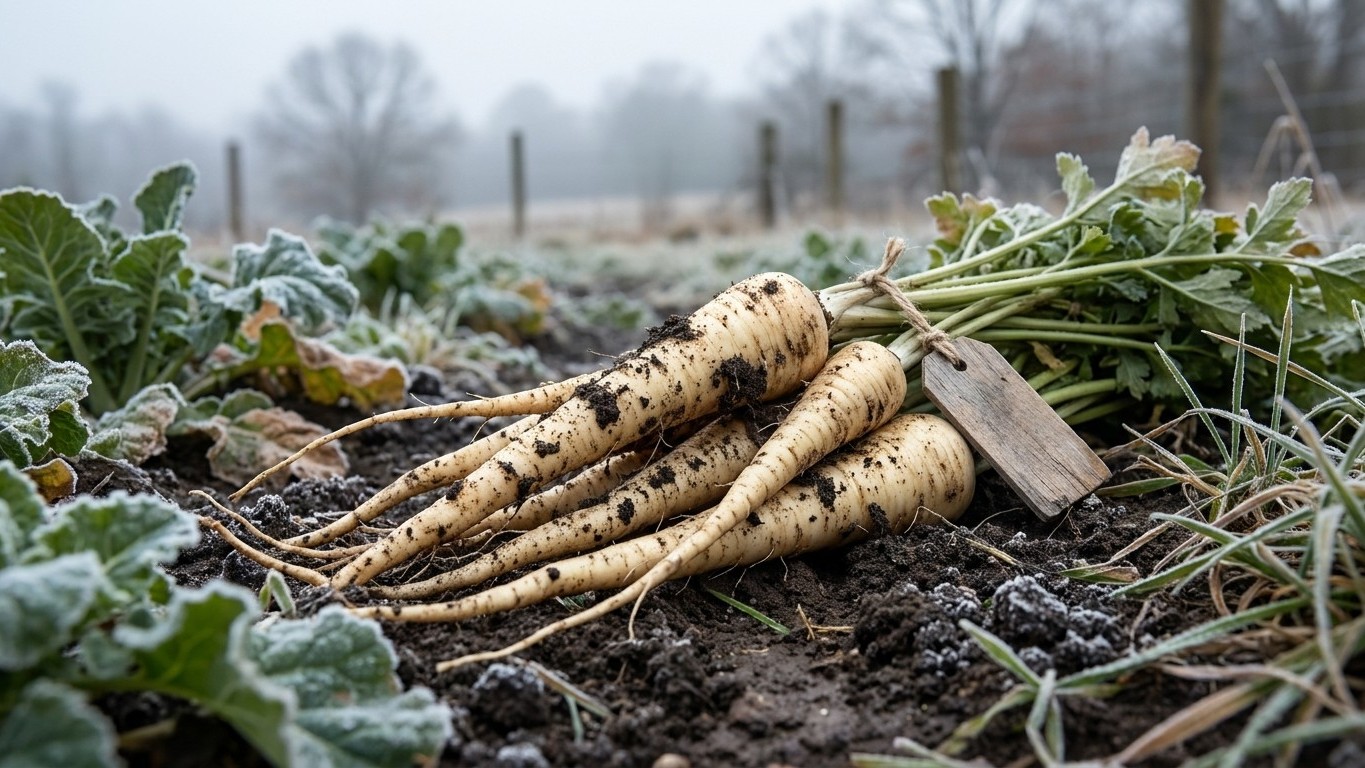

Yes, West Virginia grows parsnips that get properly sweet, not just parsnips that get big. The reference station in Charleston posts a coldest-month average minimum of 26.1°F, which means hard freezes are routine rather than occasional. That’s the exposure parsnips need to convert stored starch into sugar. The growing season lines up too, with room to spare between harvest-ready roots and the first frost. Still, soil and watering habits can undo all of that.
The short answer
The question that actually decides this isn’t what zone West Virginia sits in. It’s whether the coldest month here delivers real, sustained cold, the kind that sits on a root in the ground for weeks rather than a single overnight dip. At the Charleston reference station, the average daily minimum for the coldest month comes in at 26.1°F. That’s not a record low and not some abstract yearly average, it’s the typical low temperature the crop sits in during the coldest stretch, night after night. A number like that puts West Virginia solidly in frost territory, not marginal territory.
That distinction matters because a mild-winter zone can grow a parsnip that looks flawless and tastes like nothing. Sweetening isn’t a function of hardiness rating or which zone map a county falls into. It’s a direct chemical response to cold exposure: enzymes in the root break down starch into sugar as a defense against freezing, and that process needs several weeks of frosty weather, not a token frost or two. West Virginia’s coldest-month figure suggests the state clears that bar comfortably in most areas, since a 26.1°F average minimum means nights well below freezing are the norm rather than the exception during that stretch.
Where this gets more complicated is elevation. The Charleston station sits in a river valley, and river valleys run warmer than the ridges and higher ground surrounding them. Cold air pools in low spots on some nights and drains away on others, but broadly speaking, higher elevations across the state see earlier and harder frost in fall than the valley floor does. A backyard at 2,500 feet in the eastern highlands is going to hit its frost threshold well before a garden in the Kanawha Valley does. That’s good news for sweetening, since more frost exposure, not less, is what parsnips want. The risk in West Virginia isn’t a winter too mild to do the job; if anything, gardeners at higher elevation need to plan around an earlier frost arrival, not worry about whether frost will show up at all.
So the short answer holds across most of the state: plant them, leave them in the ground through the first hard frosts, and the sugar conversion will happen on its own. The soil and the calendar are the parts that require more attention.
Does the season fit?
Parsnips ask for 100 to 120 days from the day the seed goes into the ground, not from the day it sprouts. Utah State University Extension is specific about that: this is a crop sown directly in place, no transplanting, and the clock starts at seeding. Matching that requirement against West Virginia’s frost calendar means walking through the timeline step by step rather than eyeballing it.
- Sowing window: seed goes in 2 to 3 weeks before the last spring frost. With the last spring frost falling between April 9 and April 23 here, that puts sowing somewhere in the stretch from mid-March to early April, depending on exact location and how the soil is behaving that year.
- Germination lag: parsnip seed is slow, 14 to 21 days before anything visible breaks the surface. A row that looks like bare dirt for nearly three weeks is normal, not a failed sowing, so resist the urge to till it under and start over.
- Maturity: counting 100 to 120 days forward from the seeding date lands the roots at full size somewhere between late June and early August, well inside the growing season and nowhere near the calendar’s edge.
- Frost arrival: the first fall frost shows up between October 18 and November 1, months after the roots have already reached harvest size.
- The buffer: that leaves roughly ten to sixteen weeks of open ground between a mature root and the frost that will sweeten it, meaning there’s no scramble to beat the season and no reason to rush harvest before cold arrives.
Put together, the fit here is comfortable, not tight. The 100-to-120-day requirement clears West Virginia’s frost-free window with weeks left over on both ends, and that slack is exactly what lets gardeners leave the crop in the ground deliberately, waiting for frost to do its work rather than harvesting on a deadline.
What goes wrong here
- Forked roots from heavy or stony ground. Parsnips send a single taproot straight down, and anything that root hits, clay, rock, compacted soil, splits it into two or three legs instead of one straight root. Much of West Virginia’s ground runs to clay and stone on hillsides and in older gardens. The fix is deep, loose, sandy soil; where the native ground is heavy, double dig the bed to break up compaction well below where the root will travel, and clear stones out of that zone entirely.
- Forked roots from overwatering. This is a separate cause from soil texture, not the same problem restated. Too much water, especially inconsistent heavy watering after dry stretches, encourages the root to branch rather than drive straight down. Even a perfectly loose, sandy bed can produce forked roots if watering swings between soggy and bone-dry. Even moisture, not excess moisture, is the fix.
- A season that runs out. Sowing too late, waiting past the recommended 2-to-3-week window before last frost, eats into the buffer described above. At higher elevations where the local frost calendar shifts earlier than the valley reference dates, a late sowing can push maturity uncomfortably close to first frost. Sowing on time, right after the soil can be worked in that mid-March to early April stretch, keeps that buffer intact.
- Pulling the crop too soon. This isn’t a climate failure so much as an impatience failure. Roots dug right at the 100-day mark, before any real cold has settled in, will be mature but starchy rather than sweet. Given how much frost exposure West Virginia’s climate generally provides, the remedy is simply waiting: leave the roots in the ground through several hard frosts before digging.
Common questions
Do parsnips need to be dug up before the ground freezes solid?
No specific hard-freeze threshold is published in the data available here, so gardeners should watch their own ground conditions rather than a calendar date. The general practice is to dig before the soil freezes hard enough to make digging impossible, while still allowing several weeks of frost exposure first.
Can parsnips be left in the ground all winter in West Virginia?
Many gardeners do leave them in place and harvest through late fall and into early winter as needed, digging portions as the ground allows. A heavy mulch layer can help keep the bed workable longer into the cold season.
Does it matter which part of West Virginia the garden is in?
Yes. The frost dates and coldest-month figure cited here come from the Charleston reference station, a river valley that runs warmer than the surrounding highlands. Gardens at higher elevation should expect earlier fall frost and should sow accordingly, adjusting the mid-March to early April window earlier rather than later.
Why did my parsnips grow fine but taste bland?
That almost always traces back to harvest timing rather than the local climate. Roots pulled before several weeks of hard frost haven’t had the chance to convert starch to sugar yet. Given West Virginia’s coldest-month average minimum of 26.1°F, the frost exposure is generally available, it just needs to be given time to work before the roots come out of the ground.