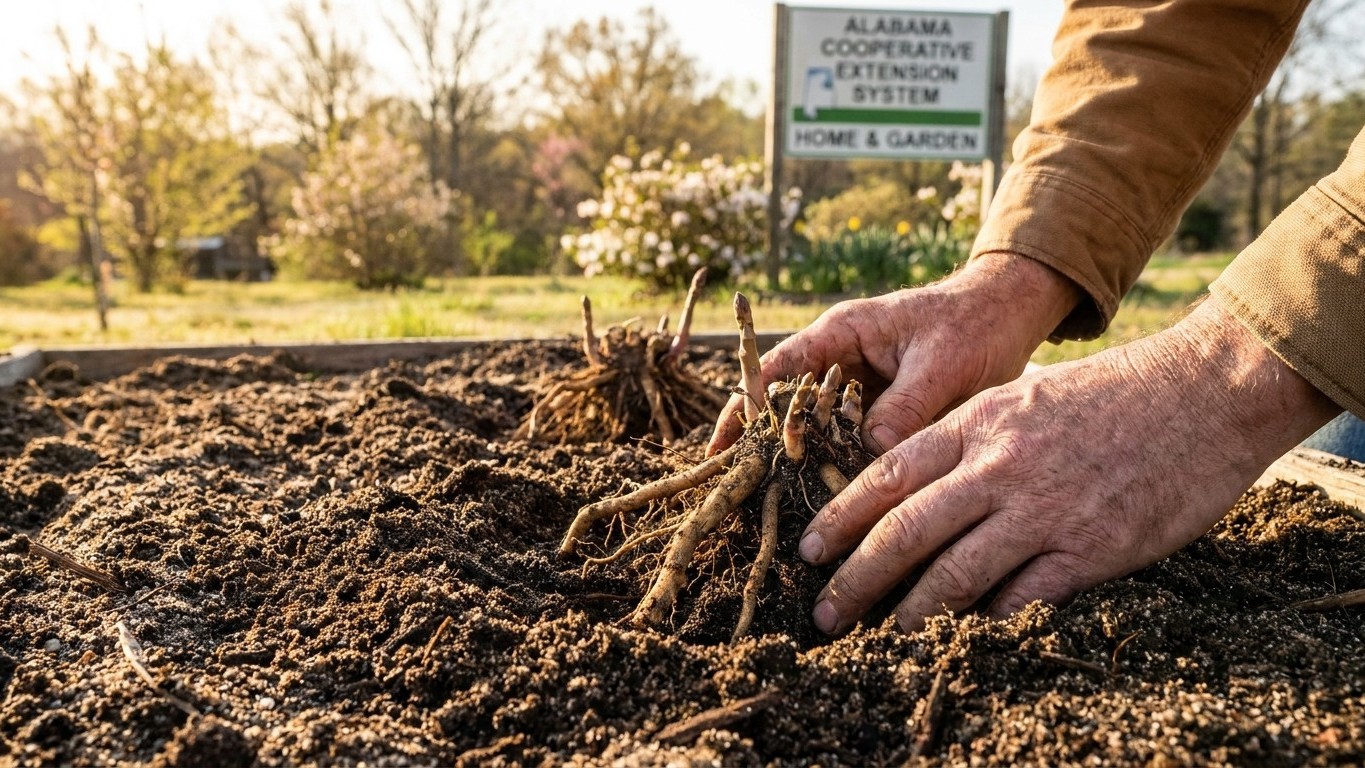

Plant Asparagus Crowns in West Virginia in early spring, timed to the state’s last-frost window of April 9 to April 23. The crowns go into an 8-inch furrow, and once that bed is established it will keep producing for 10 to 15 years. Soil drainage decides whether that decade and a half pays off. Asparagus tolerates most soils, but only the ones that drain.
The short answer
West Virginia’s official state soil, the Monongahela series, is classed as moderately well drained. That’s a middle grade, not a pass. The surface layer runs 27 percent sand, 18 percent clay and 54 percent silt, with organic matter around 3.0 percent and a surface pH near 5.0, which is strongly acid. A soil built that way holds water longer than a sandy loam would, and on flatter ground or wherever a builder has compacted the subsoil, that moderate rating can slide toward poor. For a crop planted once and left for a decade or more, that’s not a detail to shrug off.
This is a representative figure for the state, not a reading of any one backyard. Bottomland along a creek, a hillside plot, or a lot that’s been graded and filled will behave nothing like the mapped series. The only way to know what a specific bed does is to dig a hole, fill it with water, and time how long it takes to disappear. If it’s still standing after an hour, the ground is too tight for asparagus as it sits. The fix isn’t complicated: build a raised bed 8 to 10 inches high, or mound the row, and work in enough organic matter that water has somewhere to go besides sideways.
The commitment asparagus asks for is unusual among garden vegetables. There’s no harvest at all in the first two years, and the first cutting doesn’t come until year three, and even then it’s brief, about 4 weeks. The following year stretches to 6 weeks, and after that the bed can be cut for about 8 weeks each spring. The rule for stopping isn’t a date on a calendar. It’s a look at the spears: once most of them come up thinner than a pencil, cutting stops for the season so the plant can rebuild its roots.
Crown selection is limited to sex, not flavor or yield, at least according to the only source behind these figures. Four varieties are named this way:
| Variety | Type |
|---|---|
| Jersey Giant | All-male |
| Jersey Knight | All-male |
| UC 157 F1 | Male/female |
| Purple Passion | Male/female |
No published reason favors one over another here, so the choice comes down to whatever a local supplier carries.
Will the summer here water it for you?
An established asparagus bed wants 1 to 2 inches of water every other week for its first two years, then eases to every three weeks once the roots are deep. Charleston’s summer normals run 13.8 inches across June, July and August, split as 4.72 inches in June, 5.38 in July, and just 3.75 in August, the driest of the three. Laid against the every-other-week schedule, here’s how that plays out.
- June: 4.72 inches of average rainfall roughly matches the low end of what a young bed needs across the month, provided it falls in usable doses rather than one runoff-heavy storm.
- July: 5.38 inches looks generous on paper, but a single downpour that dumps most of that total in one afternoon soaks little of it past the top few inches, especially in a soil already inclined to hold water at the surface, like the Monongahela series.
- August: 3.75 inches is the month that exposes the gap. Spread evenly it’s under an inch a week, well short of the every-other-week 1-2 inch target, right when summer heat is pulling the most moisture back out of the ground.
- Year three and beyond: once watering shifts to every three weeks, August still tends to be the month a garden hose earns its keep, since it’s the one stretch where the normals fall shortest.
None of this replaces a rain gauge staked next to the row. Normals describe an average year built from three decades of records, not the year a bed is actually growing in. A slope, a nearby ridge, or simply a dry August can leave the ground short even when the seasonal total looks fine on a chart. The safest habit is checking soil moisture by hand every week through the growing season and adding water whenever the top few inches have dried out, rather than trusting the calendar alone.
When to put the crowns in
Crowns go into the ground in early spring, worked into an 8-inch furrow rather than dropped into a shallow hole. In the Charleston area, that window sits around April 9 to April 23, the span when the last spring freeze typically clears out. That’s a mean date built from three decades of records, not a guarantee tied to this particular year, so it’s worth treating as a target range rather than a fixed morning to circle. Gardeners at higher elevations across the state should expect that window to run later, since a river valley like Charleston warms faster than the ridges above it.
The furrow itself isn’t filled in all at once. Crowns are set at the bottom, covered lightly at first, and then backfilled gradually as the season goes on, adding roughly 2 inches of soil every other month until the trench is level with the surrounding bed. That staged fill lets the emerging spears push through loose soil rather than fighting a deep, compacted cover from day one.
Seed is the alternative route, and it moves the timeline in the opposite direction. Starting asparagus from seed adds a full growing season before crowns would even be ready to set out, since the plants need that first year just to build a root system worth transplanting. For a gardener who wants spears sooner rather than later, buying dormant crowns and setting them in early spring is the faster path; seed suits a patient gardener more interested in growing the whole plant from scratch, or one who can’t source crowns locally.
Nothing here is published about a chilling requirement tied to West Virginia’s winters, and no source behind these figures addresses ideal soil pH for the crop. Both would be reasonable things to guess at, but neither one is backed by data worth repeating as fact.
Common questions
Can asparagus crowns go in later than the April frost window if a cold snap runs long?
The April 9 to April 23 range is a mean, not a hard rule, so waiting a week or two for the soil to warm and dry after a late freeze is a reasonable adjustment rather than a mistake.
Does a heavier, slower-draining soil rule out asparagus entirely?
No. It means the bed needs help, usually a raised or mounded row with organic matter worked in, so water has somewhere to go besides sitting around the crowns.
Why is there no harvest at all for the first two years?
The plant spends those years building the root system that will feed a decade or more of spring cutting; cutting early would drain energy the roots haven’t stored yet.
How is the end of each harvest season decided?
Not by counting weeks on a calendar, but by watching the spears: once most of them come up thinner than a pencil, cutting stops so the plant can grow ferns and rebuild for next year.
If you follow the almanac, here is when to plant asparagus by the moon. It is a tradition, not a proven method.