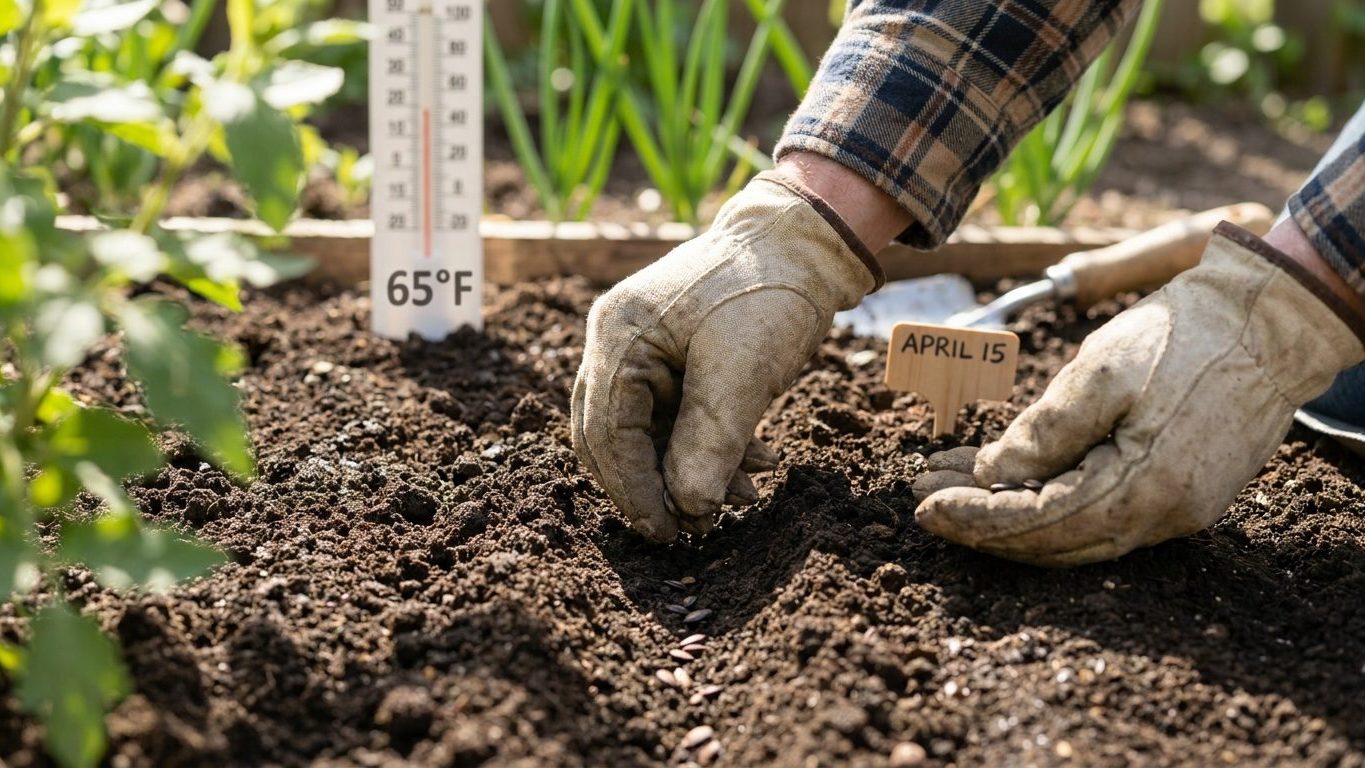

Most of Wisconsin can move melon transplants outdoors between late May and early June, once the soil has warmed past the point where the last frost date still matters. Seeds started indoors need a three to four week head start on that window, and gardeners direct-seeding should wait even longer for the ground to catch up.
The short answer for Wisconsin
NOAA’s 1991-2020 climate normals put Wisconsin’s last spring frost between April 16 and April 29, based on the 30-70% probability band at the reference station used for this data (USW00014839). That range is not a guarantee: it means that on any given year, there’s still a meaningful chance of a freeze on either side of it. It marks when frost becomes unlikely enough to risk a summer crop, not when the soil is actually warm enough for melons.
Melons germinate poorly, if at all, in cold soil. Where sweet corn tolerates soil in the high 50s, melons want it closer to 65-70°F, measured a few inches down. That threshold typically arrives two to three weeks after the last frost date, which is why the realistic outdoor window for direct seeding or transplanting sits in late May to early June across the southern two-thirds of the state, and later further north.
The fall side of the calendar is just as important, more so, since melons need every warm day they can get before frost cuts the vines down. First fall frost lands between October 17 and October 29 at the same reference station. Counting from a late-May transplant date to mid-October gives roughly 140 to 150 days on the calendar, but melons don’t use all of that as growing time. The first two to three weeks after transplant are mostly establishment, not fruiting growth, so the effective window for a melon to size up and ripen is closer to 100-120 days depending on how early the reader manages to get plants in.
That effective window is the number that should drive variety choice, not the full frost-to-frost span. A melon rated for 75-85 days to maturity from transplant fits comfortably. One rated for 95-100 days is cutting it close in a cool or delayed spring, and that’s before accounting for the state’s modest heat load, covered next.
What will not work here

Long-season melons bred for hot climates are the first casualty in Wisconsin. The reference station used for these normals averages just 7.0 days a year at or above 90°F. That’s a low heat load compared to the melon-growing regions these varieties were often selected for, and heat load, not just day count, is what pushes sugar development and ripening speed in melon fruit. A variety that needs consistent 85-95°F days to finish on schedule will often stall short of full ripeness here, even if the calendar days technically add up.
Watermelon varieties bred for very large fruit (the 20-25 pound icebox-and-up types) tend to fall into this same trap. They’re frequently rated at 85-100 days and expect sustained heat through the second half of that span. Smaller, faster watermelon types built for 70-80 days, and cantaloupe or muskmelon varieties in a similar range, have a far better track record of actually finishing before the October frost line closes the season.
Watering by memory instead of by month
Summer rainfall across June, July and August averages about 11.4 inches at the reference station, which sounds like enough to coast on. It isn’t evenly distributed. June averages 4.38 inches, August 3.65, but July, right when melon vines are setting and sizing fruit, drops to just 3.4 inches, the driest of the three. A gardener who waters on a fixed weekly schedule based on June’s rainfall will often under-water in July without noticing, since the plant doesn’t wilt dramatically, it just slows fruit sizing and sweetness.
The reverse problem shows up with spacing. Wisconsin’s rainfall pattern includes enough humid stretches, especially after a wet June, that melons planted too close together are prone to powdery mildew and other foliar disease. Vines packed tight to save space trap moisture at the leaf level longer after a rain or dew, and that’s exactly the condition mildew needs. Wider spacing than a seed packet suggests for a drier climate is often the safer call here.
What changes across Wisconsin
Wisconsin spans USDA Plant Hardiness Zones 3b to 6a, a system built on one variable: average annual extreme minimum winter temperature. That’s a wide spread for a single state, and it means there is no single planting date that fits both ends of it. A gardener near the zone 6a end of the range is typically working with a longer frost-free season and warmer spring soil than one near the 3b end, sometimes by several weeks on both the spring and fall side.
| Zone range end | General growing season pattern | Practical shift for melons |
|---|---|---|
| Toward 6a | Earlier soil warm-up, longer frost-free stretch | Closer to the standard late-May to early-June window; slightly longer-season varieties are more workable |
| Toward 3b | Later soil warm-up, shorter frost-free stretch | Push transplant later, favor the shortest-maturity varieties, lean on black plastic mulch or row cover to add heat |
The lakeshore adds its own wrinkle, separate from the zone map. Lake Michigan holds heat into fall, which delays the first freeze right along the shoreline compared to inland areas at a similar latitude. Inland southern Wisconsin typically sees its first freeze in early October, while the north freezes noticeably earlier still. A reader gardening within a few miles of the lake may get extra weeks in fall that a reader thirty miles inland, at the same latitude, does not.
None of this tells an individual reader which zone their own property falls into. The USDA Plant Hardiness Zone Map is the tool for that, and it’s worth checking directly rather than guessing from a county name or a memory of past winters, since zone boundaries inside a state this size can shift over surprisingly short distances.
Where to check this for your own county
Wisconsin as a whole is described by statewide climate normals at one reference station. A county-level recommendation from the University of Wisconsin-Madison’s Division of Extension will almost always beat what’s written here, because it accounts for local soil, microclimate and the varieties that have actually been trialled nearby, not just averaged statewide numbers.
University of Wisconsin–Madison Division of Extension‘s website is a good place to start. From there, the two things worth searching for specifically are a local or regional planting calendar for vegetables (Extension offices often publish these by county or by climate zone within the state), and any variety trial results for melons or cucurbits run through the county office or the university’s horticulture program. Those trials are where a gardener finds out which specific cantaloupe or watermelon cultivars have actually performed well in Wisconsin conditions, rather than relying on a seed packet’s national-average rating.
It’s also worth asking the local office, by phone or email, whether they’ve noticed a shift in typical last-frost timing in recent seasons. Climate normals are averages over a 30-year period (1991-2020 in this case), and an individual office tracking local frost reports year to year sometimes has a more current read on how the pattern is trending in that specific county.
Checking this against your own garden
Every date here is a regional average. The reader’s own garden, checked directly, outranks all of it, and doesn’t require any equipment beyond attention.
Soil warmth can be judged by feel: press a bare hand a few inches into the planting bed in mid-morning, after the surface sun has had time to work but before afternoon heat skews the reading. Soil that still feels cool and slightly damp-cold, even on a warm day, isn’t ready for melon roots yet, regardless of what the calendar says. Soil that feels neutral to warm at that depth is a better sign than any date.
Once plants are up, the first flush of male flowers is a useful marker, but not the one to celebrate. Melons typically produce several male flowers before the first female flowers (the ones with a small swelling at the base that becomes the fruit) appear. Seeing male flowers only means pollination is still a week or two off, and it’s a sign the plant has settled in and started reproductive growth, which is itself a good sign after a slow, cool spring.
The appearance of the first true leaves, the ones that look like small versions of the mature melon leaf rather than the rounded seed leaves, is the clearest signal that a transplant or direct-seeded plant has moved past the fragile establishment stage. A garden where true leaves show up quickly and evenly across a planting is running warmer and more favorably than the state averages suggest; one where they’re slow and uneven points to a cooler microclimate that might call for row cover or a later second planting as insurance.
Some gardeners also time melons by the Moon: when to plant watermelon and cantaloupe by the moon, as almanac tradition rather than fact.