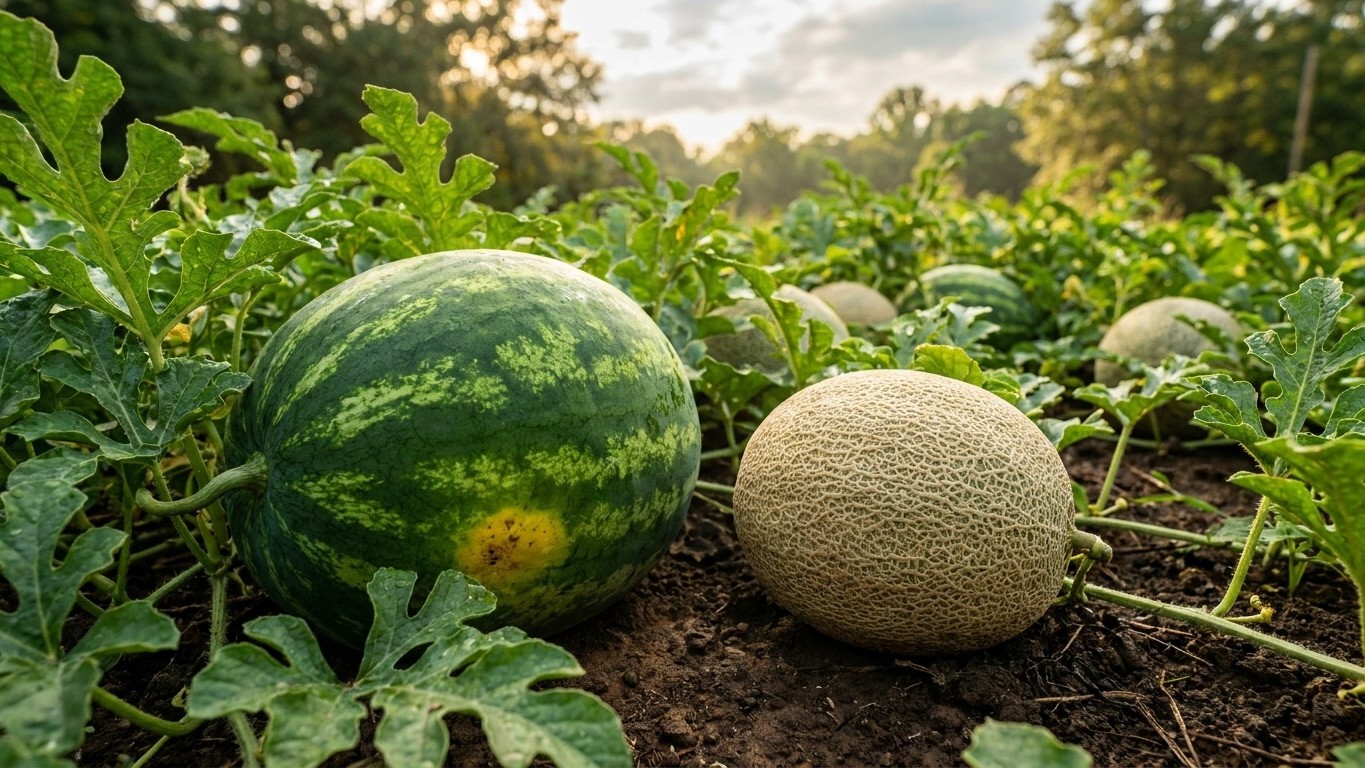

Short-season melons are the safer bet almost everywhere in Wisconsin. That means compact muskmelon and cantaloupe types built to ripen in 70 to 80 days, and icebox-style watermelons rather than the big 90-to-100-day field types. The reason isn’t really the calendar. It’s the heat.
The short answer for Wisconsin
Start with the frost dates, because they set the outer edges of the season. The last spring frost at the reference station (USW00014839, NOAA’s 1991-2020 Climate Normals) falls somewhere between April 16 and April 29, and the first fall frost lands between October 17 and October 29. Stack the earliest fall frost against the latest spring one and the frost-free window shrinks to about 171 days. Stack the latest fall frost against the earliest spring one and it stretches to roughly 196 days. Either way, that’s enough raw days on the calendar for almost any melon type to reach maturity.
Days on the calendar aren’t the whole story, though. Melons don’t ripen on daylight alone, they ripen on heat units, and Wisconsin’s heat load is thin. The reference station averages just 7.0 days a year at or above 90°F. That’s the number that actually separates the melons worth planting here from the ones that will sit green on the vine into October.
A muskmelon or cantaloupe bred for a 65-to-80-day maturity window converts that modest heat budget efficiently: it sets fruit early in the warm stretch of July and finishes before the heat units run out. A compact, early watermelon type in the 75-to-85-day range does much the same. Full-size watermelons bred for 90 to 100 days, and heat-hungry specialty melons like casaba or late honeydew types, are betting on a summer that this station’s own normals say doesn’t show up often enough.
| Melon type | Typical days to maturity | Fit for Wisconsin’s heat load |
|---|---|---|
| Short-season muskmelon / cantaloupe | 65-80 | Good match |
| Icebox / compact watermelon | 75-85 | Good match |
| Full-size, long-season watermelon | 90-100+ | Marginal without season extension |
| Casaba, late honeydew types | 100+ | Poor fit statewide |
Season-extension tricks (black plastic mulch, row cover early on) can push a marginal type into range, but that’s compensating for a heat deficit, not something the open ground here provides on its own.
What will not work here

The clearest failure pattern is a full-season watermelon planted as if it were growing in Georgia. With only 7 days a year above 90°F, the sugar-building heat spike those varieties depend on for the last stretch of ripening just doesn’t arrive reliably. The vine can look healthy, the fruit can size up fine, and the flesh still comes out pale and watery because the plant never got the heat units to finish the job.
Rainfall works against certain habits too, though not the way most gardeners assume. Summer rain at the reference station averages about 11.4 inches across June, July and August, with July running driest at 3.4 inches and June wettest at 4.38. That sounds like enough to skip watering. It isn’t, and here’s why: a lot of that rain arrives as a single thunderstorm rather than a steady soak. On the sandy soils common in Wisconsin’s central and northwestern counties, that water passes through the root zone within a day, leaving the plant dry again well before the next storm. A weekly watering habit built around “we got rain this week” fails on that kind of ground, even in a summer with normal totals.
Tight spacing is the other common misstep, and it interacts directly with those same rainfall numbers. Melon vines packed close together trap humidity after a thunderstorm-driven soak, and that moisture sits on the leaves longer without airflow to dry it out. Powdery mildew and other foliar disease follow. A spacing plan copied from a seed packet written for a drier Western state doesn’t account for how a Midwest thunderstorm-and-humidity pattern behaves on a crowded vine.
Finally, a short season defeats the slowest melons outright in parts of the state where the frost-free window sits closer to 171 days than 196. A 100-day watermelon planted from seed directly in the ground, rather than transplant, can run out of runway before the first fall frost even shows up on the early end of that range.
What changes across Wisconsin
Wisconsin is not one growing zone, and treating it as one is where a lot of melon disappointment starts. The USDA Plant Hardiness Zone Map (built on the 1991-2020 normals) puts the state anywhere from zone 3b to zone 6a. That’s a wide spread for a single state, and it’s built on one variable only, the average annual extreme minimum winter temperature, not the length of the growing season directly. But the two track closely enough in practice: the coldest zones tend to sit where the growing season is shortest.
The frost-date range in the facts above already hints at this. The state’s caution note is specific: Lake Michigan delays the first fall freeze right along the lakeshore, while inland southern Wisconsin typically freezes in early October and the north freezes considerably earlier than that. A gardener working a plot a few miles from the lakeshore can be picking melons into a mild mid-October, while a gardener two counties north or west is already looking at frost damage.
That spread means there’s no single planting date, and no single “safe” melon type, that applies to the whole state. A gardener in the milder southern tier, especially near the lake’s moderating effect, has more room to try a slightly longer-season watermelon or push a transplant date a week earlier. A gardener in the north, where the season runs shorter and the winters colder, should lean harder toward the fastest-maturing muskmelon and icebox watermelon types, and treat any variety over 85 days as a stretch goal rather than a default choice.
None of this is a substitute for knowing which zone applies to a specific piece of ground. The USDA’s own map, not a state-wide range, is the tool for that.
Where to check this for your own county
Wisconsin as a whole is covered here using one reference station’s normals. That’s useful for ruling melon types in or out at the state level, but it isn’t a county recommendation, and a county recommendation is what actually matters when a specific planting date is on the line.
The University of Wisconsin’s Cooperative Extension, at extension.wisc.edu, is the place to take this next. Two things are worth looking for there specifically. First, a local planting calendar tied to a county or regional office rather than the statewide average, since the frost-date spread already discussed here (April 16 to April 29 for spring, October 17 to October 29 for fall) can shift by a week or more depending on exactly where that county sits relative to Lake Michigan or the state’s northern tier. Second, any variety trial results published for melons in that region. Extension offices routinely test cantaloupe, muskmelon and watermelon cultivars against local disease pressure and local heat accumulation, which is a more direct answer than a national seed catalog’s generic days-to-maturity number.
A county-level source will also flag anything unusual to that specific area: a pocket of sandy soil that needs different watering habits, a documented disease pressure like powdery mildew showing up earlier some years, or a local microclimate that runs a week or two ahead of or behind the state normals used here. The state level is the starting point. The county office is where that starting point gets corrected for one actual garden.
Checking this against your own garden
None of the numbers above beat what a gardener can feel and see on their own ground, and three signs settle most of the uncertainty a frost date alone can’t resolve.
Soil warmth by hand is the first and most direct check. Melon seed germinates poorly in cold soil no matter what the calendar says, so pressing a hand a few inches into the planting bed and feeling for warmth that holds steady, not just a sunny afternoon surface warmth, is a better transplant signal than any date.
The first flush of male flowers is the second sign worth tracking. Melon vines produce male blooms before the female flowers that actually set fruit, and a heavy early flush of males with no females yet is normal, not a problem. It’s the timing of that first flush, early or late relative to a typical year on that same plot, that tells a gardener whether their particular spot is running warmer or cooler than the regional normals suggest.
The appearance of the first true leaves, the second set that emerges after the rounder seed leaves, marks the point where a seedling has shifted from surviving on stored seed energy to actually growing on its own. A slow gap between seed leaves and true leaves usually points to a soil that’s still too cool, regardless of what the frost-date range implies about the season having started.
Watching those three signs on one specific patch of ground, season after season, builds a more reliable local calendar than any single station’s 30-year average ever will.