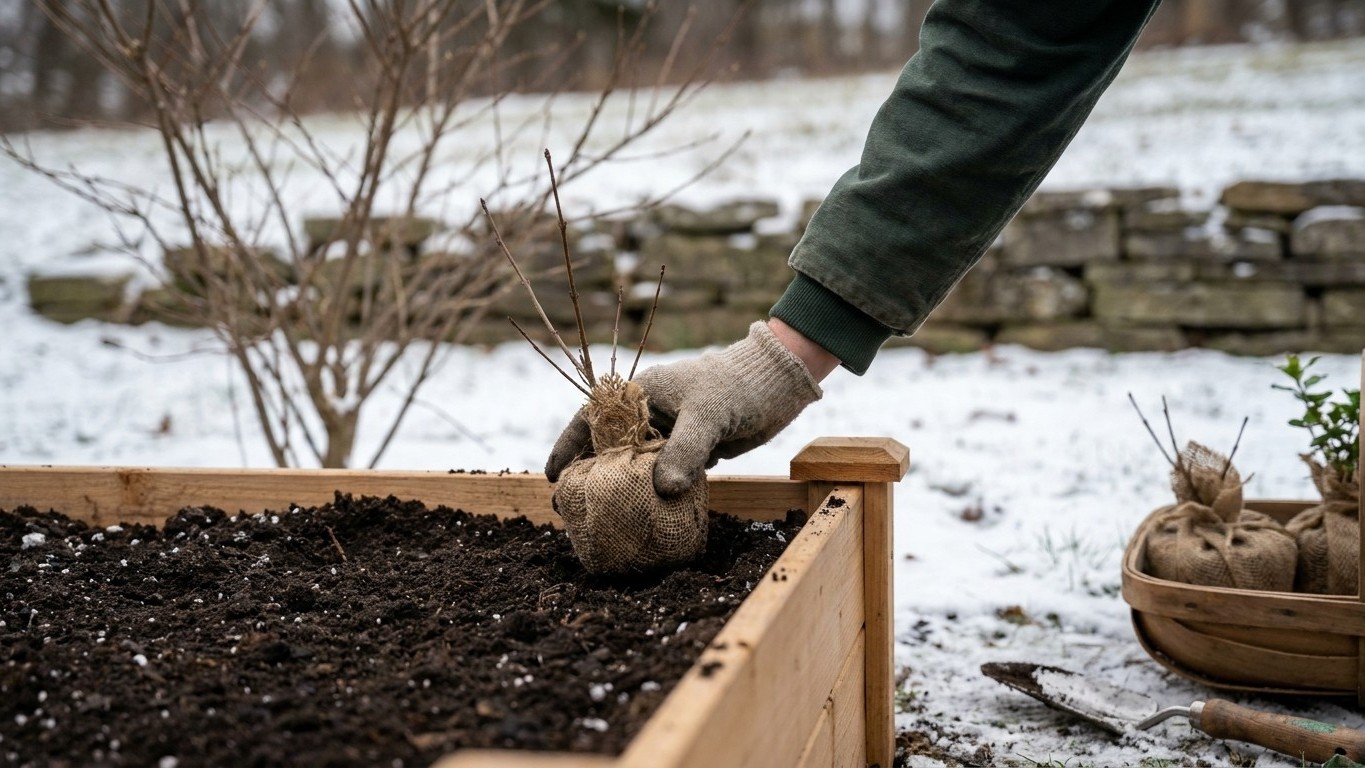

December in Wisconsin sits weeks past the state’s average first fall frost and months ahead of the last spring one, so the direct answer is short: nothing new goes into open ground. What’s left is bare-root and dormant plantings where the soil still allows it, cold frames and low tunnels protecting what’s already growing, seed started under cover for the longest-lead crops, and the pruning, ordering, and planning work that decides how strong next season starts.
What goes in the ground in December
Wisconsin’s USDA hardiness zones run from 3b in the north to 6a in the south, and that range matters more in December than almost any other month, because it decides whether the ground is frozen solid or just cold. According to NOAA’s 1991-2020 climate normals, the state’s average first fall freeze falls between October 17 and October 29. By December, soil temperature a few inches down has typically dropped well below anything a root can use, and in the north it’s frozen hard enough that a shovel bounces off it.
That means the honest answer for most of the state is that no new seed or transplant goes outside this month. Garlic and shallots are the exception that proves the rule: they’re normally tucked in during October so roots can establish before freeze-up, and by December that window has almost always closed. In the southernmost zone 6a counties, near the Illinois border, an unusually open stretch of ground in early December can still take a late garlic planting, but treat that as a narrow exception, not a plan.
What’s still possible
A few things genuinely belong in a Wisconsin garden this month:
- Cold frames and low tunnels protecting hardy greens already in the ground, keeping soil a few degrees warmer than open air
- Bare-root fruit trees, shrubs, and roses, but only on the rare day the ground is workable rather than frozen
- Forcing rhubarb or witloof chicory indoors in a dark, cool space for an out-of-season harvest
- Mulching perennial beds and strawberry rows heavier once the ground has frozen, not before
Nothing on that list involves fresh seed hitting bare December soil, and that’s by design, not by omission.
What to start under cover
Counting backward is the only way this works. Wisconsin’s last spring frost falls between April 16 and April 29 depending on location, and most vegetable transplants need six to ten weeks indoors before they go out around that date. Run the arithmetic and most sowing dates land in January or February, not December, which means this month is mostly a holding pattern for indoor starts.
There are two real exceptions. The first is winter sowing: perennial flowers and native wildflowers that need 60 to 90 days of cold stratification before they’ll germinate can be sown into small containers and set outside now, using the cold months themselves as the incubator. The container acts like a mini cold frame, and the seed wakes up on its own once temperatures rise. The second is the small group of vegetables with unusually long lead times, such as celeriac or the slowest artichoke varieties, which can start indoors in the back half of December in the earliest-frost southern counties and still be ready to move out by late spring.
Everything else is a trap dressed up as a head start. Sow tomatoes, peppers, or squash this early and by transplant time they’re rootbound, leggy, and stressed before they ever see the garden, which sets them back further than starting on schedule would have. The opposite mistake, waiting too long on the true long-lead crops like onions from seed, means running out of season entirely once the calendar catches up. December’s job is patience for most crops and precise timing for the handful that need a true head start.
What is ready to pick
Outdoors, the harvest is thin to nonexistent across most of Wisconsin by December, and there’s no point pretending otherwise. The garden’s outdoor producing season closed with the fall frost weeks earlier. What still feeds a household comes from three places instead.
Overwintered kale, leeks, and Brussels sprouts left in the ground under a heavy mulch or a blanket of snow often taste better after a hard frost, since cold converts stored starches to sugar. Digging them out takes some work when the ground is frozen, but the flavor reward is real. Cold frames extend this further, holding spinach, mache, claytonia, and other cold-hardy greens in a harvestable state well into winter with almost no input beyond keeping the frame closed on the coldest nights.
Indoors, sprouts and microgreens fill the gap on a much faster cycle, ready in one to two weeks from a windowsill tray with no soil required for many varieties. Stored crops need attention too. Squash, potatoes, and onions put up in the fall should get a hands-on check now: soft spots, a sweet fermented smell, or sprouting eyes mean that item gets used immediately rather than left to spread rot to its neighbors in storage.
The jobs that matter this month
A garden with nothing new in the ground still has a full workload, and December’s jobs are the ones that quietly decide how next season starts.
Dormant pruning of apple and pear trees, along with raspberry and blackberry canes, is best done while the plant is fully asleep and the structure is easy to see without leaves in the way. Seed catalogs are worth ordering from early, since the most popular and most disease-resistant varieties routinely sell out before spring planting season arrives. This is also the natural time to sketch next year’s crop rotation on paper, moving nightshades, brassicas, and legumes to new beds so the same soil-borne pests and nutrient drains don’t hit the same spot two seasons running.
Soil testing doesn’t have to wait for spring either. A sample sent to a lab now gives results in time to plan amendments, rather than scrambling once planting season is already underway. Compost piles benefit from a turn and, if they’re stalled by cold, a layer of insulating material like straw to keep the microbes working. Tools deserve real attention too: cleaning off caked soil, sharpening pruners and hoe edges, and oiling metal parts before months of damp storage take a toll. Raised beds, trellises, and fencing that took a beating during the growing season get fixed now, while there’s time and no plants in the way. None of this shows up as a harvest, but skip it and the cost shows up in spring as delayed planting, dull tools, and beds that need repair mid-season instead of before it.
What not to do in December
The most common mistake is trusting the air temperature over the soil. A mild, sunny December day can feel like spring, but the ground several inches down is often still frozen or close to it, and anything planted into it simply sits without rooting. Check the soil itself, not the thermometer reading for the afternoon.
A related error is uncovering mulched perennials or strawberry beds too early after a warm stretch. That mulch is doing a specific job, buffering the soil against the freeze-thaw cycles that heave roots and crowns out of the ground. Pull it back during a thaw and a hard freeze a few days later can do real damage to a plant that survived the whole winter otherwise.
Pruning during a warm spell carries its own risk. Cuts made when wood has softened slightly in a thaw are more vulnerable to damage if temperatures drop hard right after, so dormant pruning is safest done on a cold, stable stretch rather than the first mild day that comes along.
Nitrogen is the other classic misstep. Feeding it to dormant lawns, trees, or overwintering perennials this month doesn’t help anything currently growing, since almost nothing is in active growth, and it risks leaching away with winter precipitation before roots can ever use it. Save the feeding program for when growth actually resumes.
Checking this against your own county
A state-wide December guide is a starting point, not an instruction sheet. Wisconsin’s hardiness zones span 3b to 6a, and that range alone can shift a frost window by weeks between the far north and the southern counties. Lake Michigan adds another layer, delaying the first fall freeze along the lakeshore while inland spots freeze considerably earlier, and elevation changes the picture again in hillier areas.
The most reliable way to translate any of this to a specific address is the University of Wisconsin-Madison Division of Extension, which publishes county-level guidance and a planting calendar built for local conditions rather than a statewide average.
Common questions
Can I plant garlic in Wisconsin in December?
Generally no. Garlic is normally planted in October so roots establish before the ground freezes, and by December that window has closed across most of the state. Only in the warmest southern counties, on a rare stretch of unfrozen ground, does a late planting still have a chance.
What vegetables survive a Wisconsin winter in the ground?
Kale, leeks, and Brussels sprouts can survive under a heavy mulch or snow cover and are often sweeter after frost exposure. Cold frames extend this list further to include spinach, mache, and claytonia, held in a harvestable state through much of the winter.
When should I start seeds indoors for a Wisconsin garden?
Count backward from the last spring frost, which falls between April 16 and April 29 depending on location. Most vegetable transplants need six to ten weeks indoors, putting the bulk of indoor sowing in January and February rather than December.
Is it too late to prune fruit trees in December?
No, December is a good time for dormant pruning of apples, pears, and cane fruits, as long as the wood is fully frozen-dormant rather than softened by a recent thaw. Wait for a cold, stable stretch rather than the first mild day.