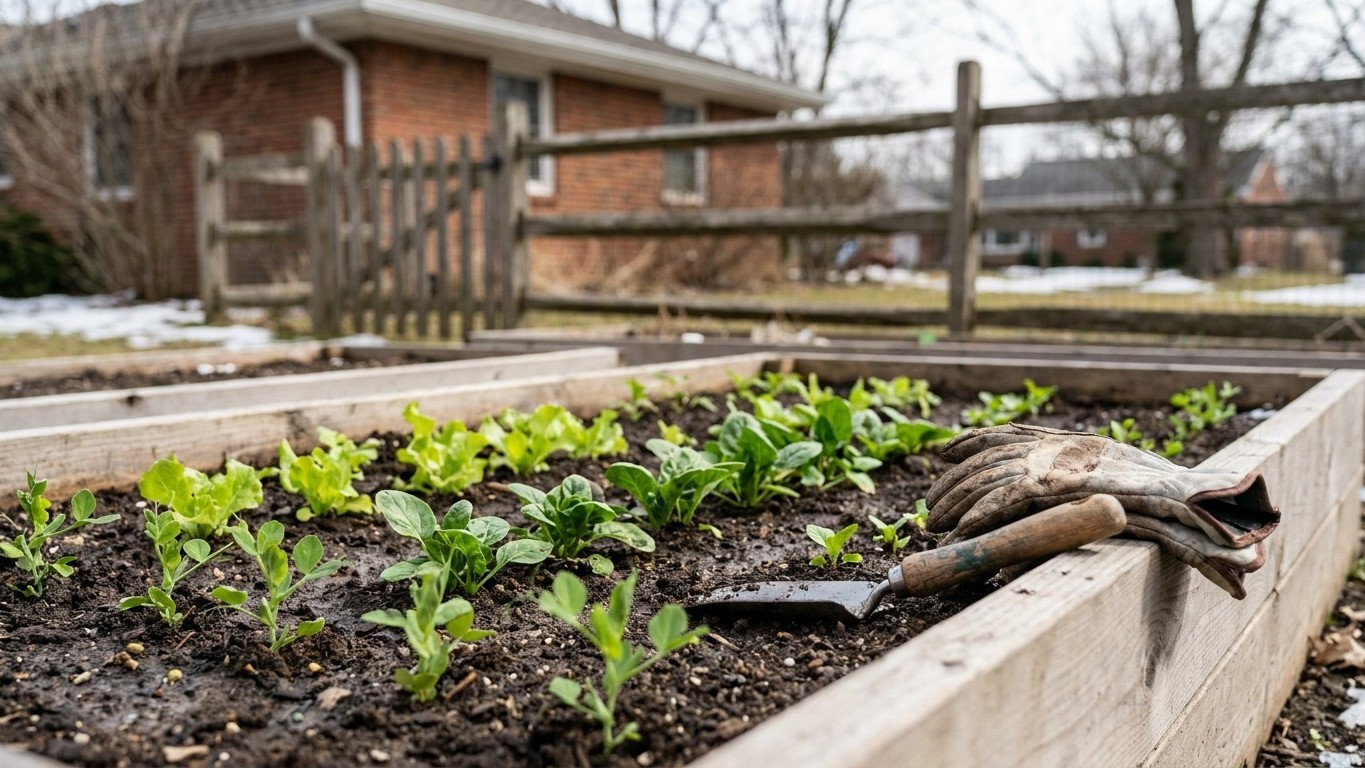

March in Wisconsin sits well ahead of the frost window, so the honest answer is: almost nothing goes into open ground yet. What you can do is prep bare-root stock, force a few crops indoors, and get hardy greens started under cover, while the real planting calendar waits for April and May.
What goes in the ground in March
Soil temperature decides what survives outdoors, not the page of a calendar. Wisconsin’s last spring frost falls between April 16 and April 29, depending on where in the state you garden, which puts most of March three to eight weeks ahead of that window. Ground in the north is often still frozen solid or buried under snow. In the south, soil is frequently thawed on the surface but saturated underneath from snowmelt, which is exactly the kind of cold, wet soil that rots seeds before they germinate.
That said, a few things move forward this month if the ground is workable. Garlic and shallots, if fall planting was missed, can sometimes still go in during a thaw window in the southern counties, though results trail well behind fall-planted crops. Bare-root fruit trees, brambles, and asparagus crowns are typically shipped by nurseries for exactly this stretch, and they go into the ground as dormant stock the moment the soil can be worked with a shovel rather than a pick. Cold frames and low tunnels let you push spinach, mache, and hardy lettuce a few weeks earlier than open ground would allow, because they buffer the coldest nights.
What still works indoors
Forcing crowns is one of the few genuinely productive March projects. Rhubarb and chicory crowns, dug and brought into a dark, cool space, can be forced into pale, tender stalks or chicons within a few weeks, giving you a harvest while the garden itself is still bare. It is a low-tech trick, and it is one of the only fresh crops this month realistically delivers.
What to start under cover
Seed starting in March is arithmetic, not habit. Count backward from the April 16 to April 29 frost window and the math tells you when to sow. Tomatoes need roughly six to eight weeks indoors before transplant, which lands the sowing date in the first half of March for most of the state. Peppers and eggplant run longer, eight to ten weeks, so if seed hasn’t gone in by late February, early March is the last reasonable window without pushing transplant dates too late. Broccoli and cabbage also want six to eight weeks under lights, and because they tolerate cooler soil, they can go outside under cover before tomatoes do.
The two ways this goes wrong are opposite problems. Start too early without strong light and warmth, and seedlings stretch into leggy, rootbound plants that struggle after transplant, especially peppers, which sulk badly once pot-bound. Start too late, particularly in the northern counties where the growing season is already shorter, and slow-maturing crops like peppers or eggplant may not size up before fall frost arrives in mid-to-late October. Southern Wisconsin gardeners have a little more slack than gardeners near Lake Superior or in the state’s colder interior valleys, where the whole calendar compresses.
A heat mat under trays speeds germination for peppers and tomatoes, both of which are slow to sprout in cool rooms. Grow lights matter more than a sunny window this early in the year, since March daylight in Wisconsin still runs short and weak.
What is ready to pick
Outdoors, March offers little. Kale and leeks that overwintered under snow cover can still be usable if they survived, and pulling them as soon as the ground softens enough to dig is worth doing before they turn woody with the first real warmth. Cold frames that were seeded in fall or late winter may be holding a small crop of spinach or arugula, and that is often the only fresh green harvest of the month for gardeners without a heated greenhouse.
Indoors, sprouts and microgreens are the reliable win. Both grow from seed to harvest in a week or two on a countertop, regardless of what is happening outside, and they are an easy way to get fresh greens onto the table while the garden itself is dormant.
This is also the month to walk the root cellar or basement storage and take stock. Squash with soft spots near the stem end are starting to break down and should be used first. Potatoes that have sprouted eyes are still edible once the sprouts are removed, but they are declining fast. Onions gone soft at the neck won’t hold much longer. Sorting stored crops now, rather than discovering the losses later, saves food that is still good and keeps rot from spreading to the rest of the batch.
The jobs that matter this month
March carries more weight than its bare planting list suggests, because several jobs here have hard deadlines attached. Dormant pruning of fruit trees, brambles, and grapevines needs to happen before buds swell, since cuts made after growth starts cost the plant stored energy and invite disease into fresh wounds. Apple and pear trees, along with raspberry and blackberry canes, are still dormant through most of the month across Wisconsin, which makes this the window.
Seed ordering is a deadline job too. Popular varieties, especially disease-resistant tomatoes and anything from a small regional seed company, sell out by early spring, and a gardener who waits until April is choosing from what’s left rather than what they actually wanted.
Soil testing pays off now if the ground has thawed enough to pull a sample, since results take a few weeks to come back and amendments like lime need time to work into the soil before planting begins in earnest. Turning the compost pile as it thaws restarts decomposition that cold weather stalled, and a pile turned now will be closer to finished by the time it’s needed for bed prep.
Round out the month with the unglamorous maintenance: sharpening and oiling pruners and shovels, checking hoses and drip lines for winter cracks, repairing raised bed frames and deer fencing before anything is growing behind them, and mapping out crop rotation so beds that grew tomatoes or brassicas don’t repeat the same family. None of this shows up in a harvest basket, but skipping it costs real time once the season actually opens.
What not to do in March
The most common mistake is treating a warm afternoon as a season change. A 60-degree day in March does not mean the soil has warmed to match, and direct-sown warm-season seeds like beans, squash, or corn will simply sit in cold, wet ground and rot rather than germinate. Wait for the soil itself to warm, not the air.
Uncovering mulch or winter protection too early after a mild stretch is the second classic error. Wisconsin’s frost window runs into late April in a normal year, and a stretch of warm days in March is routinely followed by a hard freeze. Strawberry beds, perennial crowns, and newly planted bare-root stock that get stripped of mulch too soon are exposed right when a freeze is still likely.
Fertilizing too early is the third trap. Nitrogen applied to lawns or perennial beds before roots are actively growing mostly washes away with snowmelt and spring rain, feeding runoff instead of plants, and it can also push premature top growth that a late frost then damages. Hold off until soil and air have both warmed consistently, not just for a few days.
Finally, resist starting every seed tray on the same day out of impatience. Staggering start dates by crop, based on the backward count from frost, avoids the leggy-seedling problem that comes from weeks of indoor waiting.
Checking this against your own county
A state-wide answer for March is a starting point, not a instruction sheet for a specific yard. Wisconsin spans USDA Hardiness Zones 3b to 6a, and that range alone means a gardener near the Lake Michigan shoreline is working weeks ahead of one in the state’s northern interior. Elevation, wind exposure, and the moderating effect of Lake Michigan and Lake Superior all shift real-world frost dates in ways a single statewide range can’t capture. Before committing seed or transplants to the ground, check current conditions and local frost data through the University of Wisconsin-Madison Division of Extension, which maintains county-level guidance and planting calendars tuned to local conditions.
Common questions
When is it safe to plant tomatoes outside in Wisconsin?
Not until after the last spring frost, which falls between April 16 and April 29 depending on location. Tomato transplants started indoors in early March are typically ready to go out once that window has passed and nighttime lows have stabilized.
What is the USDA hardiness zone for Wisconsin?
Wisconsin ranges from Zone 3b in the coldest northern interior to Zone 6a near the Lake Michigan shoreline, based on the USDA Plant Hardiness Zone Map. That spread is wide enough that a planting date good for one part of the state can be off by weeks for another.
Can you plant grass seed in March in Wisconsin?
Soil temperatures are generally still too cold for reliable germination this early across most of the state. Cool-season grass seeding works better later in spring or in early fall, once soil has warmed or cooled into the right range.
What vegetables can handle frost in Wisconsin?
Spinach, kale, and other hardy greens tolerate light frost and are the safest bet for cold frames or low tunnels this early. Onions, shallots, and garlic also handle cold soil far better than tomatoes, peppers, or squash, which need soil and air well above freezing to thrive.