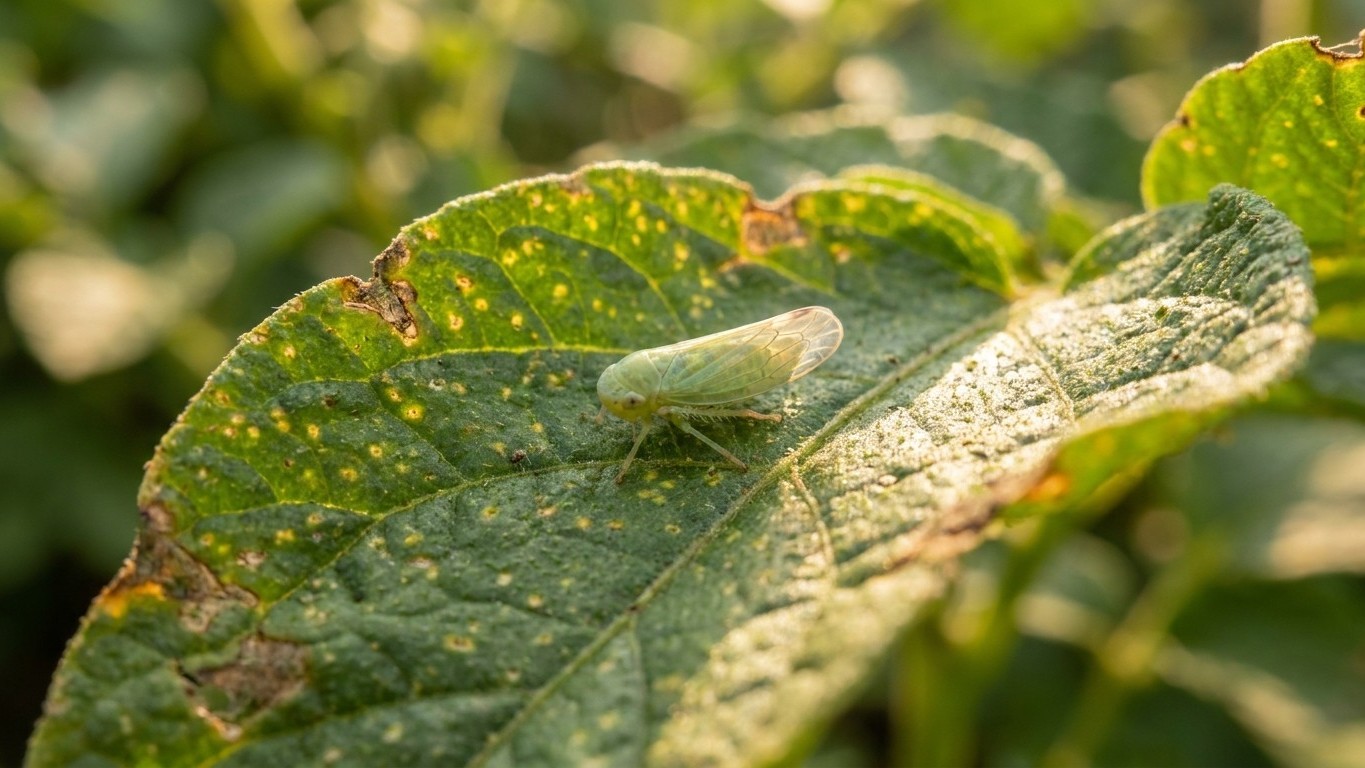

Potato leafhopper doesn’t overwinter in Wisconsin. It rides warm southerly winds up from the Gulf Coast each spring, usually landing in the state sometime between late April and June, then builds toward a mid-to-late-summer peak. There’s no single “leafhopper day” on the calendar, only a wide window tied to wind patterns and how fast the season warms.
The weeks to watch

The University of Wisconsin-Madison Division of Extension’s home vegetable garden guide (A2088) doesn’t publish a species-specific arrival window for potato leafhopper. What it does say is that the home-garden pest season runs April through September, and that most pests in that guide don’t become abundant until mid-August. That’s a general pattern covering the whole insect lineup in a home garden, not a potato-leafhopper-only forecast, but it’s the closest local benchmark available, and it lines up with what’s known about the species’ migratory habits.
Early arrival, low numbers
Because the insect flies in on storm fronts rather than emerging from local soil, the first individuals can show up any time the wind cooperates, sometimes as early as late April in a mild spring. Numbers stay low at this stage. Damage is rarely visible yet.
The mid-to-late-summer buildup
Populations climb through June and July as adults reproduce on-site, and by the point the extension guide flags for general garden pests, mid-August, leafhopper numbers and the visible damage they cause are usually at their worst. That’s also when many home gardeners first notice something’s wrong, well after the insect actually arrived.
Reading the calendar from your last frost

The insect doesn’t care what the calendar says. It cares about wind and warmth, and those two things determine how early it reaches a given garden. What a Wisconsin gardener actually has on hand is a frost date, and that’s a useful anchor even though the leafhopper’s arrival isn’t fixed to it the way a soil-temperature pest would be.
NOAA’s 1991-2020 climate normals put the last spring freeze for southern Wisconsin (station USW00014839) between April 16 and April 29. Transplants typically go in the ground once that risk has passed. From there, count forward toward the extension guide’s mid-August pest peak to get a working sense of how long a young planting has before pressure builds.
- Start from your local last-frost window: April 16 to April 29 for the southern part of the state, later farther north.
- Count forward to mid-August, the point the extension guide flags as when garden pest pressure generally becomes heaviest. That’s roughly fifteen to sixteen weeks, a season-long span, not a single trigger date.
That stretch is exactly why row covers can’t just go on once and stay put. They need to come off for pollination on crops that need it, and go back on, or come off for good, depending on when leafhopper numbers are actually climbing in a given year. An early warm spring pulls that whole timeline forward; a cold, wet one pushes it back.
What it attacks, and what the damage looks like

The tell usually shows up before the insect does. Leaf tips and margins turn yellow, then brown, in a wedge or V-shaped pattern that spreads inward, a symptom growers call hopperburn. Leaves may cup, curl, or feel brittle at the edges, and heavily hit plants look stunted and scorched even with plenty of water. That scorched look is the giveaway, since it mimics drought stress closely enough that gardeners often water more, which doesn’t help.
Both nymphs and adults do the damage, feeding on the underside of leaves by piercing plant tissue and removing sap while injecting saliva that damages the surrounding cells. Nymphs are wingless and far less mobile than adults, which means they stay put on one leaf and feed continuously, often doing more damage per insect than the adults that can fly off to a fresh plant. That distinction matters for treatment timing, since nymphs are easier to catch with a direct spray of water or a close inspection of leaf undersides, while adults simply move on.
Crops most commonly affected in home settings include:
- Potatoes
- Snap beans and other legumes
- Alfalfa (a major host in agricultural settings, and a source of leafhopper flushing into nearby home gardens after mowing)
- Rhubarb and some ornamentals, including certain maples
How Wisconsin sits in this pest’s range

Potato leafhopper isn’t a regional specialty. It’s a widespread migratory insect that reaches most of the eastern and midwestern United States every growing season, since it can’t survive northern winters and simply reinvades from the south each year. For a state like Wisconsin, that widespread range means the real question isn’t whether the insect shows up, it’s when and how heavily, since presence itself isn’t in doubt in any given year.
The state’s own extension service, University of Wisconsin-Madison, is the source for the general home-garden pest season used above, so there’s no need to borrow a neighboring state’s data here, the guidance is already local. What that guidance doesn’t do is rank Wisconsin’s severity against other states or flag a particular part of the state as a hot spot, so any claim about the northern part of the state seeing lighter pressure than the south should be treated as a reasonable inference from a shorter growing season, not a documented fact.
What actually works against it

Because this insect blows in fresh every year instead of overwintering locally, tactics that work well against soil-dwelling or overwintering pests, crop rotation, fall cleanup, tilling under old plant debris, don’t do much here. The insect isn’t hiding in last year’s soil. It’s arriving on the wind this year, which changes which defenses are worth the effort.
- Choose resistant or tolerant varieties. Some potato varieties with denser leaf hairs (trichomes) interfere with feeding and egg-laying, and cost nothing extra beyond the seed order itself.
- Time planting to dodge the peak. Getting transplants in early enough to establish a strong root system before the mid-August pressure window gives plants more capacity to outgrow light feeding damage.
- Use row covers during the vulnerable window. A physical barrier blocks adults from reaching leaves and laying eggs, but it has to come off once flowers need pollinator access, and it does nothing once leafhoppers are already established underneath it.
- Scout leaf undersides regularly. Nymphs are pale green, wedge-shaped, and run sideways when disturbed rather than jumping or flying; a strong jet of water can dislodge them from small plantings before numbers build.
- Remove severely hopperburned foliage. This won’t reverse existing damage, since the injured tissue is already dead, but it can reduce the surface area available for continued feeding on a still-recovering plant.
None of these measures reach an insect once it’s caused visible hopperburn on a given leaf. The damage is tissue death, not something that heals, so every tactic here is about limiting new feeding, not undoing old scorching.
Common questions
Does potato leafhopper survive Wisconsin winters?
No. It’s a migratory species that dies out with cold weather and reinvades the state each spring on wind currents from farther south, which is why fall garden cleanup does little to reduce next year’s population.
Can I tell potato leafhopper damage apart from drought stress?
Hopperburn tends to follow a wedge or V-shaped pattern starting at the leaf tip or margin, while drought stress usually shows more uniform wilting across the whole leaf. Checking leaf undersides for small, pale, sideways-moving nymphs is the more reliable check.
Is there a set date to put row covers on for this pest?
No fixed date exists, since arrival depends on wind patterns each spring rather than the calendar. Using the local last-frost window (April 16 to April 29 in southern Wisconsin) as a starting point for early protection, then watching for the general mid-August pest pressure noted by UW-Madison Extension, is the more reliable approach than picking a specific day.