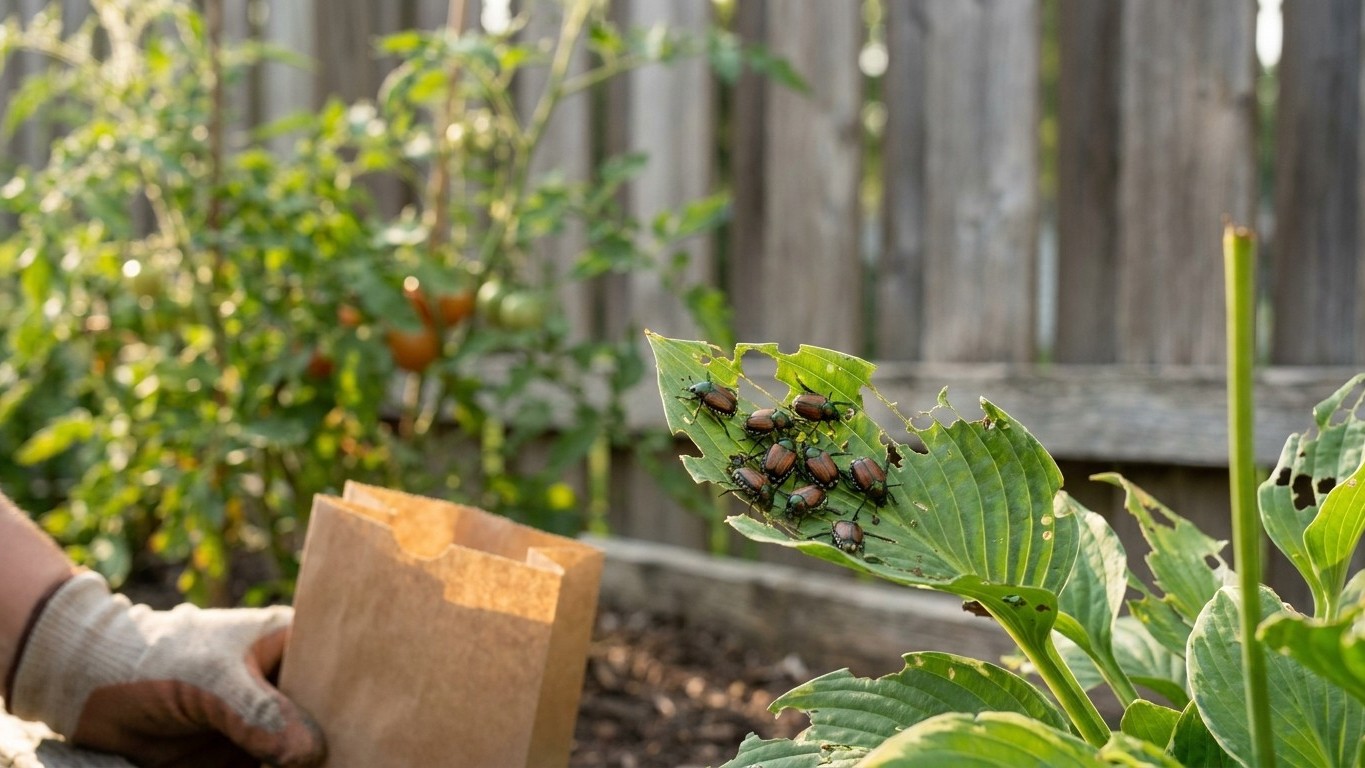

Wisconsin gardens deal with a predictable lineup of insects that runs from April through September, according to the University of Wisconsin-Madison Division of Extension. The Colorado potato beetle in Wisconsin that gardeners contend with moves onto potato plants in May, Cucumber beetles in Wisconsin that gardeners battle show up on cucurbits around the same time, the Squash vine borer in Wisconsin that gardeners track starts laying eggs in the last week of June alongside the Squash bug in Wisconsin that growers watch for on the same plants, the Cabbage looper in Wisconsin that gardeners spot on brassicas becomes active through midsummer, and most corn pests don’t build up numbers until mid-August. Check the undersides of your earliest transplants in April, before any damage shows, so a flea beetle or cutworm problem gets caught while a hand brushing them off still does the job.
What Wisconsin gardens actually deal with

Asparagus beetles don’t wait for warm settled weather the way most garden pests do — they’re on the spears the same week those spears break ground, sometimes before you’ve even hardened off your tomatoes. That’s the twist here: Wisconsin’s pest calendar doesn’t follow one steady warm-up, it opens in cold pulses, and each wave — beetles, then leafhoppers, then flea beetles chewing seedlings to lace — has its own narrow window where a small move stops real damage.
Asparagus beetle, potato leafhopper, tarnished plant bug and thrips

The Asparagus beetle Wisconsin gardeners deal with appears on spears as soon as they poke through the soil, scarring the tips and leaving them tough and discolored. Potato leafhopper causes a triangular browning at leaf tips called hopperburn, tarnished plant bug and thrips distort new growth and stipple leaves, aphids build up on tender new growth as noted by the Aphids Wisconsin resource, and later in the season Cabbage maggot in Wisconsin that gardeners find attacking brassica roots joins Slugs Wisconsin gardeners deal with on damp, low-lying beds Imported cabbageworm in Wisconsin, which growers also watch for on those same plants, rounding out the cool-season pest lineup. Cut and use spears promptly while they’re beetle-free, and clean up old fern growth in fall to remove overwintering sites.
Flea beetles

Flea beetles in Wisconsin chew small, round shot-holes through the leaves of eggplant, radish and brassica seedlings, and can kill young plants outright before true leaves fill in. Their larvae feed on roots underground, doing damage you never see above the soil line. Row cover over seedlings from the day they go in the ground keeps adults off until plants are big enough to shrug off the feeding.
Colorado potato beetle

This is, in WISC Extension’s own words, the most distinctive pest of potatoes, and it moves onto potato plants in May. Adults are rounded and yellow-orange with ten black stripes, and the larvae that follow are humpbacked, brick-red grubs with black spots down each side, the stage that does most of the actual leaf-stripping. Hand-pick both stages and crush the bright yellow-orange egg clusters on leaf undersides before numbers build, and rotate where potatoes go each year so overwintering adults don’t wake up next to a fresh planting.
Cutworms and common stalk borer

Cutworms hide in the soil by day and clip young transplants off at the base overnight, leaving a seedling toppled with no visible culprit. Common stalk borer instead tunnels into the stem itself, causing a wilted plant with a small, easy-to-miss entry hole. A cardboard or foil collar pushed an inch into the soil around each transplant stem blocks cutworms without any spray.
Cabbage maggot, onion maggot and seed corn maggot

These three share a life cycle: a small gray fly lays eggs at the base of the plant or in the soil near seed, and the legless white maggot that hatches tunnels into roots, bulbs or the seed itself. Damage shows up as wilting transplants that pull up with chewed roots, or seed that simply never sprouts. A floating row cover sealed tight at the soil edge keeps the adult flies from ever laying eggs near the row.
Aphids

Aphids cluster on new growth and leaf undersides, sucking sap and leaving curled, yellowing leaves behind along with a sticky honeydew that can turn black with sooty mold. A hard spray of water knocks down light infestations, and lady beetles and lacewings usually keep numbers in check if nothing has wiped them out with a broad-spectrum spray already.
Imported cabbageworm, cabbage looper and diamondback moth
All three chew ragged holes in cabbage-family leaves and leave dark green frass pellets behind, and a bad infestation can bore straight into a forming head. The imported cabbageworm is a velvety green caterpillar with a faint pale stripe, the cabbage looper arches its back like an inchworm as it moves, and the diamondback moth larva is smaller and tapers at both ends. Bt sprays (Bacillus thuringiensis) kill the caterpillars without touching most beneficial insects.
Striped and spotted cucumber beetles
WISC Extension flags both as vectors of bacterial wilt, which matters more than the direct feeding damage they cause. The striped beetle is yellow with three black stripes, the spotted beetle is yellow-green with twelve black spots, and both chew seedling leaves and transmit the wilt bacteria while feeding. Row cover from planting until flowers open protects seedlings through the vulnerable stage, then has to come off so pollinators can reach the blossoms.
Squash bug
Adults are flat-backed and brownish-gray, and they lay neat rows of bronze-copper eggs on the underside of squash leaves, easy to spot and crush before they hatch. Feeding by nymphs and adults causes yellow speckling that spreads into full wilting on heavily infested plants. Trap boards laid on the ground overnight collect adults that hide underneath by morning.
Squash vine borer
WISC Extension calls this one a very serious and hard-to-control problem, and for good reason: egg-laying begins the last week of June, and by late July squash plants start wilting as the larvae, cream-white caterpillars with brown heads, hollow out the stem from the inside. Sawdust-like frass at the base of a wilting vine is the tell. Check stem bases starting in late June, before wilting appears, and slit an infested stem lengthwise to remove the larva while the plant can still recover.
European corn borer and corn earworm
Most corn pests, per WISC Extension, don’t become abundant until mid-August, which is later than gardeners often expect given how early other pests arrive. Corn borer larvae are flesh-colored with a brown head and tunnel into stalks, while corn earworm larvae, striped in green, brown or pink, feed down into the ear tip and are often found still there at harvest. Removing stalk debris after harvest denies both species a place to overwinter.
Slugs, white grubs, wireworms and sap beetles
Slugs feed at night, rasping ragged holes in low leaves and leaving a telltale slime trail behind. White grubs and wireworms live underground and chew roots, stunting plants without any obvious above-ground sign until you dig. Sap beetles show up late, drawn to fruit that’s already overripe or cracked, and are more a symptom of ripe produce sitting too long than a cause of primary damage.
Telling damage apart

The shape of the damage tells you more than the plant it’s on. Chewed edges and ragged holes mean something is biting: a beetle, a caterpillar, a slug. Fine white or yellow stippling without holes points to a sap-sucking insect working from the underside of the leaf. Sudden wilting of one stem or vine, especially with sawdust-like material at the base, points to a borer working inside the tissue rather than anything on the surface. Sticky residue with black mold underneath it is aphid honeydew, not a disease on its own.
Not everything that looks like pest damage is a pest. Yellowing between the veins with no chew marks anywhere is usually a watering or nutrient problem, not an insect at all, and spraying for a bug that isn’t there wastes time and money. Disease shows up as spots, blotches or a powdery coating rather than clean bite marks, and it spreads across a planting in a pattern that doesn’t match where an insect was seen feeding.
A quick reference
| What you see | Likely cause | What to check |
|---|---|---|
| Ragged holes, chewed leaf edges | Chewing insect (beetle, caterpillar, slug) | Look under leaves and at soil level, especially after dark |
| Fine stippling, no holes | Sap-sucking insect (aphid, leafhopper, thrips) | Check leaf undersides for tiny insects or eggs |
| Sudden wilting of one stem or vine | Borer, or bacterial wilt from a cucumber beetle | Split the stem or check for bacterial ooze |
| Sticky film with black mold | Aphid honeydew and sooty mold | Look for aphid clusters on new growth |
| Yellowing between veins, no chew marks | Watering or nutrient issue, not a pest | Check soil moisture and recent fertilizing |
When each one shows up
The season runs roughly April through September, per WISC Extension, but the pests inside that window follow plant stages and warming soil more than the calendar. Asparagus beetle and flea beetle show up as soon as the crops they favor emerge. Colorado potato beetle moves onto potatoes in May. Cabbage-family pests and root maggots track cool-season plantings early, then again in fall as brassicas go back in. Squash vine borer is the one with the sharpest deadline: egg-laying begins the last week of June, and by late July the wilting is already underway, so the window for checking stems before real damage sets in is narrower than for almost anything else on this list.
The mid-season lull, and the mid-August wave
Corn pests are the exception to an otherwise front-loaded season. European corn borer and corn earworm don’t build up numbers until mid-August, well after most other pests have already peaked, which means a garden that looked clean in July can still need attention in the ear-filling stage. This timing, along with the other dates above, comes from WISC Extension’s guidance centered on conditions near Milwaukee. A garden farther north or in a colder pocket of the state should expect the same insects on a calendar running a week or two later.
Start looking as soon as a susceptible crop reaches the stage that pest favors, not on a fixed date. Check potato leaves weekly from the time plants are a few inches tall, squash stems from late June onward, and corn ears once silks begin to brown. A five-minute walk through the garden every few days catches most of these before the damage is done.
What actually works
Prevention first
Rotating crop families each year breaks the cycle for pests that overwinter in the soil right where last year’s crop stood, including Colorado potato beetle and the root maggots. Row cover, sealed tight at the soil edge, physically blocks flea beetles, cabbage maggot flies and cucumber beetles from ever reaching the plant, and it has to come off once flowers need pollinating. Timing plantings to avoid a pest’s peak window helps, such as getting squash stems checked before late-June egg-laying turns into late-July wilting. Leaving some flowering plants nearby brings in lady beetles, lacewings and parasitic wasps that keep aphid and caterpillar numbers down without any product at all.
Targeted intervention, and what doesn’t work
Hand-picking works well on anything large and visible: Colorado potato beetle adults and larvae, squash bug egg clusters, squash vine borer larvae once a stem is slit open. Bt sprays (Bacillus thuringiensis) are the most reliable targeted control for cabbageworm, looper and diamondback moth caterpillars, and they leave most beneficial insects alone. Ultrasonic pest repellers and companion-planting marigolds as a stand-alone cure do essentially nothing against any insect on this list, despite how often they’re sold as a fix. Beer traps reduce slug numbers somewhat but need refilling every couple of days to matter, and a board or overturned pot laid on damp soil catches just as many slugs with no beer involved.
What control costs
Cost here is mostly a matter of time, not money, and the cheapest methods for a home garden are also the most labor-intensive. Hand-picking and squashing eggs costs nothing but a few minutes a day, repeated through the whole season for anything with overlapping generations like aphids or cabbageworm. Row cover and physical barriers cost more upfront for the material itself but need almost no repeat labor once installed, aside from removing them at flowering and checking the edges stay sealed.
| Method | Relative cost | Time investment | How often repeated |
|---|---|---|---|
| Hand-picking / egg-crushing | Lowest, no material cost | A few minutes daily | Continuously through the season |
| Row cover and barriers | Moderate upfront material cost | One installation, occasional check | Reused each season if stored well |
| Encouraging predators | Low, mainly plant selection | Minimal once established | Ongoing, builds over years |
| Bt and other targeted sprays | Moderate, repeat purchase | Application plus reapply after rain | Every 1 to 2 weeks during an outbreak |
Hand-picking and barriers are the cheapest options for a home garden by a wide margin, since neither requires an ongoing purchase. Sprays cost the most over a season once you count repeat applications after rain washes them off, and they only make sense once a targeted problem, like an active cabbageworm infestation, is confirmed rather than suspected.
Local help
The University of Wisconsin-Madison Division of Extension tracks pest outbreaks around the state and will identify a specimen you’re not sure about, which beats guessing from a photo online. Bring or photograph the actual insect, not just the damage, since damage alone often fits more than one culprit. For more on gardening across the state, including how conditions shift outside the Milwaukee area these figures come from, see our Wisconsin guides.
Pest-by-Pest Guides for Wisconsin Gardens
Once you’ve got a feel for the seasonal rhythm of pest pressure in the state, it helps to look at how individual pests behave. Aphids are worth watching first: they can appear as early as mid-May in the southern counties and hang on through late September in a mild fall, even though Wisconsin’s cold winters wipe out most populations outright. If you’re growing asparagus, the asparagus beetle page covers the pest that shows up as soon as spears push through the soil in spring and then returns for a second round on the fern later in summer, with notes on timing your first inspection to the spear stage. And for the slimy visitors that show up after rain, the slugs page lays out the two peaks Wisconsin gardeners see each year — a spring surge once nights stay above 50°F, and a second wave in September when cooler, wetter weather returns. Each of these guides walks through the same practical questions: when the pest shows up, what makes a bad year worse, and what actually stops it.
Common questions
Do I need to spray every week all season just in case?
No. Spraying on a schedule instead of in response to an actual problem wastes product and kills off the predators that would otherwise keep aphids and caterpillars in check. Check plants a couple of times a week and treat only what you actually find.
Why are my squash plants wilting even though I don’t see any bugs?
Check the base of the stem for a small hole and sawdust-like frass before assuming it’s a watering problem. Squash vine borer larvae feed inside the stem where you can’t see them, and by the time the vine wilts the damage is often already done.
Are ladybugs actually eating my aphids or is that a myth?
They’re actually doing it. Lady beetle adults and especially their larvae, which look nothing like the adult and are often mistaken for a separate pest, eat aphids in large numbers, and a garden with a healthy population rarely needs a spray for aphids at all.
Is it too late to do anything once I see cabbage worms on my broccoli?
It’s not too late, but act quickly. Bt sprays work best on young caterpillars, so treat as soon as you see the first ragged holes rather than waiting until the head is riddled with frass, and reapply after rain since the product breaks down in sunlight and water.