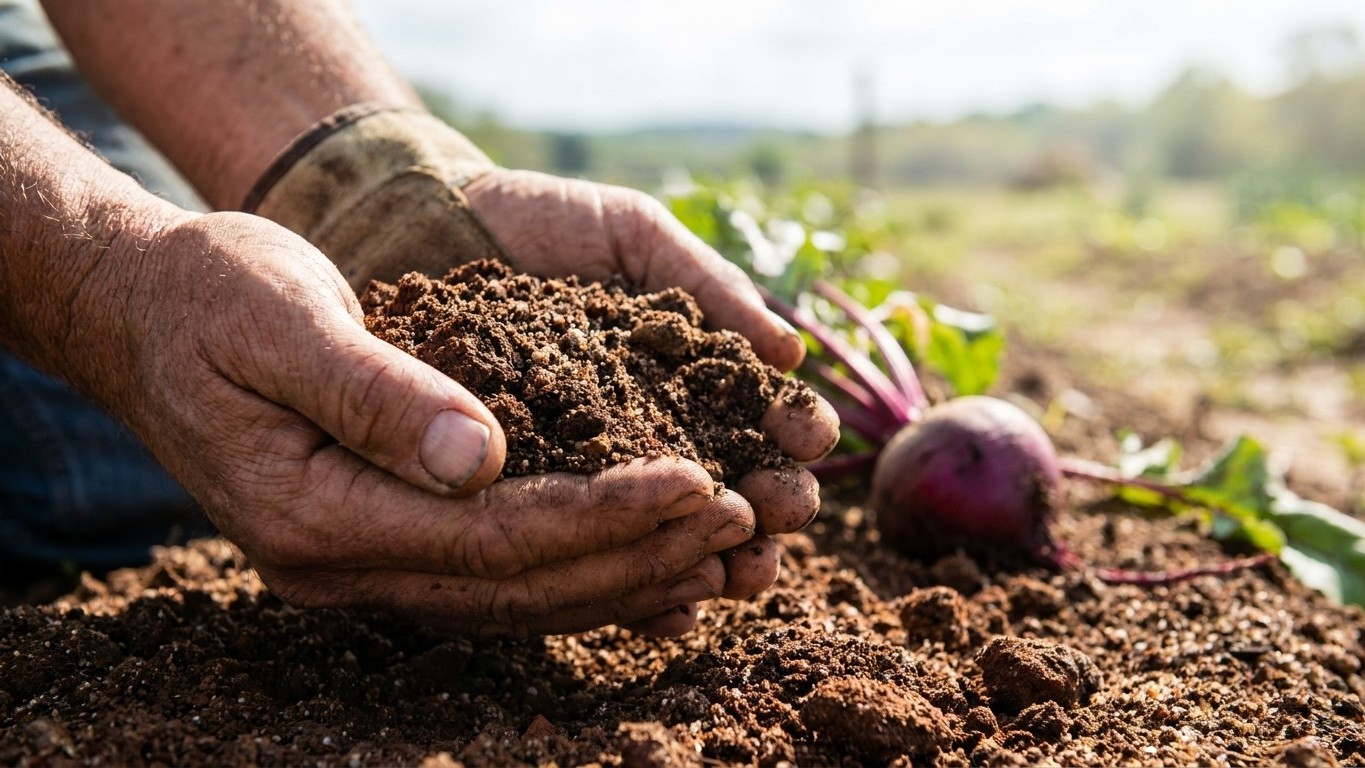

Wyoming’s representative ground, the Forkwood series, is an alkaline, low-organic-matter loam that drains well but starts thin on the fertility beets want. Add compost, expect a short frost-free window shaped by elevation, and treat the state soil as a baseline, not a match for your own raised bed or river-bottom plot.
The short answer
The soil USDA lists as representative of Wyoming is the Forkwood series, an Aridisol, the kind of dry-climate soil that forms under low rainfall and tends toward alkaline, sometimes carrying salts near the surface. Its surface horizon runs close to neutral, about pH 7.2, with a texture split of 42 percent sand, 20 percent clay and 38 percent silt, which lands it in loam to silt territory. Organic matter sits around 1.5 percent, and drainage is classed as well drained.
Set that against what a beet actually wants: deep, sandy, well-drained ground rich in organic matter, built up with no more than 1 inch of composted material per 100 square feet, according to Utah State University Extension. Forkwood clears the drainage bar and the texture is workable, loam rather than heavy clay. Where it falls short is fertility. At 1.5 percent organic matter, this soil is thinner than what a beet root prefers, which means the compost cap from the Extension guidance is not optional decoration, it is the fix for the exact gap this soil shows.
The near-neutral pH is a reasonable starting point and not something most gardeners need to fight. What the state soil data does not tell you is how many days your particular town spends above 90 F, and that figure is not published in the sources behind this page. What is documented is the season length: roughly 130 frost-free days at 6,000 feet, with frost possible in any month at higher elevations. That elevation-driven window matters more for a Wyoming beet bed than a single heat-day count would, because it sets how much runway you have before cold returns, not just how hot the middle of summer gets.
None of this describes your yard specifically. Wyoming spans hundreds of mapped soil series, and a river bottom, a hillside, or any lot a builder has cut and filled will differ from Forkwood in ways a $15 soil test will catch and a state average never will. Treat the numbers above as the shape of the region’s tendencies, alkaline, well drained, low in organic matter, and confirm your own plot before you plan around them.
The six weeks that decide it here
Beets are sown directly in place, never transplanted, and the standard timing is 2 to 3 weeks before the last frost. NOAA’s 1991-2020 climate normals put that last spring freeze, at the 32 F threshold, somewhere between May 7 and May 18 for the reference station. Count backward and a Wyoming beet crop is typically going into the ground in late April or the first days of May, which means the first six weeks of root development, the window Utah State University Extension flags as decisive for bolting, land squarely inside a Wyoming spring at elevation.
That spring is not a gentle one. Frost is possible in any month at higher elevations, and a 130-day frost-free season is short by national standards, which tells you the swing between a warm afternoon and a cold night stays wide well into what other regions would call late spring. For a beet seedling, that swing is the risk, not the average temperature. A stretch of dry, windy days combined with a cold snap is exactly the kind of water stress Extension guidance ties to premature flowering, and Wyoming’s spring pattern of freeze risk stacked against low humidity gives that stress more chances to show up than a milder, wetter climate would.
The practical takeaway is that the six weeks after sowing need steady soil moisture more than they need warmth. A bed that dries out between waterings during a cold, dry stretch in May is setting up the exact early stress that pushes a beet toward bolting rather than root growth. This is a separate problem from the heat-driven woodiness that shows up later in the season, and the fixes for one do not automatically solve the other.
What goes wrong here
- Bolting from an early dry spell. A Wyoming spring that swings between frost risk and dry wind can starve a young beet of consistent moisture in its first six weeks, and Utah State University Extension ties that early water stress directly to premature flowering. The remedy is steady watering through that window rather than an occasional deep soak, plus a floating row cover during any late cold snap so the plant isn’t fighting cold and drought at once.
- Woody roots from summer heat. Once temperatures push above 85 F, water stress at that stage makes the root fibrous and tough rather than tender, a different failure from bolting and one that shows up later in the season. Mulch to hold soil moisture and keep watering consistent through the hottest stretch rather than letting the bed dry out between waterings.
- Thin fertility slowing root growth. At roughly 1.5 percent organic matter, Forkwood-type ground doesn’t hand a beet much to work with on its own. Work in compost up to the 1-inch-per-100-square-foot ceiling Extension recommends, since beets do better with steady, moderate fertility than with a heavy one-time feed.
- A short season cutting harvest short. With roughly 130 frost-free days at 6,000 feet and frost possible in any month at higher elevations, a beet crop sown late risks running out of season before reaching full size from seeding. Sow as close to that 2-to-3-week-before-last-frost window as your local frost date allows, and use row cover to buy extra days on both ends.
Common questions
Does Wyoming soil need lime or sulfur before planting beets?
The representative state soil sits close to neutral, around pH 7.2, which is not a pH that typically demands correction for a garden bed. But that number describes the Forkwood series as mapped, not your specific plot, so a soil test is the only way to know whether your ground actually needs adjustment.
How long from sowing to harvest for beets in Wyoming?
Beets are direct-sown, and the maturity window runs from seeding, not from a transplant date. Given a roughly 130-day frost-free season at 6,000 feet, timing sowing close to the 2-to-3-week-before-last-frost window matters more here than in longer-season states, since there’s less slack if planting is delayed.
Is bolting the same problem as a woody root?
No. Bolting is premature flowering triggered by water stress in the first six weeks after sowing. Woodiness is a texture problem caused by water stress once temperatures climb above 85 F later in the season. They happen at different stages and need attention at different times, not a single “keep it watered” fix.
How much compost should I add to a Wyoming beet bed?
Utah State University Extension caps composted organic matter at 1 inch per 100 square feet. Given that the representative state soil runs low in organic matter already, working in compost up to that ceiling addresses a real gap rather than being an optional extra.