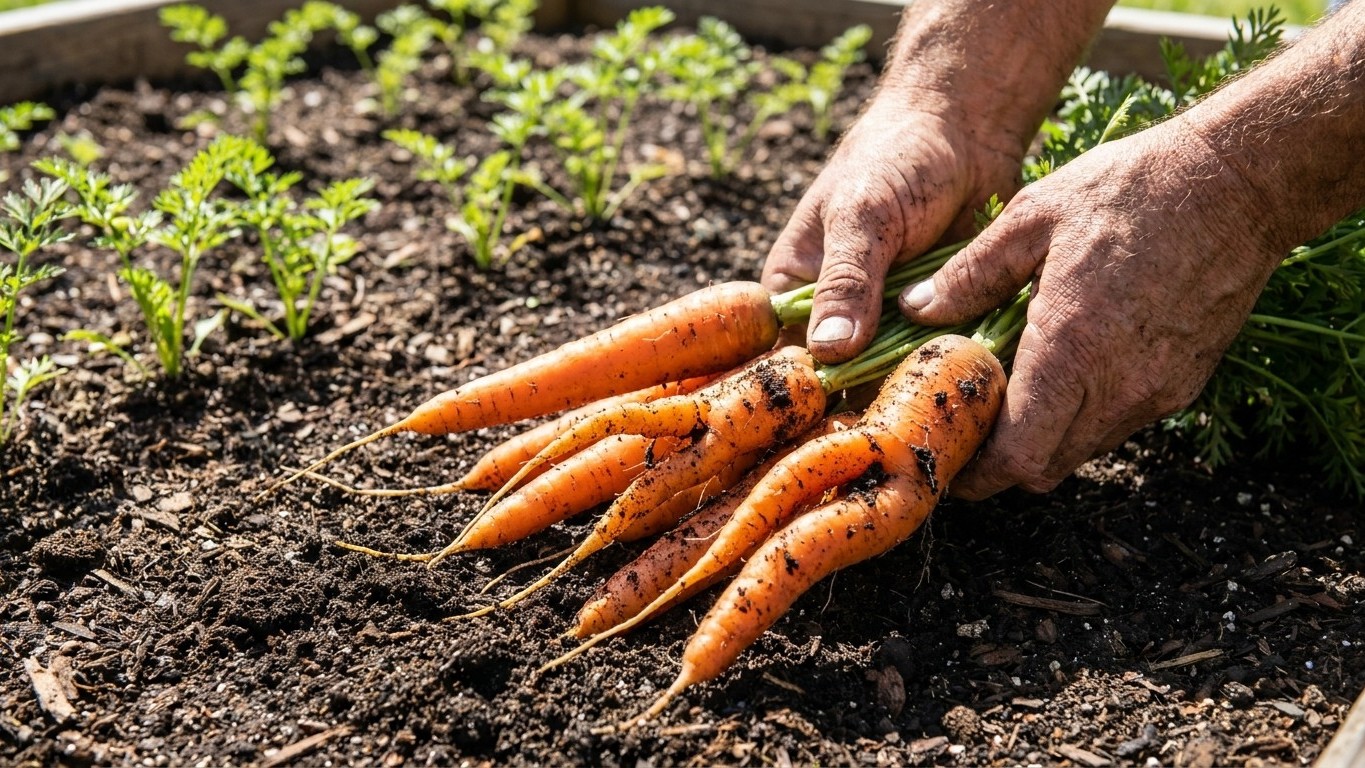

The direct answer: Wyoming carrots go into the ground as soon as spring soil can be worked, weeks ahead of the last frost, because the crop germinates in cool dirt and needs 70 to 100 days from seeding, not from any transplant date, to size up. Whether that timing actually works in your yard depends far more on your own dirt than on a calendar. Wyoming’s representative soil, the Forkwood series, drains well, but plenty of home gardens across the state look nothing like it.
The short answer
The soil USDA lists as representative of Wyoming is the Forkwood series, an Aridisol, the kind of dry-climate ground typical of the state’s high plains and basins. It runs alkaline and often carries salts, with a surface pH near 7.2, close to neutral but tipping toward the alkaline side. Texturally it sits in the loam-to-silt range: about 42 percent sand, 20 percent clay, and 38 percent silt. Organic matter sits low, around 1.5 percent, and the drainage class is listed simply as well drained.
That combination matters for a root crop like carrots. Utah State University Extension puts it plainly: carrots want deep, sandy, well-drained soil rich in organic matter, and heavy or rocky soil makes the root fork. On paper, Forkwood’s 20 percent clay and well-drained rating put it closer to what a carrot wants than a true heavy clay soil would. It won’t hold water and suffocate roots the way a 35 or 40 percent clay soil does. The catch is that low organic-matter figure. A carrot doesn’t need rich soil to avoid forking, but it does need loose, uncompacted ground, and 1.5 percent organic matter is thin. That’s a fertility and structure problem more than a forking problem, and the fix is the same one Extension recommends for heavier ground: work in plenty of compost before seeding, and double dig the bed if the ground has settled hard.
None of this is a verdict on any single backyard. Wyoming spans hundreds of mapped soil series, from river-bottom silt to gravelly foothill ground to whatever a builder scraped and filled before a subdivision went in. The Forkwood figures describe a mapped surface horizon across the state, not the raised bed behind your garage. Treat this as a starting point for what the region’s ground tends to do, not a diagnosis of your dirt. If your soil turns up heavier, rockier, or shallower than what’s described here, the answer isn’t a different carrot variety. It’s a raised bed, or enough compost and double digging to give the taproot a clear, loose path down.
The test that settles it in your own garden
The only way to know what you’re actually dealing with is to dig into your own bed and look, rather than lean on a statewide average.
- Dig a hole at least a foot deep in the spot you plan to seed carrots. Depth matters more than almost anything else for a root crop; if you hit hardpan, gravel, or a buried layer of construction fill well before a foot down, that’s your limiting factor, no matter what the texture looks like near the surface.
- Check that depth for stones and rubble as you go. Carrots don’t need much to fork around, a rock, a chunk of old brick, or a root left behind from a shrub is enough to split a taproot in two.
- Grab a handful of moist soil from a few inches down and rub it between your fingers. Sandy soil feels loose and falls apart almost immediately. Silt feels smooth, almost like flour when dry. Clay feels sticky and can be rolled into a ribbon without breaking. Most garden soil is some blend of the three, and where yours lands on that spectrum tells you how much compost and loosening it needs before seeding.
- Fill that same hole with water and watch how fast it drains. Water that’s still sitting after several hours points to a drainage problem that a raised bed solves far more reliably than any amount of soil amendment. Water that vanishes almost immediately suggests sandy, fast-draining ground that will need more frequent watering to keep carrots from splitting later.
Run this test in the actual bed you plan to use, not somewhere else in the yard. Soil can change completely within a few feet, especially on any lot that’s been graded, filled, or built on.
What goes wrong here
- Forking in heavy or rocky ground. When the taproot meets compacted clay, a buried stone, or old root debris, it splits rather than pushing straight down. Utah State University Extension’s fix is straightforward: work compost into the bed and double dig it before seeding, breaking up compaction well below where the root will travel. On genuinely rocky or shallow ground, a raised bed filled with loose, screened soil sidesteps the problem entirely.
- Poor germination during a hot, dry stretch. Carrot seed is small and slow to sprout, and a crusted, dried-out surface will stall it before it ever gets going. Keeping the seed bed consistently moist, not soaked, but never allowed to crust over and dry out between waterings, gives the seed the steady conditions it needs to come up evenly.
- Splitting from uneven watering. A root that swells fast after a heavy soak, following weeks of dry soil, tends to crack along its length. Carrots want steady, even moisture from seeding through harvest rather than a feast-or-famine watering schedule, especially once the roots have started to size up.
Common questions
Can I grow carrots in Wyoming clay soil without building a raised bed?
It depends on how heavy the clay actually is and how deep it runs. Utah State University Extension’s guidance is that heavy soil needs plenty of compost worked in and double digging before planting; if that loosened layer runs at least a foot deep with no rock or hardpan underneath, an in-ground bed can still work. If the clay is compacted well below the surface or drains poorly, a raised bed is the more reliable fix.
How do I know if my soil is too rocky for carrots?
Dig the test hole described above to at least a foot deep and feel through the soil as you go. Frequent stones, chunks of rubble, or old woody roots in that top foot are enough to fork a taproot, and removing them by hand, or building a raised bed with clean fill, solves it more reliably than picking through the whole bed by eye.
Does the Forkwood soil series describe my actual yard?
Not necessarily. Forkwood is the series USDA lists as representative of Wyoming as a whole, drawn from surface-horizon data across more than a hundred mapped components of that series. Wyoming contains hundreds of other soil series besides it, and any lot that’s been filled, graded, or built on can differ completely from the map. Use the state figures as a general sense of what the region’s ground tends to do, then run the dig-and-feel test in your own bed for the real answer.
How long does it take carrots to mature in Wyoming once they’re sown?
Carrots are sown directly in place, with no transplanting step, and typically run 70 to 100 days from seeding to harvest. Count that window from the day the seed goes into the ground, not from any later date, since there’s no transplant to reset the clock.