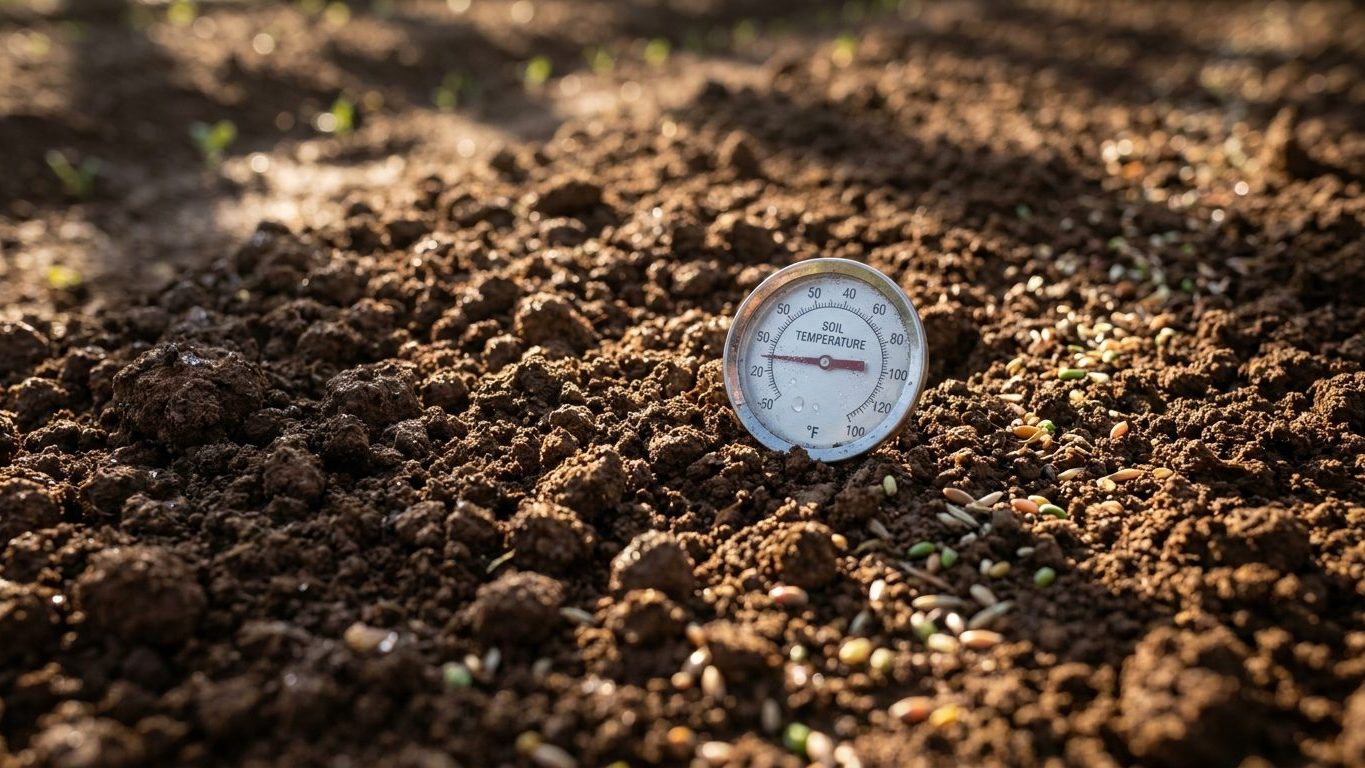

In most of Wyoming, cover crops go in the ground only after the soil itself has warmed, typically a week or two past the average last spring frost, and they come out mechanically, by mowing or crimping or letting a hard fall frost do the work. The state’s short window and cold winters shape almost every decision that follows.
When the soil is warm enough in Wyoming
The date question is really two questions dressed up as one. Wyoming’s last spring frost, according to NOAA NCEI’s 1991-2020 Climate Normals for station USW00024018, falls somewhere between May 7 and May 18. That’s a probability band, not a guarantee, built from three decades of freeze records at a single reporting station. Some years the frost breaks earlier. Some years it lingers into the back half of May, especially at higher elevations where the atmosphere doesn’t care what the calendar says.
Frost date matters, but it’s a stand-in for something else: soil temperature. Air can climb into the 60s on a sunny April afternoon while six inches down the ground is still cold and slow. Cover crop seed doesn’t germinate on air temperature. It waits for soil to reach the range a given species needs, which usually lags the last frost by one to three weeks depending on how much sun the bed gets and whether it’s covered in mulch or bare dirt. Treat the NOAA window as the earliest the risk drops, not the day to grab a rake.
Elevation changes the rules
Wyoming sits mostly above 6,000 feet, and at that elevation the growing season runs roughly 130 frost-free days in a good year. Frost is possible in any month at higher elevations, a caution NOAA’s own normals build directly into the data. That single fact should change how a gardener reads any “safe” planting date: a clear, still night in June at 7,000 feet can still drop to freezing, even after the average last frost has passed.
Species selection matters more here than in gentler climates, which is why this page won’t hand out a mix name or a brand. Cool-season grasses like oats and cereal grains, along with brassicas such as forage radish and turnip, tolerate cooler soil and germinate faster than most warm-season legumes. Seeding rate depends on species, planting method (broadcast versus drilled) and seed source, and getting it wrong wastes a season that’s already short. The University of Wyoming Extension office (uwyo.edu/uwe) publishes county-specific guidance and can confirm rates for whatever species fits a given bed. Termination here is mechanical: mowing, crimping, cutting at flowering, or simply letting the first hard fall frost finish the job. No herbicide step is needed or recommended for a home garden cover crop.
How long the season lasts here
NOAA’s normals for the same station put the first fall frost between September 24 and October 5. Paired with a last spring frost of May 7 to May 18, that gives a growing window of roughly 129 to 151 days, depending on which end of each range a given year lands on. That range matches the “roughly 130 frost-free days” figure NOAA attaches to Wyoming’s 6,000-foot elevation band, and it’s short by national standards.
| Milestone | Date range |
|---|---|
| Last spring frost | May 7 – May 18 |
| First fall frost | September 24 – October 5 |
| Frost-free window | ~129 – 151 days |
A window that length allows exactly one full-season crop cycle for anything slow, and it makes a second sowing a real question rather than an assumption. Fast species, oats, field peas, brassicas, can sometimes squeeze in a second pass if the first goes in right after the spring frost risk clears and gets terminated by mid-summer. Slower legumes or anything meant to overwinter as a living mulch generally get one shot, planted late enough to avoid spring frost but early enough to establish real biomass before the first fall freeze locks growth down.
That timing pressure is also why transplanting versus direct seeding becomes worth checking crop by crop. A cover crop transplanted as a plug gains two or three weeks over direct-seeded stock, which in a 130-day window can be the difference between a crop that flowers and sets seed and one that gets cut short by frost before it does anything useful. Anyone stacking two cover crop cycles in one Wyoming season should work from a succession sowing guide built for short-window climates rather than guessing at overlap windows.
Heat and water in Wyoming
The two numbers that dominate cover crop planning in warmer, wetter states, days above 90°F and summer rainfall, aren’t the story here. Wyoming’s growing challenge is written at the other end of the thermometer. The mean daily minimum temperature in the coldest month, per NOAA’s 1991-2020 Climate Normals referenced against Cheyenne, sits at 18.1°F. That’s not a record low and not a monthly average; it’s the typical overnight floor across the coldest stretch of winter, and it’s the figure that actually decides which species survive the winter here at all.
USDA places the state across hardiness zones 3a to 6a, a range wide enough that a plant surviving winter in a sheltered Cheyenne yard might die outright in a colder mountain valley two counties over. That spread means any winter-survival claim needs a specific reference point, not a statewide guess. A gardener at the cold end of that range should assume anything not explicitly bred for hard winters gets killed by frost rather than merely slowed by it.
That cold floor is actually useful for cover crop planning, not just a limitation. A species that reliably winterkills at 18.1°F does the termination work for free: it dies back into a mat of mulch over winter and needs no mowing, no crimping, nothing but raking aside in spring. In a milder territory the same species might survive winter and turn into a weed the following season, forcing hand-pulling or repeated cutting. Wyoming’s cold winters flip that risk around: species that are a maintenance headache in the South become the easiest, lowest-effort choice here, because the climate finishes the job on its own schedule every single year.
Which cover crops suit Wyoming
Reasoning by type, rather than by variety, is the only honest way to answer this for a state spanning three USDA zones and a 6,000-foot elevation swing. A short frost-free window (129 to 151 days) favors species that establish fast and don’t need a long season to build biomass: cool-season cereal grains and brassicas fit that description better than slow-establishing legumes, which often need more weeks of warmth than Wyoming reliably offers before a hard frost shuts them down.
The cold winter floor, that 18.1°F mean minimum, splits species into two practical camps. Ones that winterkill reliably at that temperature become a self-terminating mulch with no mowing or crimping required, which suits gardeners who want the lowest-maintenance option. Ones bred to survive colder winters, more likely to hold on in the milder zone 6a pockets than in zone 3a valleys, need to be terminated by hand through mowing, crimping, or cutting before they set seed and turn into an unwanted spring volunteer. Knowing which camp a given species falls into locally matters more than any national planting chart, because winter survival here is a function of microclimate as much as species.
This is where a page like this one has to stop rather than guess. Naming a specific cultivar would mean claiming knowledge this site doesn’t have: which variety trial performed best in Sheridan versus Laramie versus the Bighorn Basin is a question only the University of Wyoming Extension office (uwyo.edu/uwe) can answer with any confidence, since their field trials are run in Wyoming soil under Wyoming winters. The same office can confirm seeding rates for whatever species and method a gardener settles on, since rate depends on drilled versus broadcast seeding and on the specific seed lot, not on a generic formula. Refusing to invent that number here isn’t a gap in this page. It’s the only answer that won’t waste a gardener’s short growing season on a guess.