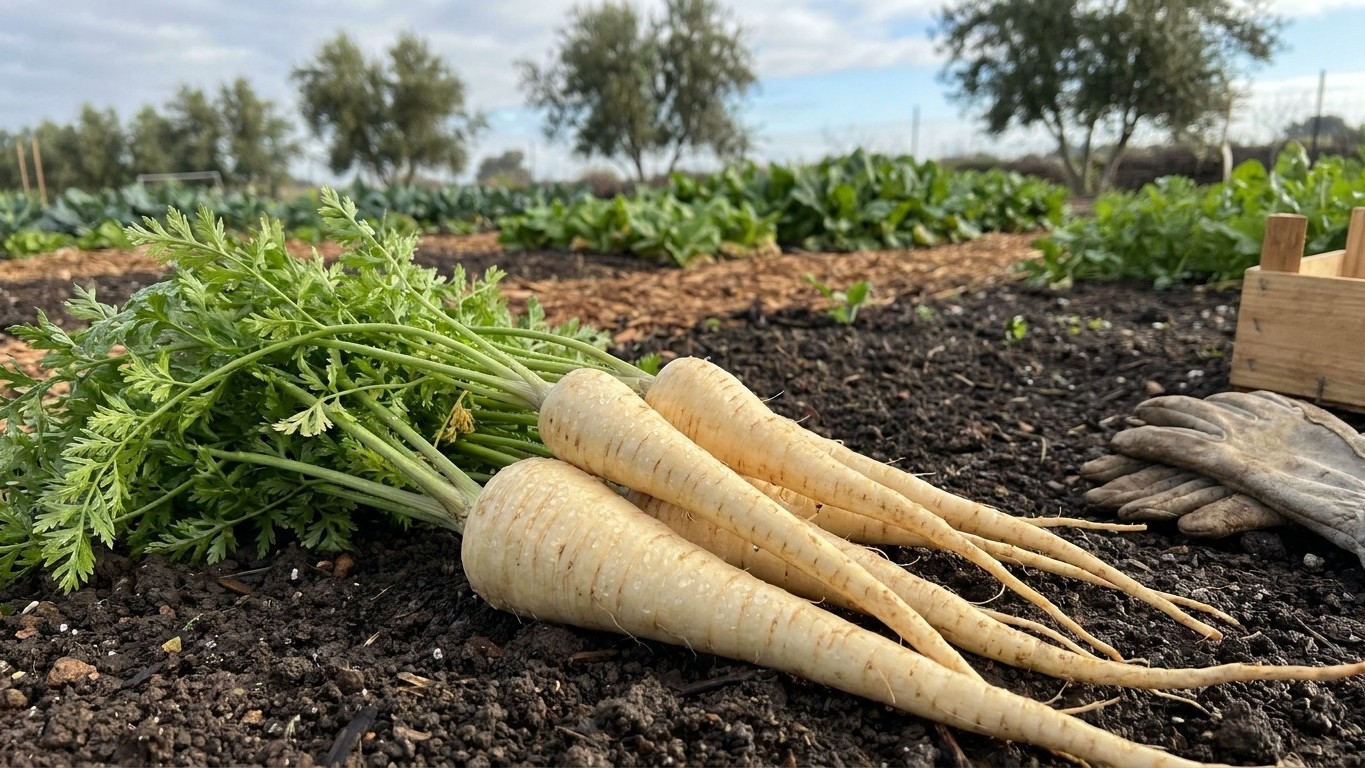

Lift parsnips after they have had several weeks of frost. In Wyoming that usually means late October into November, before the ground locks up. The roots are ready to dig when they taste sweet, not only when they look big. Stored well, they hold for four to six months. Stored beside a bowl of apples, they turn bitter. The details below cover timing, season fit and the failures that cost gardeners their crop.
The short answer
The question that decides it is whether the ground delivers several frosty weeks. Here it does. At the Cheyenne reference station, the mean daily minimum of the coldest month is 18.1°F (NOAA NCEI Climate Normals). The first fall frost arrives between September 24 and October 5, well before winter settles in. Utah State University Extension says parsnips taste best after several weeks of cool, frosty weather, because that exposure converts stored starch to sugar. A parsnip grown in Wyoming will sweeten, not merely grow, provided it stays in the ground through those weeks.
The sweetening comes from the frost the roots actually sit through. A comfortable hardiness zone says nothing about it. A garden with mild winters can grow a fine, full-sized parsnip that never gets sweet. Wyoming gardens have the opposite problem, which is getting the root to size before the cold arrives. For more on the sugar side, see Will Parsnips Sweeten in Wyoming?, and for the whole crop from seed to table, Growing Parsnips in Wyoming.
When should you dig parsnips in Wyoming?
Wait at least several weeks after the first hard frost. With that frost landing between late September and early October, the digging window opens in late October and runs through November. Pull one root and taste it raw or roasted. If it is starchy, leave the rest. If it is sweet, start digging.
Spread a thick layer of straw or leaves over the row once frosts begin. Mulch keeps the soil workable longer, so you can still dig after a hard freeze. Without it, a frozen row can force you to harvest everything at once or wait for a thaw. Elevation matters too. At higher elevations frost can come in any month, and the tops of the crop may see cold much sooner than a garden near town.
How long do parsnips keep after harvest?
USDA Agricultural Handbook 66 puts parsnip storage at 4 to 6 months at 32 to 34°F with 98 percent relative humidity (Commercial Storage of Fruits, Vegetables, and Florist and Nursery Stocks). That is a long keeper by any standard. It assumes temperature and humidity held steady, which almost no house does. A kitchen shelf, a basement corner or a refrigerator all fall short in some way, so expect less than the full figure.
Parsnips are not chilling sensitive, so cold itself is never the problem. Ethylene is. The roots produce very little of it, but the handbook notes that even low levels in cold storage cause bitterness. Keep parsnips away from apples, pears and any ripening fruit, even when the temperature is right. Top the roots after harvest, but do not trim into the crown.
Does the season fit?
The reference station has about 130 frost-free days between the mean last spring frost (May 7 to May 18) and the mean first fall frost (September 24 to October 5). That is at roughly 6,000 feet, and higher ground has fewer. Parsnips need 100 to 120 days from seeding, so the fit is workable but with little slack. Here is how the season runs.
- Sow in place, since parsnips resent transplanting. The target is two to three weeks before the last spring frost, which means mid-April to early May. The soil should be workable and the seedbed loose.
- Wait for germination. It is slow to come up, and the seed is slow in cold soil. Bare ground at two weeks is normal, so do not dig it up or re-sow yet. Keep the seedbed evenly moist so a crust does not form over the row.
- Start the 100 to 120 day count from the day the seed went in, not from emergence. A sowing in late April puts the roots at full size in late summer, with the fall frost window still ahead.
- Let the first fall frost find the crop already sized. Those frosts between late September and early October start the starch-to-sugar conversion. The roots stay in the ground through the following weeks and are dug when they taste sweet.
On a sowing made on time, the season fits comfortably enough. The slack is small, though. A cold spring that pushes sowing into late May, or a seedbed that dries out and delays germination, can push maturity right up against the frost window. A parsnip tolerates cool weather better than most garden crops, so a late finish costs size more than flavor. Still, a root pulled small in November will not make up the difference. Row cover over the seedbed in spring and mulch in fall are worth the effort here.
What goes wrong here
- Forked roots from heavy or stony ground. The root splits when it hits clay or rocks on its way down. Utah State University Extension recommends deep sandy soil and says heavy soil must be double dug. Loosen the bed to a full spade depth or more and pick out stones before sowing. A soil map gives a starting point only. A shovel test and a call to the county extension office will tell you what your bed is.
- Forked roots from overwatering. This is a separate cause. A bed kept constantly wet, especially early on, works against a single taproot. Water evenly but let the surface dry between waterings once seedlings are up.
- A season that runs out. Late sowing or a slow start leaves small roots at frost time. Sow as early as the soil allows, keep the seedbed moist until germination, and use row cover in spring if nights are still hard. Flag the row so you do not dig it up or re-sow while the seed is still waking.
- A winter too mild to sweeten. This is a problem for gardens far from Wyoming, and it is rare here. If a sheltered spot never gets weeks of frost, the roots will be edible but starchy. The fix is to plant where frost reaches the bed. Check the roots by taste before assuming they are ready.
- Frozen ground at harvest. A bare row can freeze solid before you have dug it. Mulch heavily with straw or leaves in fall, and dig on a mild afternoon.
- Bitter roots in storage. Ripening fruit nearby gives off ethylene, and parsnips pick it up. Store them in a separate cold spot, away from apples and pears. Cutting into the crown when topping invites rot, so trim the leaves only. Pests can also damage roots in the ground before harvest, and What Eats Parsnip in Wyoming, and When covers what to watch for.
Common questions
Can parsnips stay in the ground all winter?
Yes, with a thick mulch to keep the soil from freezing solid. The roots are hardy, and a sheltered row can be dug through winter on mild days. Lift whatever is left before new top growth starts in spring.
How long do parsnips keep after digging?
Four to six months at 32 to 34°F with 98 percent humidity, according to USDA Handbook 66. Few homes hold those conditions steadily, so plan on a shorter keeping time. Use the roots you stored with the least protection first.
Why do stored parsnips taste bitter?
Ethylene is the usual cause. Apples and other ripening fruit give it off, and even low levels in cold storage make parsnips bitter. Store the roots away from fruit, and keep them cold and humid.
Why is nothing showing two weeks after sowing?
Parsnip seed is slow to germinate, and cold soil slows it further. Keep the bed evenly moist and wait. Digging up the row or re-sowing too early only sets the season back.