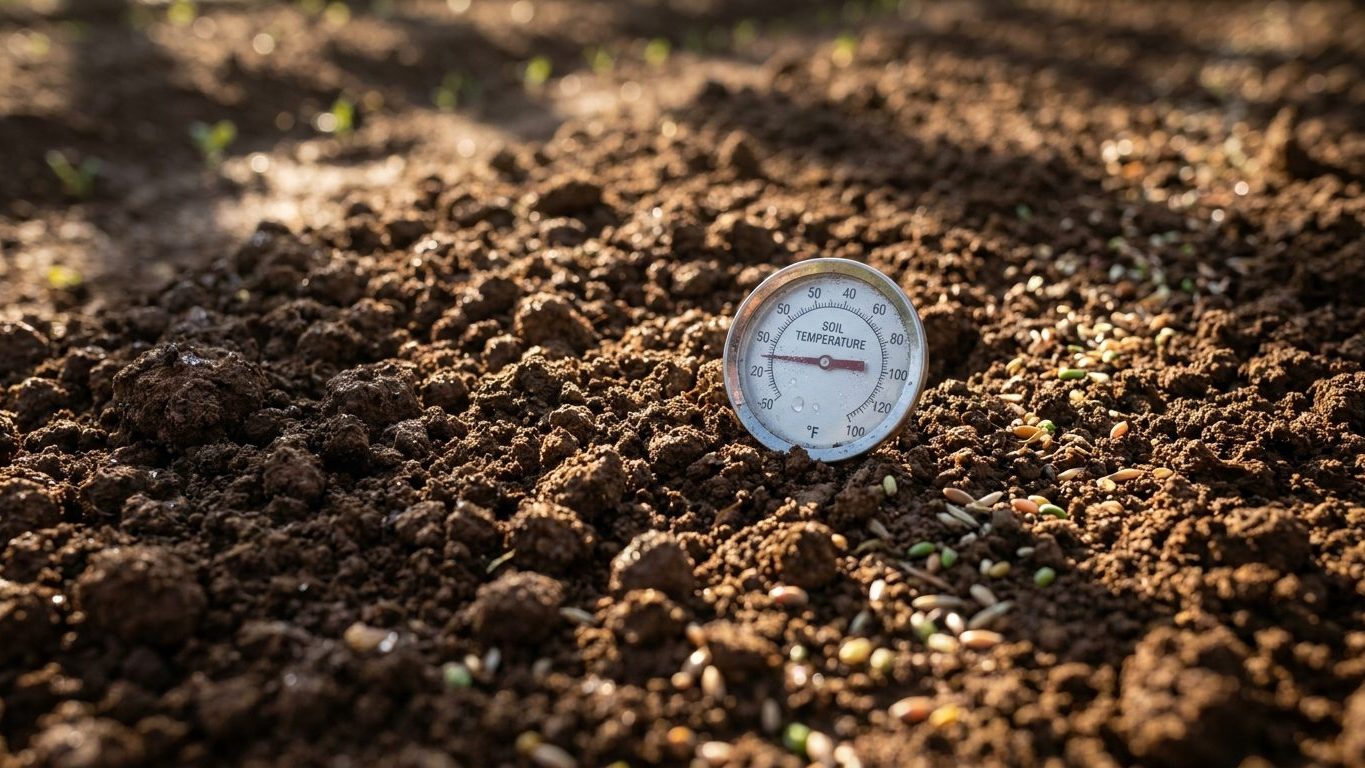

Cover crops go into Yukon ground once the soil itself has warmed, typically past the average June 5 last-frost mark, and come out by late August as the first fall frost approaches. That leaves a growing window of roughly eleven weeks, among the shortest of any territory covered in this series, short enough that species choice, timing, and even the decision to grow a cover crop at all hinge on getting that math right from the start.
When the soil is warm enough in Yukon
The average last spring frost at Whitehorse A, the reference station Environment and Climate Change Canada uses for its 1981-2010 Canadian Climate Normals, falls on June 5. That date is a mean, not a promise: in roughly half the years on record, frost has arrived later than that. Treat it as the midpoint of a window that can stretch well into June, not a green light to sow the day after.
Frost dates only tell you when the air stops freezing. Cover crops care about something else: soil temperature. A patch of ground can sit at 40°F for days after the last frost has come and gone, especially where snowmelt keeps the top few inches saturated and cold well into late spring. Seeds like oats, peas, or clover germinate slowly, if at all, in soil that cold, so growers in this territory typically wait past the frost date itself, letting the ground catch up before they put seed in.
This lag matters more here than almost anywhere else covered in this series. Yukon sits in Canadian hardiness zone 1b at Whitehorse, according to Natural Resources Canada’s Plant Hardiness Site using 1991-2020 normals. That’s the Canadian system, built on seven climate variables, and it does not convert to a USDA zone, so don’t try to line it up with hardiness numbers quoted elsewhere for US gardens. What it tells a Yukon grower plainly is that both the growing season and the soil-warming window are compressed, and every planting decision has to account for that compression rather than fight it.
Choosing species and rates by conditions, not by guesswork
Species selection follows from this timing more than from anything else. Cool-season cover crops such as oats, field peas, and some clovers tolerate cold soil and light frost better than warm-season options like buckwheat, which sulks or fails outright if seeded too early. Seeding rates depend on the species chosen, the seeding method used, and the seed source itself, so there’s no single number that applies across a territory this size. A rate suited to a dense stand of peas will waste seed and money if applied to a lighter clover mix, or the reverse. The federal agriculture extension service is the right place to get a rate matched to the species and method actually being used.
Termination, when the time comes, follows the same mechanical logic used across this site: mowing, crimping, cutting, or simply letting an early frost finish the job. No herbicide step is assumed or recommended here. A legume cover crop’s contribution to soil nitrogen is real, but the amount varies with the species grown, how much biomass it produced, and when it gets terminated, so no fixed figure in pounds gets attached to it. What matters practically is the mechanism: a well-grown clover or pea stand, mowed or crimped near flowering and left on the surface, feeds the following season’s soil rather than leaving it as it was.
How long the season lasts here
Subtract the two mean dates from Whitehorse A and the window between last spring frost (June 5) and first fall frost (August 25) comes out to roughly 81 days, just under twelve weeks. That’s the frost-free season this territory’s own climate normals describe, and it ranks among the shortest of any territory in this series.
Eighty-one days sounds tight because it is. Compare it with territories further south where cover crop growers routinely fit in a spring-sown crop, terminate it by early summer, then sow a second cover crop for fall, sometimes a third rotation before winter closes things down. That kind of succession planting depends on having enough frost-free weeks left after the first crop finishes to let a second one establish, build meaningful biomass, and still wrap up before the ground freezes again. In Yukon, there usually isn’t a second window worth using. The first sowing has to do the work of the whole season, because there isn’t enough calendar left afterward for a full second cycle.
That reality changes a decision that looks minor but isn’t: whether to direct-seed or start plants indoors first. In territories with a long shoulder season, transplanting buys extra weeks and makes a second sowing realistic. Here, with roughly eleven weeks between frosts, the calculation shifts. Species that germinate directly in cool soil and reach useful biomass quickly, certain oats and field peas among them, tend to suit this compressed calendar better than anything bred for a longer runway or a transplant step it doesn’t have room for.
There’s one way around the compression, though it uses the calendar differently rather than lengthening it. Certain cover crops don’t need to finish inside the 81-day window at all. They’re sown near the end of it deliberately, expected to establish just enough top growth before frost, then survive winter dormant and resume growth the following spring. That strategy uses the short window’s last weeks productively instead of racing to complete a full cycle within it, but it depends entirely on how well the species tolerates the cold described in the next section.
Growers working a longer season elsewhere, or curious what a second or third planting cycle looks like when the calendar allows it, can read the site’s succession sowing guide for how that timing gets planned out. In Yukon, the more useful exercise is usually the opposite: deciding which single cover crop makes the most of the one window available, rather than planning for a rotation the season can’t support.
Heat and water in Yukon
Some territories in this series lean on two numbers to describe summer stress: how many days climb past 90°F, and how much rain falls during the growing months. Yukon barely registers on either scale, and that absence is itself the useful information. Whitehorse’s climate record simply doesn’t produce meaningful counts of 90°F days; heat stress on cover crops isn’t the concern here that it is further south. The question that actually shapes what survives in this territory isn’t heat at all. It’s winter.
The mean daily minimum of the coldest month at Whitehorse runs to -2.6°F, according to ECCC’s 1981-2010 Canadian Climate Normals. That’s not a record low from some unusual cold snap; it’s the average minimum temperature the coldest month produces, year after year. It’s the figure that decides, species by species, what makes it through winter here and what doesn’t, and for cover crops, that decision matters as much as anything that happens during the growing season itself.
Why the same frost that kills a stand elsewhere here helps it
This is where the first fall frost date, August 25 on average, does double duty. It doesn’t just mark the practical end of active growth; it sets the last useful sowing date for anything meant to establish before winter. Sow too late past that mean date and a cover crop simply doesn’t get enough growth in before the killing cold arrives to do anything useful, whether that’s building biomass, suppressing weeds, or protecting bare soil over winter.
Then the coldest month, sitting around -2.6°F on average, takes over and sorts the survivors from everything else. Some species, oats prominent among them, die outright at temperatures well above that mark. In a milder territory, that same trait makes oats close to a nuisance: they never fully die back, keep regrowing through a mild winter, and end up needing extra effort to remove come spring, functioning almost like a weed. In Yukon, that weakness becomes the whole appeal. Oats sown late in the season die back cleanly once real cold sets in, collapsing into a mat of frost-killed residue that mulches the soil surface all winter without any mowing, crimping, or other intervention needed. Species built to survive genuine cold, by contrast, need to be dealt with by hand come spring, since they’ll still be alive and growing when the ground thaws.
That trade-off, between species that die conveniently and species that survive stubbornly, is really the central decision for anyone growing cover crops this far north, and it’s shaped almost entirely by that -2.6°F figure rather than by anything summer brings.
Which cover crops suit Yukon
Everything in this territory’s climate record points toward the same short list of criteria, and season length tops it. With roughly 81 frost-free days to work with, the earliest-maturing types within any species group have a real advantage over later ones. A cover crop that needs fourteen or sixteen weeks to reach useful biomass simply doesn’t fit the calendar, no matter how well it would otherwise perform. Fast establishment and quick early growth matter more here than total yield potential, since there usually isn’t time to wait for a slower crop to catch up.
Winter hardiness is the second filter, and it works in two directions rather than one. A species that dies back cleanly once the coldest month’s temperatures arrive turns into a self-terminating mulch, no mowing or crimping needed, which is a real advantage where labor and season are both limited. A species built to survive that same cold stays alive into spring and has to be terminated by hand before the next planting, whether that’s by mowing, cutting, or crimping. Neither trait is universally better; it depends on whether the goal is a maintenance-free winter cover or a stand that carries living roots through to spring for early soil activity. Deciding which of those two outcomes is wanted is really the first question, ahead of any specific species name.
Disease pressure, the filter that matters most in wetter or more humid territories, ranks smaller here simply because this climate doesn’t push it the way damp, mild regions do. That doesn’t mean it disappears entirely, but it falls behind season length and winter survival as a reason to choose one species over another in this particular territory.
None of that adds up to a single named recommendation, and it shouldn’t. Cultivar performance varies by seed source, by the specific soil and microclimate of a given property, and by trial results that only get generated locally. This page can describe what the climate record demands, short-season types, a clear choice about winter survival, mechanical termination rather than chemical, but it can’t substitute for a variety actually trialled in this territory. That’s what Canada’s federal agriculture extension service is for: matching species and seeding rate to conditions this page has no way of knowing, on a specific piece of ground it has never seen.