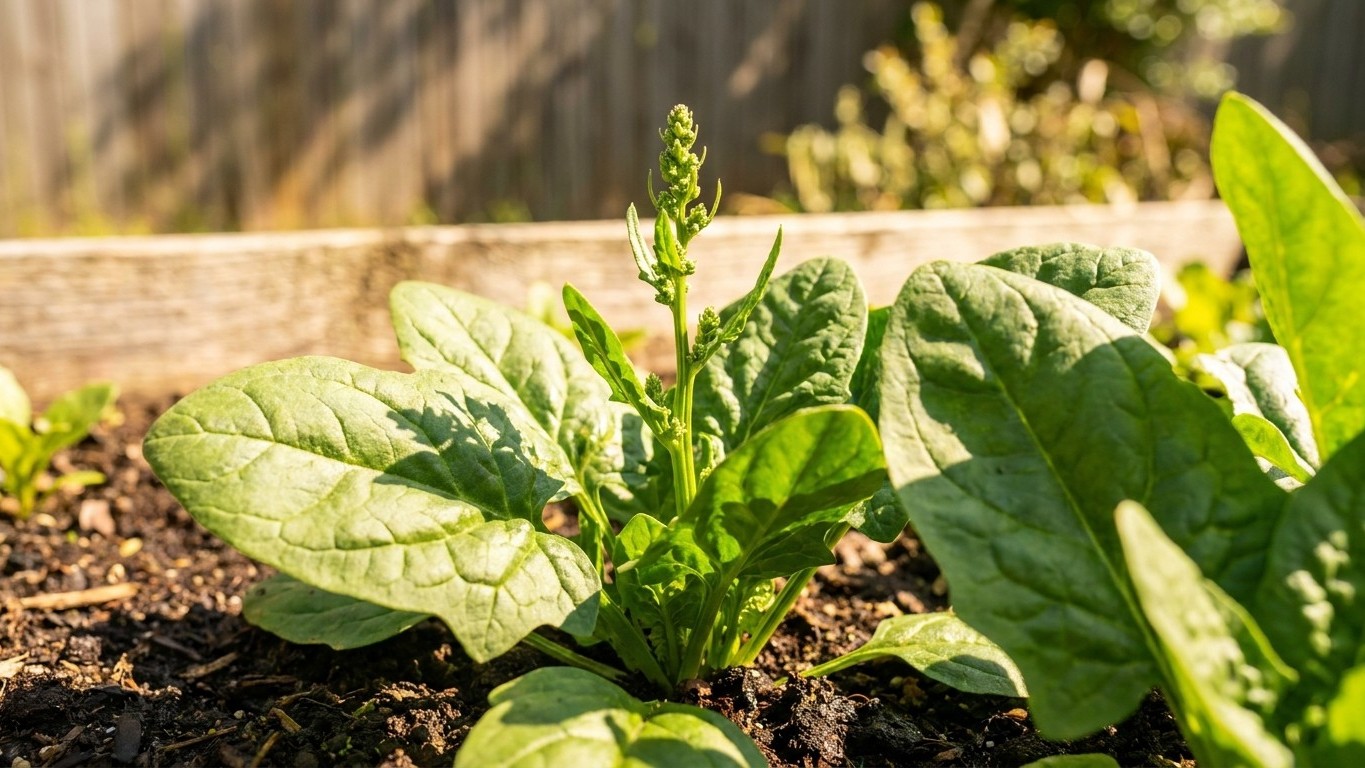

In Yukon, what eats a spinach crop is mostly the calendar. At Whitehorse A, the longest day carries 18 h 45 of daylight, and long days alone push spinach to flower, so day length is the real limit and heat comes a distant second. The sources behind this page cover timing, not insects or animals, so there is no pest list here. What follows is when the spring and autumn windows close.
The short answer
On the longest day of the year, the reference city gets 18 h 45 of daylight. That figure is calculated from the latitude of the Whitehorse A climate station using the standard sunset formula, and it counts the geometric horizon only. Atmospheric refraction adds roughly seven minutes of real daylight on top.
Spinach reads that number as a warning. Utah State University Extension says spinach bolts during long days and warm temperatures. Bolting means the plant stops making leaves and sends up a flower stalk, and the leaves turn bitter and small. Heat speeds this up, but long days alone can trigger it. A cool northern summer therefore does not buy extra weeks. A bed that never sees a hot afternoon still gets 18-plus hours of light around the solstice.
That is the surprise for gardeners who assume a cold climate is spinach heaven. It is, up to a point, and the point is the light.
Heat is the smaller half of the problem. The same source says spinach grows best where temperatures do not exceed 75 F (about 24 °C), and that seed germination is reduced when the soil is above 80 F (about 27 °C). Environment and Climate Change Canada counts 0.92 days a year above 30 °C at Whitehorse A, and 0.28 days a year above 32 °C. Those are counts of extreme days at an airport station, though. They say little about how many ordinary afternoons climb past 24 °C, and no count for that threshold is published here. So heat is a real but unmeasured second limit, and day length is the one you can plan around.
The frost dates frame everything else. The average last spring frost at Whitehorse A is June 5, and the average first fall frost is August 25. That leaves about 81 days between them, a bit under 12 weeks. These are mean dates, not safe dates. In one year out of two, the spring frost lands later than June 5, and in a good share of years the fall frost arrives before August 25. Northern and upland districts around the territory run weeks behind an airport station in the valley, so treat both dates as the middle of a window.
For the full picture of the crop here, start with Growing Spinach in Yukon. This page only covers what shortens the season, and when.
How long the spring window really is
Sowing runs 2 to 3 weeks before the last frost, because spinach germinates in cool soil and wants to be growing before the days stretch out. Counting from the Whitehorse A average, the spring calendar looks like this:
- May 15 to May 22: the sowing window, 2 to 3 weeks ahead of the June 5 average last frost. Whether the ground is workable on those dates depends on your site and your year.
- June 5: the average last frost. Half of all years it comes later, so a sowing made on the early side of the window may still meet a frost, and a late spring pushes everything down the list.
- Around June 21: the longest day, at 18 h 45. By then the plant has had no relief from lengthening light for weeks.
- The gap: from a May 15 sowing to the solstice is about 5 weeks, and from May 22 it is about 4. That is the usable spring, with the clock running from the day the seed goes in.
Four to five weeks is short. It is also optimistic, because it assumes the average year. A late thaw eats into the front of the window, and nothing can move the solstice.
The source publishes no days-to-maturity for spinach, so I can’t tell you how many harvests fit into those weeks, and I won’t borrow a number from another crop. What the arithmetic does say is that the sowing date is the one lever you control. Every week of delay in May is a week taken from a window that has a fixed end.
The 75 F ceiling matters here as well, and it carries two consequences with one number. Above it, growth stops being good, and above it the leaves also turn bitter. It is a temperature, never a calendar date, so you check it against a thermometer in the shade, not against a page of dates. In a cool Yukon spring you will rarely cross it early. Late in the window, with the days at their longest, a warm spell and the light team up. If you see the center of the rosette lengthening or the leaves narrowing, read Will Spinach Bolt Early in Yukon? for what to do next.
The autumn crop, and when the soil lets you sow
The source’s rule for a fall crop is plain: plant 50 to 75 days before the date you want to harvest. Two obstacles stand in the way of that rule, and they pull in opposite directions.
Warm soil, not cold, blocks the sowing
Gardeners tend to expect autumn trouble to be cold. For spinach, the early obstacle is warmth. Germination is reduced when the soil is above 80 F, so a seed sown into hot ground in midsummer may sit there or come up thin. In a hot region, the autumn window opens only when the soil cools. The territory is not a hot region. Whitehorse A averages under one day a year above 30 °C, so a long stretch of soil above 80 F is unlikely. But no soil temperature record is published for the station here, so I can’t call it safe. A soil thermometer a couple of inches down, read in the morning, settles it in a minute. Shading the bed or watering the row before and after sowing can help cool the top layer.
Frost ends the season, and the count runs backward
Set the harvest date at the average first fall frost, August 25. Count back 75 days and you reach June 11. Count back 50 days and you reach July 6. That makes the sowing window for a fall crop run from about June 11 to July 6.
Look at where those dates sit. They are the very weeks around the longest day, when 18 h 45 of daylight is the rule. That is the tension in the territory. The calendar tells you to sow just as the light is most likely to push the plants to flower. The source gives no day-length cutoff for spinach, so I can’t name a safe sowing day inside that range. Check the specifics for your timing in When to Sow Autumn Spinach in Yukon.
Because August 25 is a mean, not a promise, the frost comes earlier than that in roughly half of years. Count back from a harvest date a week or two before it if you want margin, which moves the whole sowing window earlier and closer to the solstice. Mean dates also come from an airport station, so a garden up a hillside or farther north should plan on an earlier end to the season than the numbers here suggest.
Common questions
Do insects or animals eat spinach in Yukon?
The sources behind this page do not cover pests, so there is no list of insects or animals to give you. What they do cover is timing: the long days, the heat ceiling, and the frost dates that cut the season short. If something is chewing your leaves, a local extension office or garden group can speak to what is active in your area.
Does a cool summer give spinach extra weeks?
No. Long days alone trigger flowering, and Whitehorse reaches 18 h 45 of daylight at the solstice. Cool weather helps with the heat limit, but not with the light.
Which spinach variety should I grow?
The source names four: Bloomsdale, Melody, Teton and Olympia. It publishes no data about any of them, such as bolting resistance, maturity or cold tolerance, so I can’t rank them or describe them. Treat them as names to look up, and compare what a seed packet actually claims.
How long does harvested spinach keep?
UC Davis Postharvest says the best storage is 32 F at 95 to 98 percent relative humidity, and that spinach will not hold good quality beyond 2 weeks. That is a ceiling, not a plan. At the 41 to 50 F a fridge door actually holds, it yellows faster. The coldest spot is the back of the bottom shelf, so keep the leaves there, not in the door.