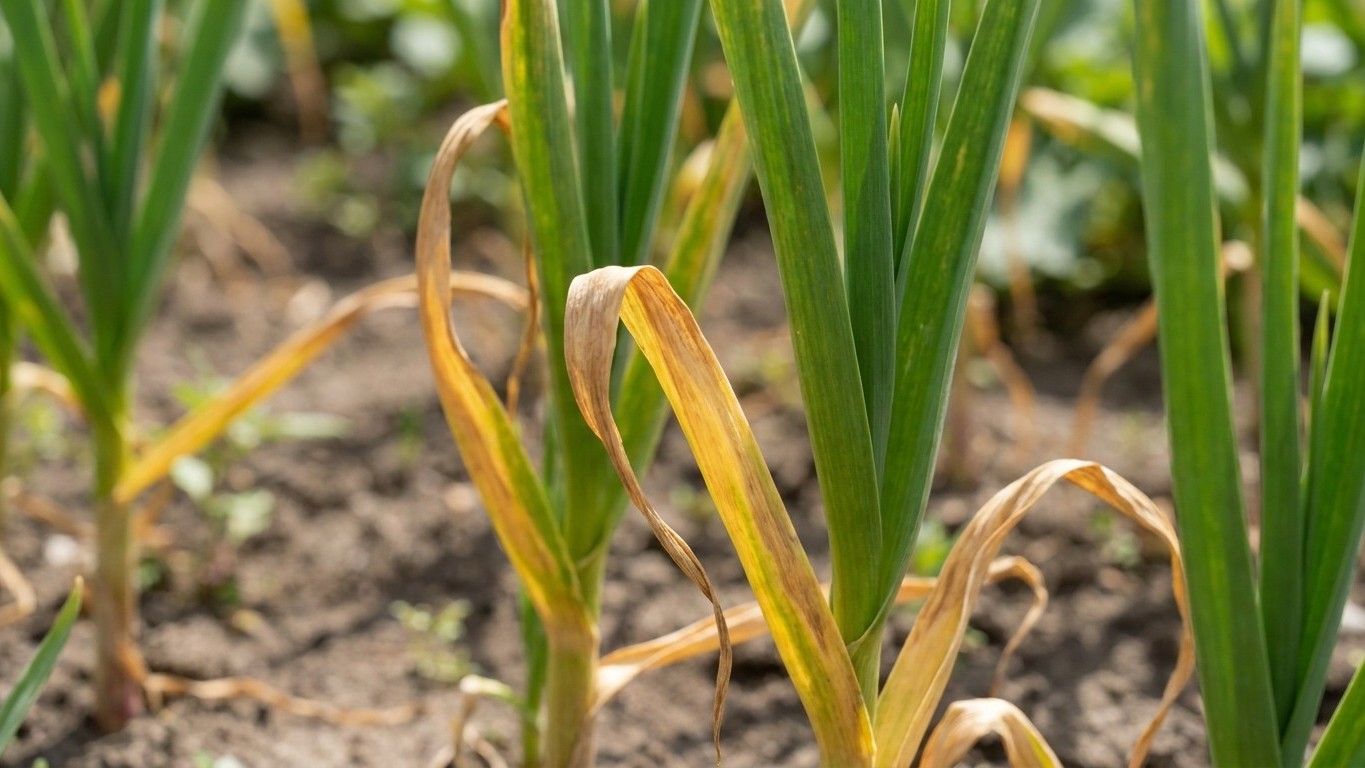

Garlic tells you it is ready by dying back from the bottom up, not by a date on the calendar. When roughly the bottom half of the leaves have browned and dried while a few leaves near the top stay green, the bulb below has finished sizing and wrapping itself in papery skins. Pull one test bulb from the row, brush off the dirt, and slice it in half: if the cloves fill out to the skin and the wrapper layers are still intact, start Harvesting the rest before the remaining leaves finish dying off.
Why this matters for garlic

Pull garlic too soon and you lose size and shelf life in one move. The cloves are still soft, the wrapper skins are thin, and the bulb will not cure into something that keeps past a few weeks in the pantry. Pull it too late and the outer wrappers split underground, the head loosens into separate cloves in the dirt, and rot or mold can set in before you even lift a fork. Both mistakes look identical from a few feet away, a patch of garlic with some green leaves left, and neither shows itself at the moment you make it.
Garlic sits in the ground for the better part of a year, and the harvest date is the last decision in that whole run, the one that locks in everything the crop did with its planting depth, its winter mulch and the spacing you gave it back in fall, steps laid out in Growing Garlic. Get the depth or mulch wrong months earlier and a strong spring can still bail you out. Get the harvest window wrong and there is no fixing it: an underdeveloped bulb never finishes sizing on a shelf, and a bulb that split in the ground has already started to fail as a keeper. The proof shows up in storage, sometimes not until midwinter, when bulbs that should still be firm turn soft or start sprouting early.
When to do it
There is no fixed date for pulling garlic, and the first fall frost is not the trigger here. Frost matters for planting the cloves the previous autumn, not for lifting the bulbs, which happens during the warm part of the growing season once the plant itself signals it is finished. The signal is foliage dieback: garlic leaves die from the bottom of the plant upward, and the stage you want is roughly the point where the lower leaves have browned and dried while several leaves near the top are still green.
Sources do not agree on the exact leaf count to wait for, and that disagreement tracks region as much as anything else. Growers in short, cool summers tend to pull at the first hint of lower-leaf browning, because the window from ready to overripe closes fast once daytime heat sets in. Growers in longer, hotter growing seasons often see a slower, more gradual dieback and have a little more room to wait without losing the crop to splitting. In both cases the plant is the clock, not the wall calendar, and a grower who marks a date from last year’s harvest and repeats it blind is the one most likely to pull early or late.
How to do it
Test dig before you commit
Once the lower leaves start browning, stop watching the plants and start digging one up. Choose a bulb from the middle of the row, not an edge plant, since edge plants dry out and mature faster than the rest of the bed. Use a garden fork rather than pulling by the stalk. The stalk will snap off before a full-size bulb releases from packed soil, and a snapped stalk gives you no way to hang or braid that bulb later. Slide the fork in several inches out from the plant and lever up gently underneath, then lift the bulb by hand.
Cut the test bulb in half from top to root. A bulb that is ready shows plump, well-defined cloves that fill the space inside their wrappers, with several intact papery layers around the outside. A bulb pulled too early looks more like a single fat clove with thin, translucent skin and no real separation. A bulb left too long shows cloves that have started to push apart from each other, wrappers that are already cracked, or a papery layer that has gone loose and started to slip.
| Sign in the ground | What it means | What to do |
|---|---|---|
| Most leaves still fully green | Bulb still sizing | Wait, recheck in a few days |
| Bottom third to half of leaves browned, top leaves green | Bulb likely finished, wrappers forming | Test dig one bulb to confirm |
| Most leaves collapsed or brown | Wrappers may already be splitting | Harvest immediately, do not wait |
Lifting the bulbs
Dig, do not yank, every bulb in the bed once your test dig confirms readiness. Pulling by the stalk on a dry bulb tears the wrapper layers loose from the neck, and a bulb with a torn neck wrapper will not cure properly no matter what you do afterward. Work the fork in a full circle around each plant before lifting so you are not tearing roots and forcing the bulb sideways through compacted soil. Harvest in dry weather if you can choose it, since bulbs lifted from wet soil carry mud into the curing space and are more likely to mold before the wrappers finish drying.
Right after they come out of the ground
Do not wash the bulbs and do not trim the roots or stalks yet. Brush off loose soil with a dry hand or a soft brush, leave the roots and stalk intact, and move the whole plant out of direct sun within an hour or two of lifting. Garlic left lying in full sun on a hot afternoon can sunscald, which shows up as soft, cooked-looking patches on the outer cloves within a day or two. From here the bulbs go straight into curing, a multi-week process covered in Curing Garlic: The Weeks That Decide How Long It Keeps, and skipping or rushing that step undoes a harvest done exactly on time.
What goes wrong
Pulling too early
Impatience is the most common mistake, and it does not announce itself until curing. A bulb pulled while most of the plant is still green will cure into a small, papery-light head with cloves that never filled out, and you will not know the harvest was early until you weigh the crop or crack a bulb open weeks later and find loose, undersized cloves. The tell to catch beforehand is the same test dig described above: if the cut bulb looks like a single thick clove instead of several distinct ones, it needed more time.
Leaving it too long
The opposite mistake shows up faster, sometimes within days of the ideal window closing. Leaves collapse all at once, wrapper layers split open in the soil, and cloves that were tightly packed start to separate and go their own way underground. Split-wrapper garlic still tastes fine but will not store, since the protective layers that slow moisture loss and keep out mold are exactly the layers that have already failed. Once the leaves are mostly down, treat every extra day as a risk, not a buffer.
Bruising and rough handling
Garlic bulbs bruise more easily right after lifting than most growers expect, and a bruise does not show as a mark at first. It shows up weeks into storage as a soft, discolored patch when the rest of the bulb should still be firm. Tossing bulbs into a bucket, dragging them across gravel by the stalk, or piling them several layers deep in a hot trailer bed all cause damage that only becomes visible after the crop is already in the pantry. Handle a freshly dug bulb the way you would handle an egg, not a potato, until it has cured enough to toughen up.
Bulbs harvested at the wrong stage also make poor seed stock for next year, since the biggest, healthiest cloves for replanting come from bulbs that matured and cured properly in the first place. That tradeoff, and how many seasons you can keep replanting your own cloves before quality drops, is covered in Replanting Your Own Garlic: How Long It Works Before It Declines.
How this changes across the country
Cold-winter states
In places with long, hard winters, such as Minnesota, Vermont or northern New York, growers plant hardneck garlic almost exclusively because it tolerates cold dormancy better than softneck types, and that same hardneck habit means the plant sends up a scape that gets cut off earlier in the season, well before the bulb harvest itself. The growing season in these states tends to be shorter, and the leaf dieback that signals harvest often happens in a tighter window than gardeners further south will see. That compressed timing is part of why checking with your state extension office for the general local pattern is worth doing, rather than leaning on a national average.
Mild-winter states
In warmer states such as Georgia, Texas or coastal California, softneck varieties are more common because they need less winter chill to form a bulb, and the growing season stretches out enough that leaf dieback tends to be more gradual. That gentler dieback gives growers a bit more margin around the test-dig method described above, but it also means a bulb can sit past ready for longer without an obvious visual change, which is exactly the situation where relying on leaf color alone, without a physical test dig, leads to overripe bulbs. Whatever the region, the same leaf-and-test-dig method applies, just with a different rhythm to how fast the plant moves through it.
Common questions
Do I have to wait until every leaf is brown before I harvest?
No, and waiting for full leaf collapse is one of the more common ways gardeners end up with split, overripe bulbs. The window you want is when the lower leaves have died back but a handful near the top are still green, not when the whole plant looks dead.
Can I pull a few bulbs now and leave the rest for later?
Yes, staggering the harvest by a few days across a bed is normal, since plants at the edge of a row or in slightly different soil often mature a little ahead of the rest. Dig the ones that pass a test cut and leave the others until they show the same signs.
I think I harvested too early or too late, is the garlic still okay to eat?
It is still edible either way, it just will not keep as long as a bulb harvested at the right stage. Early-pulled garlic tends to be milder and softer and is best used fresh within a few weeks rather than stored for winter. Overripe, split-wrapper garlic should be used first, since it is already partway toward spoiling.
Does it matter if it rains right before I plan to harvest?
It matters more than most gardeners expect. Digging in wet soil packs mud into the wrapper layers and root crown, which slows drying during curing and raises the odds of mold. If rain is forecast and your test dig already shows a ready bulb, it is worth harvesting a day early into dry soil rather than waiting through wet ground.