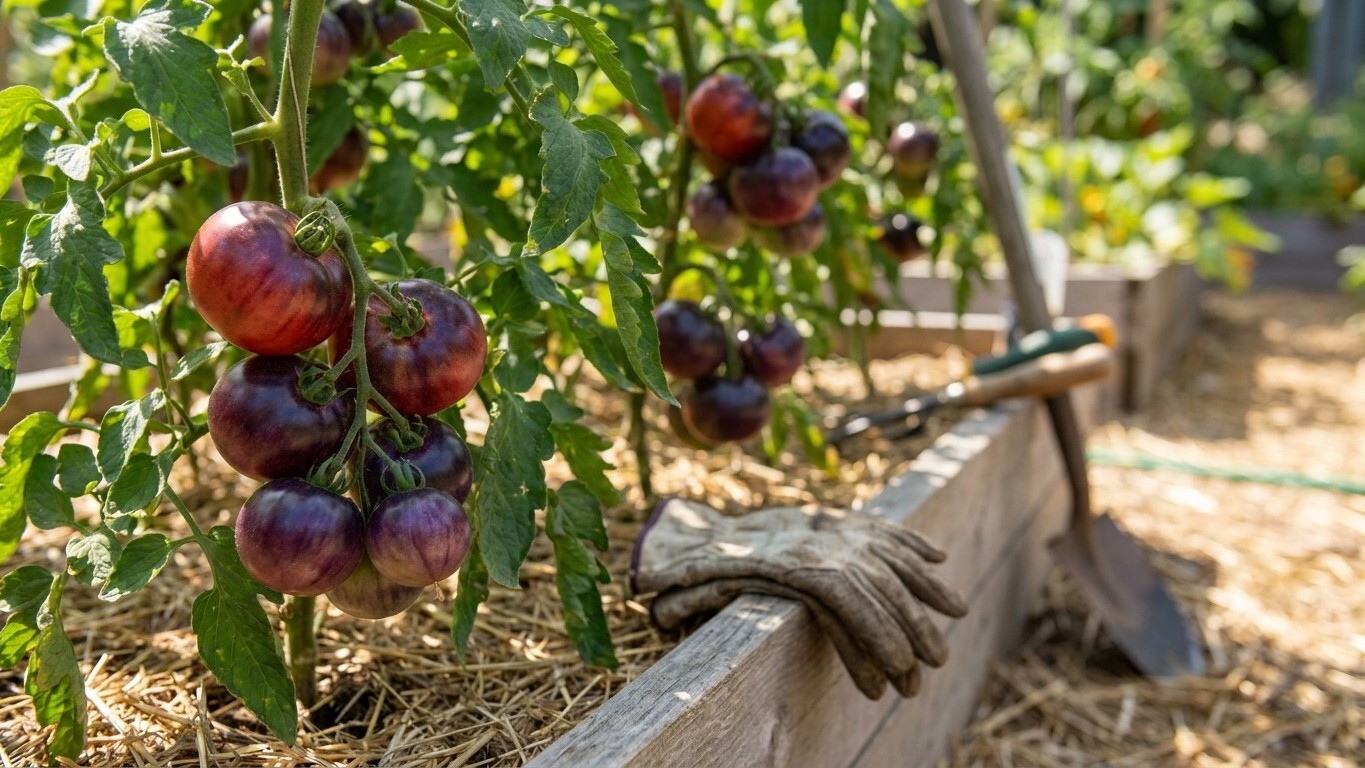

Blue Tonic is an indeterminate slicing tomato bred to keep setting fruit on a vine that never stops growing, and it needs roughly 72 days from transplant to first ripe tomato, per the Wild Boar Farms catalog that introduced the variety. That span is long enough that where you garden decides whether the plant finishes a real harvest or just a few fruit before frost. Check your area’s frost-free window against that 75 to 72 day count before you commit trellis space to it, and if the arithmetic comes up short, look at a faster-maturing slicer instead.
What Blue Tonic actually is

Blue Tonic is an indeterminate vine. It doesn’t stop at a set height or ripen in one flush the way a determinate bush tomato does. It keeps throwing new trusses along the main stem and side shoots until cold, disease, or the gardener’s pruning shears end the season, which is the trait the variety is named for and the reason it needs a tall stake or cage rather than a short cage meant for a compact plant.
The fruit is a medium to large round slicer. The shoulders carry a deep blue-purple pigment, an anthocyanin that intensifies with direct sun exposure, and the color fades down to red-orange at the blossom end. Inside, the flesh is standard tomato red. It’s a slicing tomato bred for the table, not a paste type, so plan for sandwiches and salads rather than sauce pots.
The catalog figure of 72 days is counted from the day you set a transplant in the ground, not from the day you sow seed indoors. Add another five to seven weeks on top of that if you’re starting from seed and counting backward from your own last frost date. Catalog days-to-maturity numbers also shift by a week or two either direction depending on how warm the season runs, so treat the figure as a planning range rather than a fixed date. If you haven’t settled on your season’s varieties yet, the broader rundown of tomato varieties is worth a look before you lock in bench space for one long-season slicer.
What Blue Tonic is good for
Blue Tonic is built for the cutting board, not the sauce pot. Slicing tomatoes carry more water in the flesh and a looser internal structure than paste types, so a knife goes through a round of it and produces a wide, juicy disc that holds its shape on bread or over lettuce. That same water content works against it on the stove: dropped into a pan, the high moisture means it takes far longer to reduce to anything resembling a sauce, and what you get after all that simmering is a thin, watery result rather than a thick one. If sauce is the goal, that cooking time is the tell that a different category of tomato is the better tool, not this one.
The round shape and size also point toward raw applications specifically. A medium to large slicer like this one gives you full-diameter rounds that cover a sandwich or fill a plate on their own, which is the whole reason slicing types are bred round and regular rather than oblong or knobby. Layer it with salt and olive oil, stack it on a burger, or use it as the base of a caprese-style plate, and the fruit is doing the job its category was built for.
Flavor is where this variety stays quiet. Nothing about sweetness, acidity, or richness has been published for Blue Tonic, and its striking anthocyanin coloring is a pigment trait, not a flavor indicator, so don’t read taste into the color. What can be said is only what the slicing category implies: flesh built for raw eating rather than cooked reduction. Anyone wanting a documented flavor profile will need to grow it and taste it directly, since no seed source or grower report attached to this variety makes a specific claim.
Because it’s indeterminate, expect fruit in a steady trickle rather than one glut, which suits a kitchen that wants a few slicing tomatoes at a time over many weeks rather than a bulk harvest for canning day.
Where it ripens in time, and where it is a gamble
The math here is simple once you lay it out. Take your area’s frost-free window (last spring frost to first fall frost, as reported by your regional weather service), subtract about two weeks for the soil to warm enough to safely transplant a tomato, then subtract Blue Tonic’s 75 to 72 day catalog span. What’s left over is your harvest margin, the number of days between your first ripe tomato and the frost that ends the season. Under 30 days of margin means a single flush of fruit, and a cool year takes even that.
Tight margins that call for a greenhouse
At Whitehorse, the reference station for Yukon, the numbers actually run negative. Even setting out in mid June, the earliest ripe fruit lands in late August, after the first frost by about five days on the calendar. Yukon’s annual accumulated warmth also falls near 600 degree-days, which is short of what a full-season tomato needs no matter how the frost dates fall, so a greenhouse or high tunnel isn’t a nice-to-have there, it’s the only route to a ripe Blue Tonic at all.
Rankin Inlet, the reference station for Nunavut, comes out at zero days of margin: one wave of fruit around mid September, with nothing in reserve if the season runs cool. Yellowknife (Northwest Territories) and Calgary (Alberta) both land around 30 to 32 days of margin on paper, but their annual degree-day totals, roughly 905 and 1,171, still fall short of what this variety needs to push fruit through a full 75 to 72 day cycle. All four verdicts land on the same answer: start under cover.
Winnipeg (Manitoba) and Saskatoon (Saskatchewan) do better, with margins in the mid 30s and degree-day totals in the range extension agronomists describe as just adequate. A black plastic mulch to warm the soil earlier, or trading Blue Tonic for an earlier-maturing type, is what moves those margins from marginal to reliable. For a garden that tight, a faster slicer such as Tidy Treats may simply fit the season better than a 75 to 72 day vine.
Comfortable margins
| Territory | Reference station | Set-out window | First ripe | Margin |
|---|---|---|---|---|
| Washington | Seattle | mid March to early April | mid June | 154 days |
| South Carolina | Charleston | mid to late March | mid June | 162 days |
| Texas | Houston | mid February to mid March | late May | 189 days |
| Nevada | Las Vegas | late January to mid February | late April | 224 days |
| Louisiana | New Orleans | early to late February | early May | 226 days |
These margins are wide enough that frost is not the limiting factor at all. The catch in these places isn’t the calendar, it’s the thermometer in July and August, which the next section covers.
The two ways a season goes wrong
A long frost-free window on paper doesn’t guarantee a finished tomato, and a short one doesn’t automatically kill the crop either. Two separate limits sit underneath the frost date, and a frost table alone shows neither.
In the far north, accumulated warmth can run short even across a technically long enough frost-free window. Tomatoes don’t just need to avoid frost, they need enough cumulative heat to move through flowering, fruit set, and ripening, and fruit set itself stalls once nights drop below 50°F even without any frost in sight. That’s the mechanism behind the greenhouse recommendation for Yukon, Nunavut, the Northwest Territories, and Alberta: the degree-day totals at those stations fall short of what a 75 to 72 day vine needs, independent of the frost calendar.
In the deep south, the opposite problem shows up. Once daytime temperatures push past roughly 86°F, tomato pollen goes sterile and flowers drop without setting fruit. Charleston, Jacksonville, Houston, Las Vegas, and New Orleans all carry a stretch of summer months where this happens, which is why growers in those areas run a spring crop and a separate autumn crop rather than one continuous season, even though their frost-free margin looks enormous on paper.
For Blue Tonic specifically, the northern limit is the one to plan around first. Its 75 to 72 day span is on the longer side for a slicer, which means it needs sustained warm days for most of the summer to finish at all, not just an absence of frost. Gardeners in the comfortable-margin states should set the spring transplant early enough to clear a full harvest before the mid-summer heat shuts pollination down, and treat any fruit that sets after that stretch as a bonus from the cooler autumn window rather than the main crop.
What it resists, and what it does not
Blue Tonic carries High resistance to Verticillium Wilt and to Fusarium Wilt races 1 and 2, per the catalog. High resistance means the plant can carry the soil-borne fungus that causes wilt without collapsing, which matters a lot for a garden bed that’s grown tomatoes in the same soil for several years, since both pathogens persist in soil for years and are the reason older beds slowly stop producing.
That’s the full resistance list. There’s no claim on the tag for early blight, late blight, Septoria leaf spot, tobacco mosaic virus, or root-knot nematodes, and a resistance code that isn’t printed shouldn’t be assumed. Because this variety stays in the ground for the entire season rather than finishing in one quick flush, it’s exposed to a full summer’s worth of foliar disease pressure, which is exactly where early blight and Septoria tend to build up on tomato leaves as the weeks go on.
Practically, that means the wilt resistance buys you soil-borne insurance but not foliar insurance. Growers in humid regions still need to prune for airflow, avoid overhead watering late in the day, and rotate a fungicide if leaf spot shows up, regardless of what the tag says about wilt.
Growing it without the usual mistakes
Support and spacing
Because Blue Tonic is indeterminate, it needs a stake, cage, or trellis tall enough to handle a vine that keeps climbing past the height a determinate cage is built for, and a spacing plan that gives each plant room to sprawl for the whole season rather than the tighter spacing a compact bush tomato tolerates. A flimsy tomato cage bought for a patio determinate will be outgrown by midsummer and the vine will collapse under its own fruit load.
Pruning and light
The blue-purple shoulder color is anthocyanin, and it deepens with direct sun exposure on the fruit. Pruning suckers for airflow is still worth doing, but stripping too much foliage below the fruiting trusses trades disease control for washed-out color, so aim for enough removed leaf to let air move without exposing every truss to bare sun all day.
Feeding and the late-season mistake
Heavy nitrogen late in the season pushes vine growth at the expense of fruit set, which is the most common mistake with a long-producing indeterminate like this one. Ease off nitrogen once the first trusses have set fruit and lean on potassium and phosphorus instead. Consistent moisture matters more here than with a quick determinate, since the extended season gives more opportunities for a dry spell followed by a heavy watering to crack the fruit right as it ripens. Mulch and a steady watering schedule do more for this variety than for a tomato that finishes in six weeks. If you want a paste tomato running on a similar until-frost timeline, San Marzano II follows the same indeterminate pattern with a different fruit shape.
Common questions
Is Blue Tonic determinate or indeterminate?
Indeterminate. The vine keeps growing and setting new fruit clusters until frost, disease, or pruning stops it, so it needs ongoing staking through the season rather than a one-time cage set up in spring.
Why aren’t my Blue Tonic tomatoes turning blue?
Usually not enough direct sun on the fruit itself. The anthocyanin pigment that makes the shoulders blue-purple develops with light exposure, so heavy foliage shading the trusses, or a cool, overcast stretch of weather, both tend to leave the color pale or greenish instead of deep purple.
Can I grow Blue Tonic in a container?
It’s possible but not the easiest choice. As an indeterminate vine it needs a large container, at least the size typically recommended for full-size indeterminate tomatoes, plus a tall stake or cage, so a small patio pot built for a compact variety won’t hold it through a full season.
How many tomatoes will one plant actually produce?
That depends heavily on how long your local season runs past the 75 to 72 day maturity mark, since more warm weeks after first ripe fruit means more trusses set before frost. There’s no single reliable count to quote across regions, so check with your local extension service for yield expectations tied to your area’s actual growing season length.