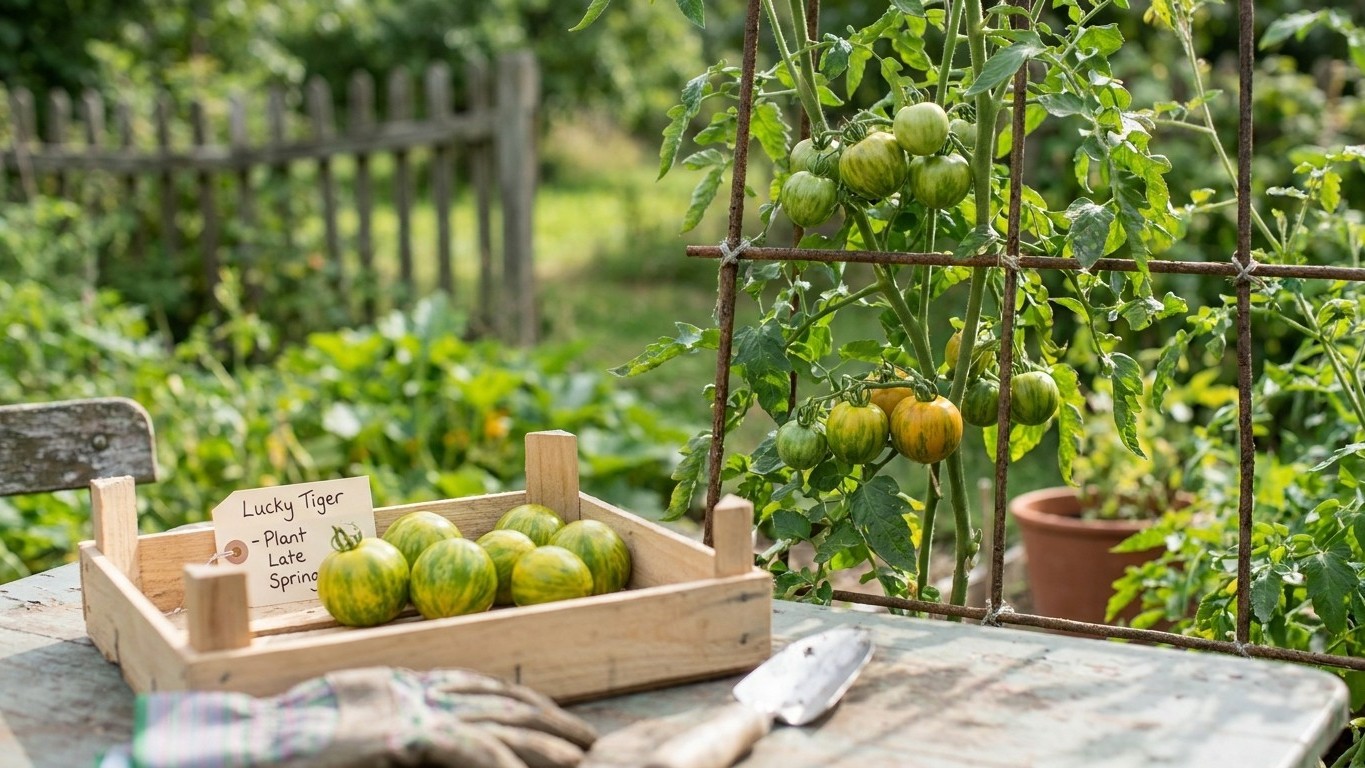

Count 65 to 70 days from the day you set transplants in the ground, not from when you sowed the seed — that’s the number that actually tells you when Lucky Tiger starts ripening. It’s an indeterminate vine, so it won’t ripen one batch and stop; it strings along clusters of striped, green-and-yellow cherry tomatoes all summer, and the ones still green when frost threatens aren’t a failure, they’re just fruit that arrived late to a plant that never really finishes.
What Lucky Tiger actually is

Lucky Tiger produces oval, roughly one-inch cherry tomatoes with a green-and-yellow background overlaid in dark green stripes that shift toward red-orange as the fruit ripens, though a faint green blush usually persists even at full ripeness. The plant is indeterminate, meaning it keeps growing and setting new flower clusters until frost or disease stops it, rather than ripening one flush and quitting. Most seed catalogues put Lucky Tiger at around 65 to 70 days from transplant, and that matters because a grower who counts from the sowing date instead will think the variety is two to three weeks faster than it actually is.
Because it is indeterminate, Lucky Tiger behaves more like a small grape tomato vine than a compact patio plant. It needs the same season-long support and feeding as a full-size indeterminate slicer, just for smaller fruit, and it keeps producing clusters of cherry tomatoes through summer and into fall wherever the season allows it. Among tomato varieties, that puts it in a different management category from a determinate type that sets its whole crop in one window and quits.
What Lucky Tiger is good for
Lucky Tiger is a small, oval cherry tomato, and that size is what determines how it gets used in the kitchen more than any other trait. A one-inch fruit has a high ratio of skin to flesh and holds relatively little water compared to its volume, so it never behaves like a paste tomato that cooks down into sauce, nor like a slicer that layers onto a sandwich. Cherry-format fruit like this is built for eating raw, whole, straight off the plant, and a large share of any harvest tends to disappear into hands and mouths in the garden before it ever reaches a cutting board.
In the kitchen, that same small size and intact skin make it well suited to salads, skewers, and quick roasting or blistering in a hot pan or oven, where the fruit is cooked just enough to soften and blister rather than broken down into a sauce base. Whole cherry tomatoes also hold their shape well in a saute or on a sheet pan, releasing some juice but not collapsing the way a big, wet-fleshed slicer would.
Its listing as a specialty variety points to another use: the green-and-yellow striping and the way it shifts toward red-orange as it ripens make it a fruit chosen partly for how it looks on a plate, in a salad mix, or at a market table, alongside more ordinary red cherry tomatoes.
Beyond that, there isn’t a published flavor profile to draw on. What’s documented for Lucky Tiger amounts to marketing language rather than tasting notes, so specifics like sweetness, acidity, or richness aren’t something that can be stated here. What can be said with confidence comes from the fruit’s category and size: this is a fresh-eating, visually distinctive cherry tomato, not a cooking or preserving variety.
Where it ripens in time, and where it is a gamble
The arithmetic behind this variety is simple once you lay it out. Take the length of your frost-free window, the stretch between the last spring freeze and the first fall freeze. Subtract the week or two most gardeners wait after that last freeze for the soil to warm before setting tomato transplants out. Subtract Lucky Tiger’s 65 to 70 days to maturity from transplant. What is left is the margin, the gap between the first ripe fruit and the first fall frost. Under thirty days of margin, expect one flush of fruit rather than a full season, and a cooler-than-average year can erase even that.
At one extreme, Whitehorse, the reference station for the Yukon, gives growers a set-out window in mid June and a first-ripe date in late August, which lands about three days after the average first frost, not before it. The region also accumulates only around 600 growing degree-days across the whole year, well short of what a tomato needs regardless of frost timing, so a greenhouse or high tunnel is not optional there. Rankin Inlet, standing for Nunavut, is only slightly better: a two-day margin and roughly 159 growing degree-days for the year, so even a plant that dodges frost never accumulates enough heat to ripen fruit in the open.
Moving south, the picture improves but not as fast as the frost-free window alone suggests. Yellowknife, for the Northwest Territories, and Calgary, for Alberta, both post margins in the low thirties, and Winnipeg and Saskatoon, standing for Manitoba and Saskatchewan, stretch that to the high thirties. All four are still graded as greenhouse territory, because the calendar window is long enough but the season’s accumulated warmth is not. Seattle, the reference for Washington, is where the arithmetic finally works outdoors unassisted: a set-out window in mid March to early April and a first-ripe date in early June leave roughly 156 days before the first fall frost, well over double what Lucky Tiger needs to finish.
| Territory | Reference station | Set out | First ripe | Margin (days) | Verdict |
|---|---|---|---|---|---|
| Yukon | Whitehorse | Mid June | Late August | -3 | Impossible outdoors |
| Manitoba | Winnipeg | Early June | Mid August | 38 | Greenhouse advised |
| Washington | Seattle | Mid March to early April | Early June | 156 | Comfortable |
| Texas | Houston | Mid February to mid March | Late May | 191 | Comfortable, split season |
| Louisiana | New Orleans | Early February to late February | Early May | 228 | Comfortable, split season |
Texas and Louisiana show the widest margins in this comparison, well over six months between first ripe fruit and first frost by the calculation above. A wide margin like that is not the same as an easy season, though, for reasons the next section covers.
The two ways a season goes wrong
A long frost-free window on paper does not guarantee a good crop, and Lucky Tiger can run into either failure mode described below, depending on where it grows.
Too cold to accumulate heat
In the northern territories above, the frost-free window can look adequate while the season still fails, because tomatoes need accumulated warmth, not just an absence of frost, to move from flower to ripe fruit. Nights below 50°F stall pollen germination and fruit set even when the days themselves feel warm and the calendar still shows weeks of margin left. That is why Yellowknife, Calgary, Winnipeg and Saskatoon are all graded as greenhouse territory above despite frost-free windows in the thirty-plus day range. A hoop house or wall of protection lets the grower add the heat the open air simply will not supply on its own.
Too hot to set fruit
In the south, the opposite limit applies. Once daytime temperatures climb past roughly 86°F, tomato pollen goes sterile and flowers drop without setting fruit, which is why Charleston, Jacksonville, Houston, Las Vegas and New Orleans all carry a note about losing the middle of summer. Growers in those regions plant in two windows, spring and fall, rather than expecting one continuous harvest, because the plant stops setting fruit through the hottest stretch and only resumes once temperatures ease.
For Lucky Tiger specifically, the heat limit matters more than the cold one. Its relatively short 65 to 70 day maturity already clears the frost-free window comfortably almost everywhere it survives the season at all. The real question in a hot climate is not whether the plant has time to finish, it is whether it keeps setting fruit through the hottest weeks or shuts down and waits for the fall window the way the crossings above describe.
What it resists, and what it does not
Lucky Tiger is an open-pollinated cross, not a hybrid bred for a disease-resistance package, and most catalogue listings for it carry no disease-resistance code at all. That is a real gap next to a hybrid like Mountain Magic, which is bred and coded for resistance to late blight, early blight and fusarium wilt. Growing Lucky Tiger means accepting that none of the common tomato diseases have been bred out of it, and treating prevention as the only defense rather than the plant’s own genetics.
The practical risks to watch for are the ordinary ones that hit any unprotected tomato: early blight and septoria leaf spot working up from the lower leaves in humid weather, and fruit cracking after a heavy rain follows a dry spell, since Lucky Tiger’s thin cherry-tomato skin splits more readily than a thick-walled slicer’s would. Consistent watering does more to prevent that cracking than any spray, because a crack forms when the fruit’s interior swells faster than the skin can stretch after a sudden soaking.
- Water on a steady schedule rather than letting the soil dry out between heavy waterings
- Mulch to even out soil moisture through hot, dry stretches
- Remove lower leaves that stay wet after morning dew as a blight precaution
- Pick nearly ripe fruit early if heavy rain is forecast for a cluster close to full color
Growing it without the usual mistakes
Because Lucky Tiger is indeterminate, it needs a support structure built for the whole season, not the light stake that suits a determinate variety. A sturdy cage or a stake driven deep enough to hold a plant that can top six feet by late summer is the right call from transplant day, not something to add once the vine outgrows a flimsy one. Trying to retrofit support onto a sprawling, fruit-loaded vine is the single most common mistake with this variety, and it usually ends with broken branches and fruit rotting where it touches the soil.
Space plants with room for that mature size and for airflow between vines, since crowding raises humidity around the lower leaves and speeds up the blight risk covered above. Prune the lowest suckers to keep the first foot of stem open and easy to mulch, but do not over-prune an indeterminate cherry tomato the way you might a determinate paste type like Amish Paste. Lucky Tiger’s yield comes from the steady accumulation of many small trusses, and stripping too much foliage cuts into that supply rather than improving it.
Feed at transplant and again once the first fruit sets, then taper nitrogen back for the rest of the season. A plant pushed hard on nitrogen late in summer puts out leafy growth instead of new flower trusses, which costs fruit right when the plant should be at its most productive. The timing mistake specific to this variety’s look is picking too early: because the fruit holds a green stripe even at full ripeness, growers used to solid-red cherry tomatoes often pull it a few days before it has developed full sweetness. Wait until the stripe shifts fully toward red-orange and the fruit gives slightly to a gentle squeeze, not until the green disappears entirely, because it may never fully disappear.
Common questions
What do I Do With the Green tomatoes still on the vine when frost is coming?
Pick any full-size fruit before the first frost hits and bring it inside, since a hard freeze ruins the flesh even on tomatoes that were about to ripen. Set them in a single layer away from direct sun, or in a paper bag with a banana, and check every couple of days for color change. Small ones that never sized up are better used green: fried, pickled whole, or chopped into a green tomato relish, and Lucky Tiger’s small size makes them convenient for pickling without cutting.
Can I grow Lucky Tiger in a container?
Yes, but size the pot to the plant’s habit rather than to the fruit size. Because it is indeterminate and can top six feet, it needs a container in the fifteen to twenty gallon range and a cage or stake as tall as you would use for a full-size slicer, not the small pot that works for a determinate patio tomato.
Why does my Lucky Tiger tomato still look striped and green even when it’s ripe?
That is normal for this variety. The background color shifts from green-yellow toward orange-red as it ripens, but the darker stripe pattern rarely disappears completely. Judge ripeness by the overall color shift and a slight give when you squeeze the fruit, not by waiting for every trace of green to vanish.
Is Lucky Tiger the same tomato as Tigerella?
No. Tigerella is an older, separately named striped cherry-salad tomato, and Lucky Tiger is a newer cross bred to update that striped look with different flavor and vigor. They share a similar striped appearance on the vine but are distinct named cultivars, so seed or seedlings sold under either name will not grow identically.