
Jasper is an indeterminate red cherry tomato bred for disease resistance and steady production, reaching its first ripe fruit in about 60 days from transplant. That count starts the day a rooted plant goes into the garden, not the day you sow seed indoors. The one thing to check before you order the packet is whether your area’s frost-free window, as reported by NOAA for the weather station nearest you, covers that 60-day span plus the two or three weeks the soil needs to warm before you can safely transplant.
What Jasper actually is

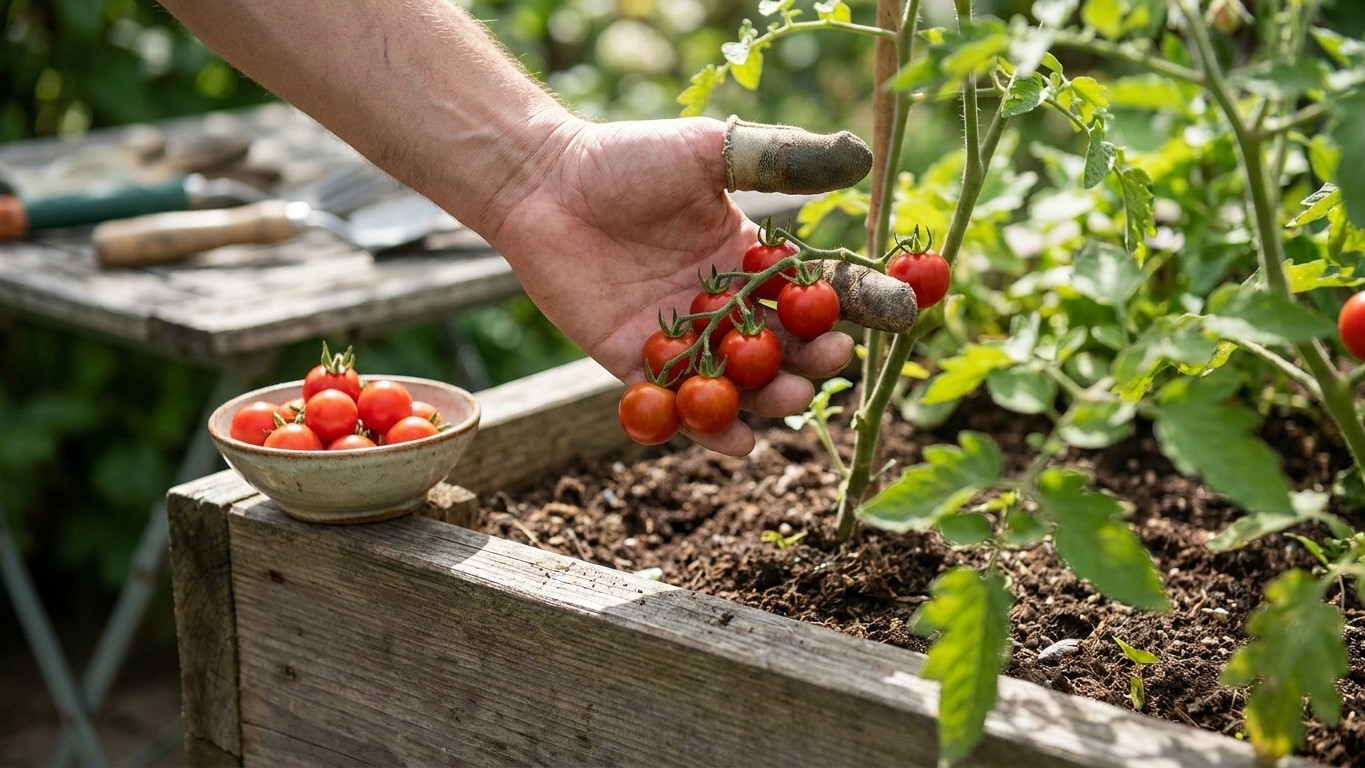
Jasper produces small, round, deep red fruit, each about an inch across, borne in long clusters that can carry a dozen or more tomatoes at once. The skin resists cracking better than most cherry types, which matters because clustered fruit sits exposed to rain and dew longer than a single large tomato would. It is bred to be sweet enough for snacking straight off the vine and firm enough to hold up in salads without collapsing.
The plant itself is indeterminate, meaning it keeps growing, flowering and setting fruit continuously until frost or disease stops it, rather than ripening one flush and quitting. That habit has direct consequences: it needs a permanent stake, cage or trellis strong enough to carry a vine several feet tall, and it needs the space to sprawl if you skip support. The 60-day figure tells you when the first fruit colors up, not when the harvest ends. A healthy Jasper plant will keep producing for months past that first picking, provided the season stays warm enough and disease pressure stays manageable. Anyone comparing it against other entries in the wider field of tomato varieties should note that a 60-day cherry and a 75-day beefsteak are simply different tools for different-length seasons.
What Jasper is good for
Jasper’s category tells you more about its kitchen role than any flavor description could. Cherry tomatoes carry a high ratio of skin to interior flesh, and that flesh is mostly water suspended in a small cavity rather than the dense, low-moisture pulp packed into a paste tomato. Cook a cherry tomato down and you get a thin, seedy liquid that never thickens the way a San Marzano or Roma will, because there simply isn’t enough solid mass per fruit to reduce into body. That is why cherry types are not the tomato you reach for when a recipe calls for hours at a simmer.
What that same low-mass, high-skin structure gives you instead is a fruit built for eating raw. Each tomato holds its shape and a burst of juice inside a skin sturdy enough to survive being picked, tossed in a bowl, and forked without collapsing into mush the way a beefsteak slice would if you tried to dice it small. That structural fact is what puts Jasper squarely in salads and snacking rather than sauce pots or canning jars: the fruit is sized and built to go straight from vine to mouth or straight from vine to a mixed green salad, not to a saucepan.
Indeterminate cherry varieties also tend to produce in a way that reinforces this use. Because the plant sets fruit continuously in clusters rather than delivering one large simultaneous harvest, you get a steady trickle of a dozen or more small tomatoes at a time rather than a crate-sized glut demanding immediate processing. That rhythm matches snacking and salad use far better than the bulk harvest a canning-focused grower would want.
Beyond what the category implies, no specific flavor notes for Jasper are published, so anything more precise than “sweet, snackable cherry tomato” would be a guess rather than a documented fact.
Where it ripens in time, and where it is a gamble
How to run the math for your own garden
The calculation is the same everywhere, only the numbers change. Take the frost-free window NOAA reports for your nearest weather station, subtract the two to three weeks the soil needs to warm before you set out a transplant, then subtract Jasper’s 60-day catalogue maturity. What’s left is your margin, the number of days between first ripe fruit and the average first fall frost. Anything under thirty days means you get one real flush of tomatoes, and a cooler-than-average year can take even that.
From risky to comfortable
At the tight end, Yukon, measured from the Whitehorse station, gives Jasper only about 7 days of margin: gardeners there set out in mid June and see first ripe fruit by mid August, right up against the frost line. Nunavut, based on Rankin Inlet, is only slightly better at 12 days, with transplant in early July and first ripe fruit in early September. Both are graded risky for exactly the reason above: a single cool stretch erases the harvest.
The middle ground belongs to the Prairies. Manitoba, from the Winnipeg station, and Saskatchewan, from Saskatoon, both post margins in the high forties, with transplant in early June and fruit by late July or early August. That sounds workable on paper, but both are still graded for greenhouse or tunnel growing, for reasons the next section explains. Alberta, from Calgary, and the Northwest Territories, from Yellowknife, sit close behind at 44 and 42 days respectively.
At the wide end of the country, margin stops being the limiting factor at all. Nevada, from Las Vegas, gives Jasper 236 days of margin, with transplant possible as early as late January. Louisiana, from New Orleans, and Texas, from Houston, both clear 200 days, with fruit ripening as early as mid to late April. In these places the frost calendar hands Jasper a comfortable season, and the constraint that matters shifts entirely to heat, which the next section covers.
The two ways a season goes wrong
Cold that a frost date does not show
A long frost-free window does not guarantee enough warmth to grow a tomato well. Plants also need a season’s worth of accumulated heat, commonly tracked as growing degree-days, and a place can have plenty of frost-free days while still falling short on that total. Saskatoon’s 1,549 degree-days and Manitoba’s 1,832, both graded as marginal, sit right at that edge: an early, short-season variety like Jasper and a plastic mulch to hold soil warmth can tip a borderline year into a workable one. Below roughly that range, in Northwest Territories and Alberta, the shortfall is severe enough that a greenhouse or tunnel is the only reliable option regardless of how many frost-free days the calendar offers. On top of the heat total, tomato flowers simply fail to set fruit when nighttime temperatures drop below roughly 50°F, which is the practical reason cold-climate growers count on covered growing rather than open ground.
Heat that shuts pollen down
The opposite failure shows up in the warmest states. Tomato pollen becomes sterile above roughly 86°F, and in South Carolina, Florida, Texas, Nevada and Louisiana, that threshold gets crossed for most of the summer. Flowers keep opening but nothing sets, so growers in those states plant a spring crop timed to finish before the heat locks in, then a second autumn crop once temperatures drop back down. For Jasper specifically, its short 60-day maturity is an advantage here: a spring transplant has time to produce a full flush of fruit before the sterile stretch begins, which a longer-season variety often does not manage.
What it resists, and what it does not
Late Blight
Jasper carries high resistance to late blight, the disease responsible for entire plantings collapsing within days in wet, cool weather. High resistance means the plant can be exposed to the pathogen and largely shrug it off, which is a meaningful advantage in humid regions or wet seasons where late blight regularly wipes out unprotected tomatoes.
Early Blight
Its resistance to early blight is graded intermediate, and that distinction matters. Intermediate resistance slows the disease and reduces its severity, it does not stop it outright. A Jasper plant can still develop the lower-leaf spotting typical of early blight, especially late in a long, humid season, and treating the intermediate rating as full immunity is the mistake that costs growers a crop they thought was protected.
The catalogue lists nothing beyond those two diseases, which means Jasper carries no documented resistance to common problems like Septoria leaf spot, fusarium wilt or verticillium wilt. Treat it as susceptible to all three: rotate tomatoes out of the same bed for a few years, space plants for airflow, and watch for the same warning signs you’d watch for on any unprotected variety. Growers who want a similarly disease-resistant cherry-type tomato with a slightly larger, cocktail-sized fruit often compare Jasper against the Mountain Magic tomato, which carries a comparable resistance profile in a different fruit size.
Growing it without the usual mistakes
Staking and spacing
Because Jasper is indeterminate, it needs a support system built for the whole season, not a small tomato cage meant for a determinate plant. A sturdy stake driven deep at planting time, a florida-weave trellis, or a heavy-duty cage all work, but whatever you choose has to carry a vine that keeps climbing and fruiting for months. Give plants enough spacing for air to move between them, since the same clustered fruit habit that resists cracking also holds humidity close to the foliage, and that humidity is exactly what early blight needs to spread.
Feeding and harvest timing
Ease off heavy nitrogen feeding once the first clusters set. Jasper’s vigorous, continuously growing habit means excess nitrogen pushes leafy growth at the expense of fruit, a mistake more common with indeterminate varieties than with a determinate plant that ripens in one flush and stops. Because it never stops producing, the real risk with Jasper is falling behind on harvest. Pick clusters as they color rather than waiting for the whole truss to finish, and expect to be out at the plants every couple of days once the season is running. Growers who’d rather manage a single large fruit on a plant with a completely different staking and pruning rhythm might compare Jasper against the Firebird tomato, a beefsteak that follows its own timeline and its own support needs.
- Support: permanent stake, cage or trellis rated for a full-season indeterminate vine
- Spacing: wide enough for airflow, given the resistance gap on early blight
- Feeding: reduce nitrogen once fruit sets to avoid excess vine growth
- Harvest: pick by the cluster every few days rather than waiting for full ripeness on every fruit
Common questions
Can I grow Jasper tomatoes in a container?
Yes, but it still needs a large container, the same size you’d use for any full-size indeterminate tomato, plus a stake or cage tall enough to support months of vine growth. A pot sized for a compact determinate plant will not hold Jasper’s root system or its support structure through a full season.
How many tomatoes will one Jasper plant produce?
It is described as a heavy producer, but no catalogue gives a reliable fruit count because it depends entirely on how long your season runs past the first 60-day maturity mark. A plant growing in a 200-day margin location will simply keep bearing far longer than one in a 40-day margin location, regardless of the variety’s genetics.
Is Jasper the same as Sakura or Sun Gold?
No. All three are popular red or orange cherry tomatoes, but they’re separate cultivars with different breeders, different disease resistance packages and different days to maturity. Check the seed packet for each one rather than assuming shared traits.
Why do my Jasper tomatoes keep splitting?
Splitting on cherry tomatoes almost always comes down to uneven watering, particularly a dry stretch followed by heavy rain or a deep soak. Keeping soil moisture consistent, and picking clusters as soon as the fruit colors rather than leaving them to over-ripen on the vine, reduces the problem more than any variety trait does.