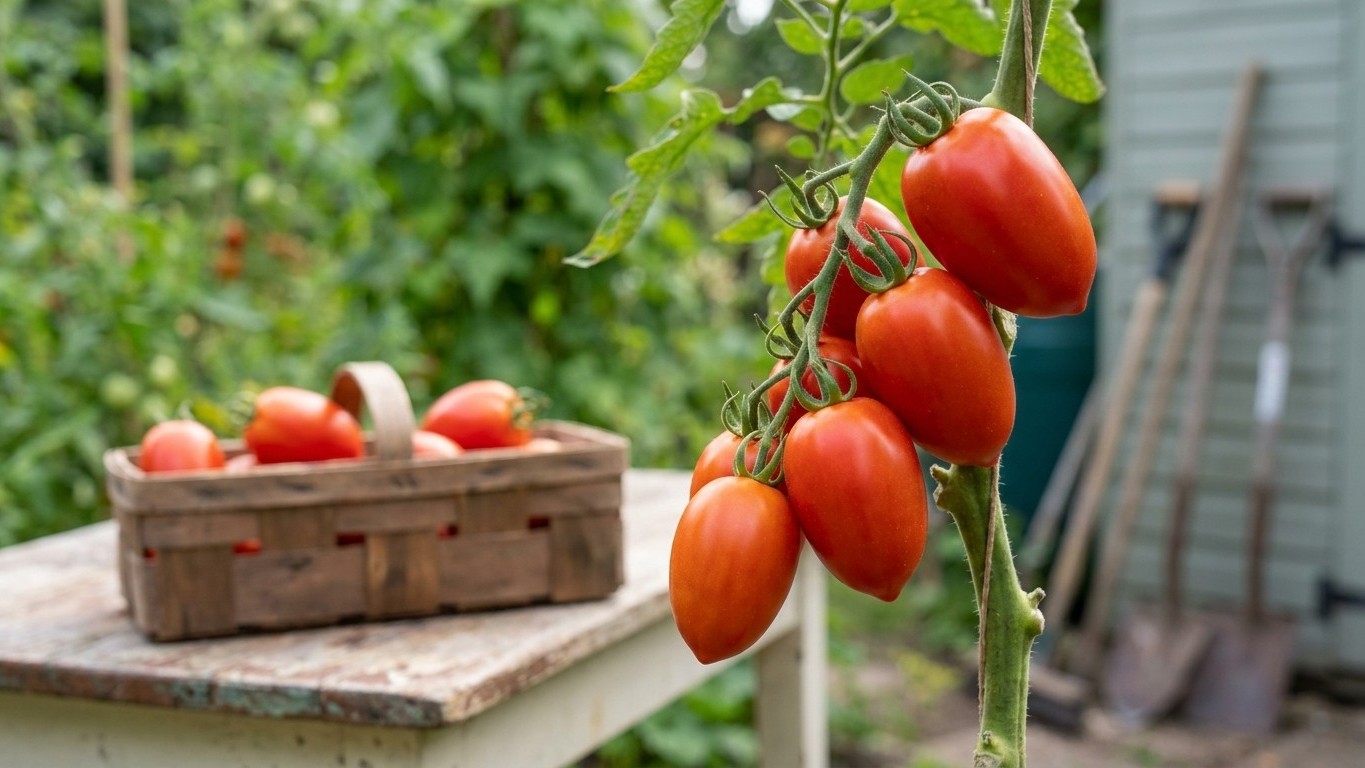

Granadero is a determinate paste tomato bred for sauce and canning, and it ripens in about 75 days from transplant according to seed catalogue listings for the variety. That figure decides more than a harvest date. It sets whether a given region’s frost-free season, and the heat that fills it, can actually carry the plant from a June transplant to a full flush of ripe fruit before cold or heat shuts the crop down. Check your area’s frost-free window against that 75-day mark before deciding how many plants to set out.
What Granadero actually is

Granadero is a hybrid roma-type tomato, meaning the fruit is oval and blocky rather than round, with thick meaty walls and few seeds, the shape processors and home canners want for sauce and paste. Seed catalogues list it at about 75 days from transplant, not from the day you sowed seed indoors, and that gap matters: a packet’s “days to maturity” always assumes a transplant already several weeks old, and the figure shifts by a week or so depending on how warm the season runs. As with other tomato varieties, the number on the packet is a starting point for your own arithmetic, not a promise.
Granadero’s habit is determinate. The plant grows to a set height, sets a fixed number of flower trusses, and then stops extending. That means a standard cage or a single stake is usually enough support, spacing can run tighter than an indeterminate variety needs, and the crop tends to arrive in one concentrated flush rather than trickling in over months. Growers who want a similar paste tomato with a longer, steadier season sometimes compare it against Amish Paste, an indeterminate heirloom that keeps producing until frost but needs taller support and a longer window to finish.
What Granadero is good for
Granadero is a paste tomato, and that classification tells you almost everything about what to do with it in the kitchen. Paste tomatoes carry thick walls of dense flesh, a small seed cavity, and comparatively little water locked inside the fruit. When you cut one open, there’s less gel and juice separating the flesh, which means less liquid to boil off before a sauce thickens. Drop a pot of Granadero on the stove and it collapses into body rather than broth, reducing to a good sauce or canning base in less time and with less standing over the pan reducing liquid.
That same low-water, high-flesh structure is a liability in the uses paste tomatoes are traditionally worst at. Sliced raw for a sandwich or a salad, a tomato like this reads as drier and denser rather than juicy, and it lacks the wall-thin, gel-filled bite that makes a slicing tomato pleasant to eat uncooked. Granadero isn’t bred for that job, and nothing about it suggests it would compete there.
The documented flavor is described only as very good, without further detail on whether that leans sweet, acidic, or balanced between the two. That’s a genuine strength for its intended use: sauce and canning don’t need a tomato that’s exciting on its own, they need one that concentrates cleanly and holds real tomato flavor through hours of simmering or through the processing involved in canning. Whatever balance of sugar and acid Granadero has, it’s flavor built to survive cooking and storage rather than flavor built to be tasted fresh off the vine.
Red color rounds out the profile without changing the calculation. If your kitchen goal is jars of sauce, passata, or canned tomatoes for winter, Granadero’s flesh-to-water ratio does the work for you. If you want something to eat out of hand, look elsewhere.
Where it ripens in time, and where it is a gamble
The arithmetic is the same everywhere. Take the frost-free window between the last spring freeze and the first fall freeze, subtract roughly the two weeks the soil needs to warm before transplants can go in without stalling, then subtract the 75 days to first ripe fruit. What’s left is the margin, the number of days you actually get to pick before the plant runs into frost. Under thirty days of margin, the plant gives you one flush and a cool year takes it before you get that.
At the tight end, the reference station at Whitehorse puts transplants out in mid June for a first ripe fruit near early September, which lands 8 days after the average first frost. That’s a negative margin, and outdoors it doesn’t work at all: Yukon needs a greenhouse or tunnel regardless of variety. Rankin Inlet, the reference station for Nunavut, is worse still, with first ripe fruit arriving 3 days after frost on average. Yellowknife, standing in for the Northwest Territories, and Calgary, standing in for Alberta, both clear frost with 27 and 29 days respectively, but that’s one flush and a single cool August erases it.
Winnipeg and Saskatoon, the reference stations for Manitoba and Saskatchewan, post wider margins of 33 and 34 days, enough that both are graded for greenhouse or tunnel production rather than open ground, with an early variety and plastic mulch improving the odds further.
At the wide end, Houston (standing in for Texas), New Orleans (Louisiana), and Las Vegas (Nevada) post margins from 186 to 223 days, and Charleston (South Carolina), Jacksonville (Florida), and Seattle (Washington) sit between 151 and 175. On paper these are comfortable. In practice, comfort doesn’t mean uneventful, which is the subject of the next section.
| Territory | Reference station | Set out | First ripe | Margin | Verdict |
|---|---|---|---|---|---|
| Yukon | Whitehorse | mid June | early September | -8 days | impossible outdoors |
| Nunavut | Rankin Inlet | early July | mid September | -3 days | impossible outdoors |
| Alberta | Calgary | early June | mid August | 29 days | risky, one flush |
| Manitoba | Winnipeg | early June | mid August | 33 days | greenhouse recommended |
| Washington | Seattle | mid March to early April | mid June | 151 days | comfortable |
| Texas | Houston | mid February to mid March | late May | 186 days | comfortable |
| Louisiana | New Orleans | early to late February | early May | 223 days | comfortable |
The two ways a season goes wrong
A long frost-free window is not the same thing as enough warmth. In the north, cumulative heat, measured in growing degree-days, can fall short even where the calendar gives the plant plenty of frost-free time. Calgary’s 1171 degree-days and Yellowknife’s 905 are simply too low for reliable ripening regardless of the frost dates, and even Seattle, with a comfortable 151-day margin, sits at a marginal 2353 degree-days because coastal summers stay cool. Fruit set has its own floor too: nights below roughly 50°F stop pollen from setting fruit, which is why a long but cool season can produce plenty of vine and very little ripe fruit.
The southern failure runs the opposite direction. Above roughly 86°F, tomato pollen goes sterile and blossoms drop without setting fruit, which is why growers from Charleston to Houston to New Orleans plant a spring crop and a separate autumn crop rather than one continuous season. The exact months this affects vary by state, but the mechanism doesn’t: heat, not frost, ends the middle of summer for tomatoes there.
For a 75-day variety like Granadero, the heat-sterility limit matters more, because it isn’t something a faster variety can outrun. A quick maturity date helps against a short cold season, since Granadero can fit inside a marginal window that would strand a 90-day heirloom, and that’s exactly why it’s a candidate for tunnel production in places like Manitoba and Saskatchewan. But the summer pollen shutdown in the deep south hits any variety at the same temperature, regardless of how fast it matures, so growers there need to time the transplant so the first flush lands before the heat sets in rather than counting on the maturity date alone to save them.
What it resists, and what it does not
Resistance as graded
Granadero carries High resistance to Verticillium Wilt and High resistance to Fusarium Wilt races 1 and 2, as graded by the seed catalogue. High resistance means the plant can be grown in soil carrying these pathogens with a good expectation of a normal crop. That’s a different promise than intermediate resistance, which only slows a disease down rather than stopping it, and a grower who treats intermediate resistance as immunity usually finds that out the hard way, mid-season, when the plant wilts anyway.
What it does not resist
The catalogue lists no resistance to early blight (Alternaria solani), late blight (Phytophthora infestans), or root-knot nematodes, which are among the most common problems on paste tomatoes generally. Treat those as full risk. Rotate tomatoes out of the same bed for a few years where blight has shown up before, scout the lower leaves regularly for the dark concentric spots of early blight, and keep a fungicide labeled for tomatoes on hand if late blight is a known problem in your area. Blossom end rot is also common on paste types, not because of any disease susceptibility but because their concentrated fruit set demands steady calcium uptake, which uneven watering interrupts.
Growing it without the usual mistakes
Support and spacing
Because Granadero is determinate, it does not need the tall trellis an indeterminate heirloom like Black Krim requires. A standard cage or a single sturdy stake holds the plant, which typically stays compact for the whole season. Space plants a little closer than you would an indeterminate variety, since the plant isn’t going to keep climbing and shading its neighbors all summer.
Feeding and pruning
Stop pushing nitrogen once fruit set begins. Determinate paste tomatoes have already fixed their truss count by the time the first flowers open, so extra nitrogen after that just grows leaves at the expense of fruit fill and delays the very ripening window that makes the variety worth growing for canning. Skip the heavy sucker-pruning routine too. On an indeterminate slicer, pruning redirects energy toward fewer, bigger fruit. On a determinate plant, it just removes trusses the plant had already committed to filling.
Timing the harvest
Because the whole crop tends to ripen inside a short window, plan the canning day around the peak rather than picking a handful at a time. A few practical checks:
- Water on a steady schedule through fruit fill to avoid blossom end rot.
- Stagger two or three plantings a couple of weeks apart if you want a trickle of fruit instead of one large batch.
- Pick as fruit colors fully, since paste tomatoes left on the vine past ripe soften fast and split.
- Clear spent plants once the flush is picked. There’s no second wave coming from a determinate variety the way there is with an indeterminate one.
Common questions
Can I grow Granadero in a pot?
Yes, its compact determinate habit suits a large container better than most indeterminate varieties would. Use the biggest pot you have room for and keep watering consistent, since containers dry out faster than garden soil and paste tomatoes are prone to blossom end rot when moisture swings.
Is Granadero the same thing as a Roma tomato?
No. Roma is its own open-pollinated variety, and Granadero is a separate hybrid bred for a similar plum shape and paste use. They’re interchangeable in the kitchen but they’re not the same plant, and Granadero’s disease resistance package is not something the original Roma carries.
Why did my Granadero plants stop setting fruit in midsummer?
In hot regions this is almost always heat, not a disease or a watering problem. Above roughly 86°F tomato pollen goes sterile and blossoms drop without setting, which is why gardeners in the hottest parts of the country run a spring crop and a fall crop instead of expecting one continuous harvest.
Can I save seed from Granadero for next year?
No, not true to type. Granadero is an F1 hybrid, so seed saved from its fruit will grow into a mixed, unpredictable plant rather than another Granadero. Buy new seed each season, or grow an open-pollinated paste tomato if seed saving matters to you.